Quick Summary
A good room thermostat order starts with the application, wiring logic, voltage, outputs, and communication requirements. Buyers who confirm these points early are far less likely to face site problems later. The safest supplier is usually not the cheapest one, but the one that can explain control logic clearly and match the room thermostat to the actual system.
This guide helps buyers check the points that matter before placing an order. It covers HVAC application, output type, protocol choice, sensor needs, installation details, compliance thinking, supplier evaluation, and common buying mistakes. The goal is simple: reduce mismatch risk before the room thermostat reaches the project.
“Yes, we can. But what system is it for?”That simple exchange explains why many room thermostat enquiries go wrong. Buyers are often ready to discuss price, lead time, or private labelling, but the supplier may still not know whether the thermostat is for a fan coil unit, underfloor heating, a boiler, a heat pump, or another HVAC system.
Even the term “smart room thermostat” can mean different things. It might refer to app control or simply a more modern display. On paper, they are all thermostats. In practice, they are very different products.
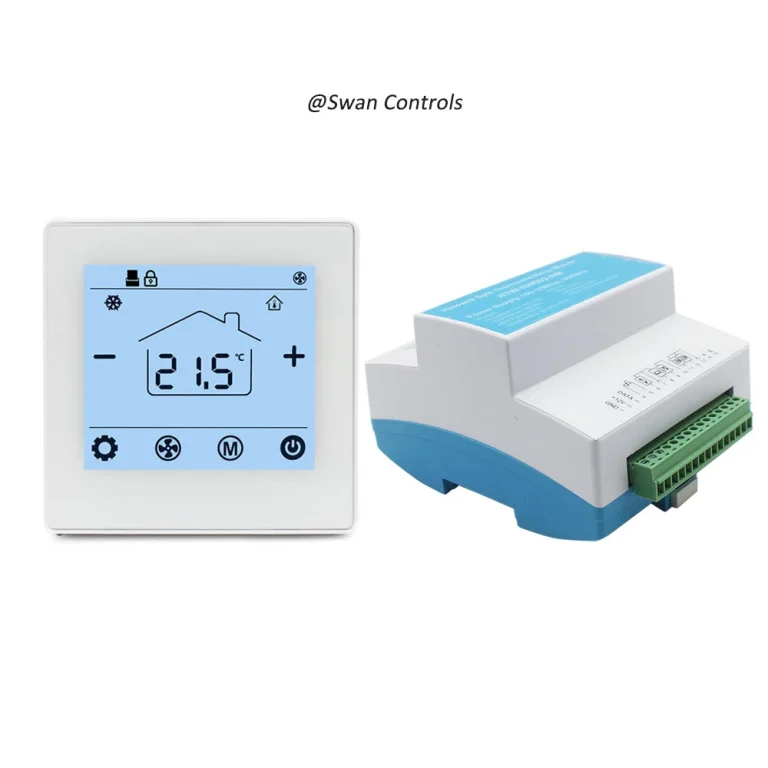
This is why product selection should always begin with system compatibility, not appearance or the lowest quotation. Although compact, this device serves as the control point between the room, the occupant, and the HVAC equipment.
If the wrong model is chosen, the issues are rarely obvious at first. Instead, projects often face slow commissioning, unstable temperatures, incorrect fan or valve operation, installer frustration, and end-user complaints. What seemed like a simple purchase can quickly become an expensive mistake.
The choice also affects comfort and energy efficiency. Organizations such as the World Health Organization, ASHRAE, the International Energy Agency, and ENERGY STAR all recognise that control strategy plays an important role in indoor comfort, health, and building operating costs.
Why room thermostat selection deserves more attention
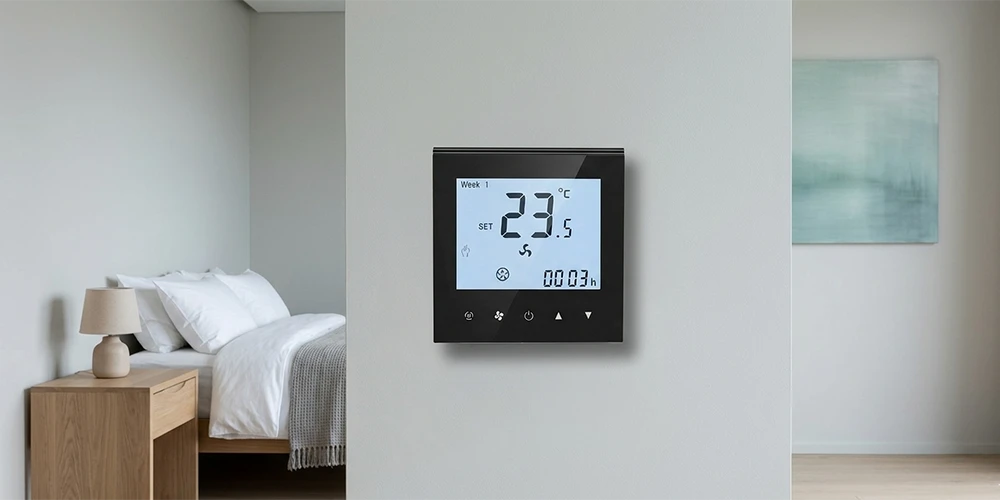
Many buyers still treat a room thermostat like a decorative wall device with a relay inside. That is too narrow. In a real project, it often decides when heating or cooling starts, how a valve reacts, whether a fan changes speed, whether the room is measured correctly, and whether the system can be monitored centrally.
That is why two similar-looking models can perform very differently. One may offer simple on/off control, while another supports 0-10V output or BMS integration. Some use a built-in sensor, while others require an external one for accurate control.
If these differences are overlooked, the project may end up with the right appearance but the wrong functionality.
The business impact is larger than many teams expect. The room thermostat itself is rarely the biggest cost item in the HVAC package. The expensive part is the correction cycle after a mismatch: new drawings, installer support, delayed site testing, replacement stock, freight, and damaged confidence. In B2B buying, a room thermostat should therefore be evaluated as a control component, not just a catalog item.
The 10 checks buyers should make before ordering
| No. | Check Point | What Buyers Should Confirm | Why It Matters |
|---|---|---|---|
| 01 | HVAC application | FCU, boiler, water heating, floor heating, heat pump, or other system type | This decides the whole selection direction. |
| 02 | Power supply | 24VAC, 230VAC, or other required input | Wrong voltage can cause installation failure or mismatch. |
| 03 | Output type | Dry contact, live output, on/off valve, 0–10V, fan speed output | The thermostat must match the real control logic. |
| 04 | System structure | 2-pipe, 4-pipe, single-stage, multi-stage, or heating-only logic | Different structures need different control behaviour. |
| 05 | Communication | Standalone, Wi-Fi, Modbus, BACnet, or Zigbee | This affects app use, BMS integration, and project fit. |
| 06 | Sensor setup | Built-in sensor only or external sensor required | Wrong sensing position can reduce control accuracy. |
| 07 | Installation details | Wall box, mounting size, terminal layout, front size | A correct function still fails if installation does not fit. |
| 08 | Documents | Datasheet, wiring diagram, manual, protocol details | Clear documents reduce project and after-sales risk. |
| 09 | Compliance | Available declarations, test reports, and market-related documents | Buyers should know what the supplier can really provide. |
| 10 | Commercial risk | Compare total project risk, not only unit price | The cheapest option may create the highest real cost. |
1) Confirm the HVAC application clearly
This is the first and most important check. It should also carry more weight than it usually gets in early sourcing conversations.
Do not start with “I need a room thermostat”. Start with “I need a room thermostat for this exact type of system”.
- fan coil units
- 2-pipe FCU systems
- 4-pipe FCU systems
- water heating
- boiler heating
- electric underfloor heating
- heat pump systems
- DX equipment
- ventilation or fresh air control
This first step is where many buying mistakes begin. A buyer may ask for a room thermostat, but that still leaves several critical questions open. Is it controlling a 3-speed fan and an on/off valve? Is it for a boiler with dry contact? Is it for electric floor heating with direct load switching? Is it for a project that needs Modbus registers or BACnet objects? Is it controlling one circuit or acting as part of a larger building system?
The reason this point deserves expansion is simple: later checks such as voltage, output, pipe type, protocol, and sensor strategy all depend on the application. That is why it should not be handled as a short category label. It should be treated as the technical starting point of the entire buying decision.
A useful buyer habit is to send one of the following with the enquiry:
- a wiring diagram
- an old controller photo and terminal map
- a short description of the HVAC system
- the project specification sheet
- a list of required functions
That single step often saves more time than several rounds of back-and-forth emails.
2) Confirm voltage and power supply before discussing functions
This sounds basic, but it is still one of the most common sources of mismatch.
Buyers should confirm:
- input power supply
- whether the project uses 24VAC, 220V/230VAC, or a wider voltage range
- whether outputs are dry contact, live voltage outputs, or signal outputs
- whether any external controller provides power or logic
A room thermostat can power on and still be wrong for the application. For example, a unit may have the correct display and interface but still offer the wrong output form for the connected equipment. In practice, buyers should check both supply and control architecture, not only the nominal voltage printed on the sheet.
A serious room thermostat manufacturer should present this clearly in the datasheet and wiring diagram, not only in sales language.
3) Check whether the project is 2-pipe, 4-pipe, boiler, or another control logic
For FCU projects, this matters immediately. A 2-pipe room thermostat is not just a simplified 4-pipe version. It assumes a different control structure. In many projects, the difference determines how heating and cooling are selected, how valves are driven, and whether seasonal changeover is handled correctly.
For heating applications, a similar logic applies. Water heating and boiler heating are often discussed casually as if they were the same. They are not always the same from a room thermostat-output perspective. Buyers should confirm what the equipment expects and how the room thermostat is supposed to control it.
This point often looks small in procurement meetings because the room thermostat is only one line in the BOM. In the field, it is not small. Wrong system logic usually creates the kind of issues that are hard to explain to end users and tedious to solve on site.
4) Confirm output type, not just “supports heating and cooling”
Many product discussions stay too general here. A sentence like “supports cooling and heating” does not tell the buyer enough.
A better approach is to confirm the actual control outputs:
- 3-speed fan outputs or not
- on/off valve output or 0–10V valve output
- dry contact for boiler or pump
- direct load switching for electric heating
- separate outputs for heating and cooling
- manual or automatic changeover
- auxiliary contact or occupancy / keycard input if needed
This is one of the most important decision points because the output logic determines whether the room thermostat can truly control the system, not just display temperature. In many complaint cases, the room thermostat was not “bad”. It was simply selected with incomplete output matching.
5) Decide whether the project needs standalone control, app control, or BMS integration
This is where buyers often misuse the term “smart room thermostat”.
In one enquiry, “smart” means mobile app control. In another, it means remote monitoring through a building management system. In another, it simply means a modern touch screen. These are different buyer intentions.
A cleaner way to evaluate the requirement is:
- Choose a standalone room thermostat when the goal is direct local control with no need for network integration.
- Choose a Wi-Fi room thermostat when the priority is app access, user convenience, or simple group control in a connected environment.
- Choose a Modbus room thermostat when the project needs central monitoring, register-based data exchange, or integration with PLC/BMS systems.
- Choose a BACnet room thermostat when the building automation environment already uses BACnet and protocol compatibility matters during commissioning.
- Choose a Zigbee thermostat when the project is designed around a compatible smart control ecosystem and low-power wireless networking.
The key point is that app-based convenience and building-level communication are not interchangeable. Buyers should never assume that a Wi-Fi model and a Modbus or BACnet model solve the same problem.
6) Check whether a built-in sensor is enough
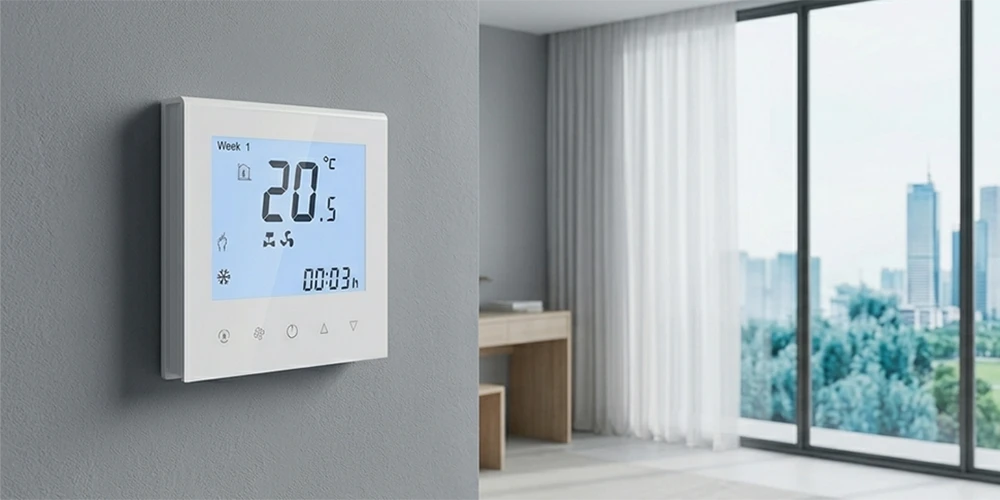
A room thermostat usually includes its own temperature sensor. In many projects, that is enough. In others, it is not.
An external sensor may be needed when:
- the thermostat location is affected by drafts or sunlight
- the wall position does not represent real room temperature
- the project uses floor heating with floor-limit protection
- a remote sensing point is needed
- better control stability depends on sensing away from the faceplate
This matters because temperature control quality depends not only on relay logic but also on where the temperature is being measured. For buyers, the practical rule is simple: if the thermostat location will not reflect the real controlled condition, ask about external sensor options early.
7) Check installation details before approving the model
Many buying teams look at the front panel and think the installation question is already covered. It is not.
Buyers should confirm:
- wall box compatibility
- front size
- mounting structure
- terminal spacing
- wiring access
- screen readability
- touch keys versus physical buttons
- colour and material finish if appearance matters commercially
This becomes especially important in projects where distributors, installers, and end users all see the thermostat differently. A distributor may care about model range. An installer cares about mounting and terminals. The end user cares about usability and appearance. A buying decision that ignores any one of these can still create friction later.
8) Ask what technical documents are available before you place the order
Good documentation is one of the clearest signs of a reliable thermostat supplier.
At minimum, buyers should ask for:
- datasheet
- wiring diagram
- user manual
- installation instructions
- communication details if using Modbus or BACnet
- sensor information
- packing information if branding matters
- compliance-related documents where applicable
If the supplier cannot explain the thermostat clearly before order confirmation, the project should assume that technical support after shipment may also be limited. In B2B buying, documentation quality is part of product quality.
9) Check compliance according to the destination market and the product type
This point should be handled carefully and practically.
Buyers do not need a long legal essay in the sourcing stage. They do need clarity on what the supplier can provide and what the market expects. This becomes especially relevant when wireless functions, EMC requirements, safety documentation, or declaration paperwork are involved.
A practical buyer question is not “Are you compliant?” in a vague sense. A better question is:
- what documents can you provide for this model?
- what is covered by current certification or declaration?
- does the wired model differ from the wireless model in documentation scope?
- what can be shown now, and what depends on final packaging or destination requirements?
That approach is better because it avoids false confidence. It also keeps the sourcing discussion grounded in actual documents instead of broad claims.
10) Compare total risk cost, not only unit price
This is where experienced buyers often separate themselves from first-time importers.
A thermostat that is slightly cheaper on paper can become much more expensive when it causes:
- installation confusion
- wrong control behaviour
- delayed commissioning
- site troubleshooting
- returns or replacements
- freight claims
- customer complaints
The safer quote is often the one attached to clearer technical matching, better documentation, and stronger application understanding.
A useful internal buyer test is this:
- Can the supplier explain the control logic clearly?
- Can the supplier match the product to the actual application?
- Can the supplier provide stable technical documents?
- Can the supplier support practical commercial needs such as OEM or neutral versioning if required?
If the answer is weak, the cheaper price may not be the better decision.
Common mistakes buyers still make
Buying by appearance first
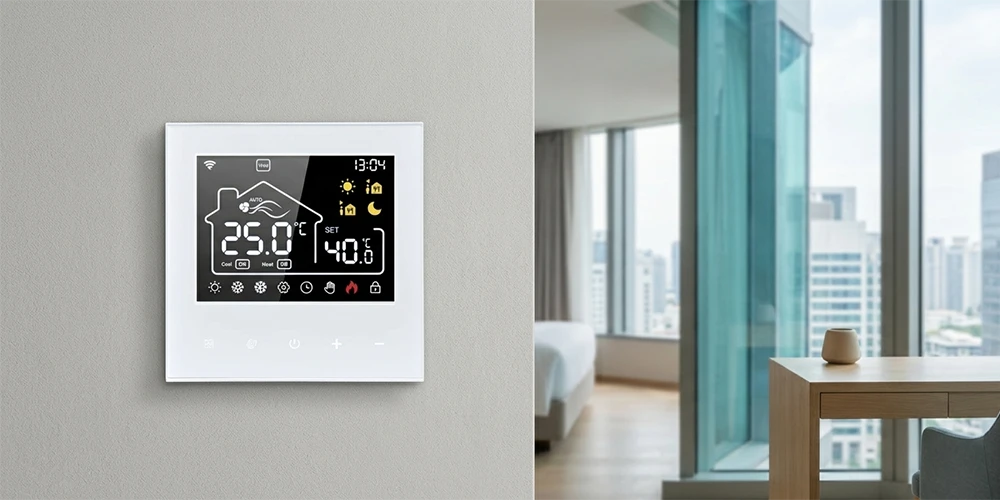
A clean design helps sales, but it does not confirm whether the thermostat can control the target HVAC system correctly.
Using “smart thermostat” as a complete requirement
That phrase is too broad. Buyers should define whether they mean app control, protocol integration, or simply a modern user interface.
Not sharing the real project setup
A supplier cannot validate the right model from a generic message alone. The more real project detail the buyer shares, the lower the mismatch risk.
Ignoring the installer view
Some thermostats look good in a catalog but are inconvenient to wire or configure. Installers quickly notice that, and complaints follow.
Treating sensor choice as a minor detail
Where the temperature is measured is often just as important as how the thermostat switches the output.
Expert insight: what the market is really rewarding now
The market is moving away from “any thermostat that works” and toward “the right thermostat for the application and control environment”.
That shift is supported by broader building trends. IEA notes that buildings remain a major energy-use sector and that better controls, codes, and efficient technologies are an important part of reducing energy use. It also points out that even small thermostat set-point changes can reduce energy demand, and that buildings offer wider flexibility potential through measures such as short-duration set-point adjustments.
That does not mean every project needs the most advanced thermostat. It means buyers should choose a thermostat based on real project value:
- better control stability
- easier commissioning
- suitable protocol choice
- clearer documentation
- lower complaint risk
- better daily usability
In practice, the best thermostat supplier is often the one that can connect these points into one clear recommendation.
Scientific data buyers should not ignore
There are three useful signals from authoritative sources.
First, thermostat decisions influence energy use in real buildings. IEA says thermostat set-point changes can immediately reduce building energy use, and in some cooling contexts even a 1°C adjustment can have a measurable effect.
Second, indoor thermal conditions matter for health and comfort, not only for preference. WHO identifies both low and high indoor temperatures as relevant housing-health concerns, and ASHRAE Standard 55 is specifically built around defining satisfactory thermal conditions for a majority of occupants.
Third, smarter thermostat control can produce measurable savings under the right conditions. ENERGY STAR says average savings for certified smart thermostats are approximately 8% of heating and cooling bills, while also noting that results vary by climate, occupancy, comfort preferences, and HVAC equipment.
For a buyer, the commercial lesson is straightforward: the thermostat is not just an accessory for adjusting room temperature. It is a control decision with comfort, operating, and support implications.
Practical examples buyers will recognise
Case 1: A hotel or apartment FCU project needing stable room control
At first glance, the buyer may only ask for a room thermostat. After a deeper check, the real requirement becomes clearer: 2-pipe or 4-pipe FCU logic, fan speed control, valve control, and possibly central visibility. In this kind of case, the decision should start with actual FCU control structure, not with display style.
Relevant pages:
Case 2: A commercial project where protocol matters more than app control
Some buyers ask for a smart thermostat because they want remote capability. After technical review, the real need is not app control but BMS compatibility. In that situation, a Modbus thermostat or BACnet thermostat is usually the more suitable choice. Choosing Wi-Fi only because it sounds modern can create integration problems later.
Relevant pages:
Case 3: A water heating or boiler project that seems simple but still needs output confirmation
Heating projects are often underestimated during sourcing. Buyers assume a thermostat is enough as long as it shows temperature and has an on/off symbol. In reality, the critical question may be whether the output is dry contact, voltage output, or direct load switching. The right thermostat for water heating and the right thermostat for boiler control are not always interchangeable.
Relevant page:

A practical supplier note
In real export projects, the main sourcing problem is usually not “Can you supply a thermostat?” The harder question is “Can you match the thermostat to the actual control logic, installation condition, and project expectation?”
That is why a useful buying workflow is:
- confirm the application first
- confirm voltage and output logic
- confirm protocol or app requirement
- confirm sensor and installation details
- finalise branding, packing, and commercial terms
This sequence reduces risk because it aligns the product with the actual project before price pressure narrows the discussion too early.
How to compare thermostat suppliers more effectively
A good supplier should be able to do five things well.
- Explain the thermostat in plain technical language. The buyer should quickly understand what it controls and how.
- Provide documents that match the actual model. A generic brochure is not enough when the project depends on exact terminals or protocol details.
- Recommend a suitable model rather than pushing whichever unit is easiest to sell.
- Support practical commercial needs such as OEM, neutral branding, or project-based discussion when needed.
- Stay realistic about documentation and compliance instead of making vague claims.
These points matter because a thermostat order is rarely only about buying a device. It is about reducing downstream uncertainty.
Final checklist before placing the order
Before sending the PO, buyers should be able to answer these questions clearly:
- What exact HVAC system will this thermostat control?
- What input power supply does the project use?
- What output logic does the equipment need?
- Is the project 2-pipe, 4-pipe, boiler, heating, or another structure?
- Does the project need standalone control, app control, or BMS integration?
- If communication is needed, which protocol is required?
- Is the built-in sensor enough, or is an external sensor needed?
- Does the model fit the installation format and wall box?
- What technical and compliance-related documents can the supplier provide?
- Is the buying decision based on total project risk, not only price?
When these questions are answered before order confirmation, most preventable thermostat sourcing problems become much easier to avoid.
FAQ
What should I check first before ordering a thermostat?
Start with the HVAC application. The right thermostat depends on the real system type, power supply, output logic, and control method, not only on appearance or price.
Is a smart thermostat the same as a Modbus or BACnet thermostat?
No. A smart thermostat often refers to app-based or user-friendly control. Modbus and BACnet thermostats are usually selected for system integration and central management.
Do I always need an external sensor?
No. Many projects work well with a built-in sensor. An external sensor is more suitable when the thermostat location does not reflect the real controlled temperature or when floor or remote sensing is required.
What documents should a thermostat supplier provide?
At minimum, buyers should ask for a datasheet, wiring diagram, user manual, and communication details if the model supports Modbus or BACnet. More project-specific documentation may also be needed.
Is the cheapest thermostat usually the best choice?
Not always. A low unit price can lead to higher total cost if the thermostat causes wrong control, installation delays, or customer complaints.
Final Note / Practical Takeaway
Buyers should check much more than screen design, logo options, and quotation before ordering a thermostat. The right buying decision comes from matching the thermostat to the real HVAC application, control logic, voltage, outputs, communication method, sensing needs, and installation conditions. In most projects, the safer supplier is the one that helps reduce mismatch risk clearly and early, not simply the one that gives the lowest first price.