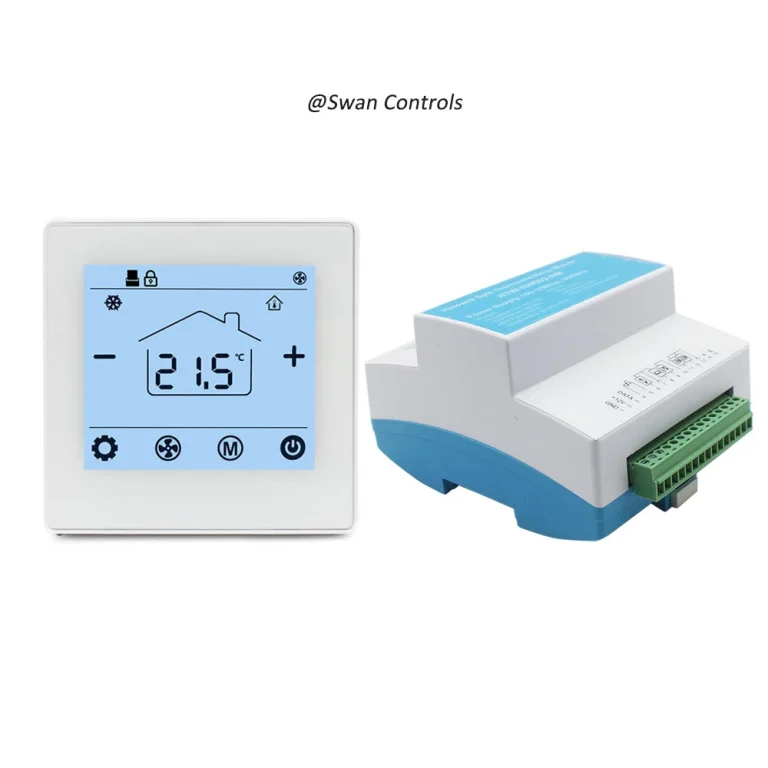
Quick Summary
Before importing a wifi thermostat, we suggest confirming the HVAC system type, control function, local market requirements, commercial terms, documents, OEM scope, and sample testing process. In cases where local scheduling or building control is more important than app control, a programmable thermostat or a BMS thermostat may still be more suitable than a wifi model.
Rather than discussing smart features only from a marketing perspective, the following analysis explains how buyers should evaluate thermostat selection based on actual installation, control logic, and project application requirements—using the checklist above as a practical starting point.
Start with the HVAC System, Not the App
Before we discuss app control, screen design, or packaging, we first need to confirm the HVAC system itself. A wifi thermostat should not be selected only because it supports app operation. If the output does not match the system, the product will create installation problems even when the app works well.
HVAC systems include fan coil units, electric heating, water heating, boiler heating, heat pump systems, packaged air-conditioning units, and others. In our daily work at Swan Controls (an affiliate of Hotowell), we mainly support fan coil and heating thermostats. In this article, we use fan coil thermostats as examples to clearly illustrate the matching logic — but the same logic can be applied to other smart thermostats for different systems.
For fan coil projects, the first step is usually to confirm several basic control points: whether the system is 2-pipe or 4-pipe, whether the fan uses 3-speed relay control or EC fan control, and whether the valve uses on/off control or 0–10V modulating control. These details directly affect thermostat compatibility.
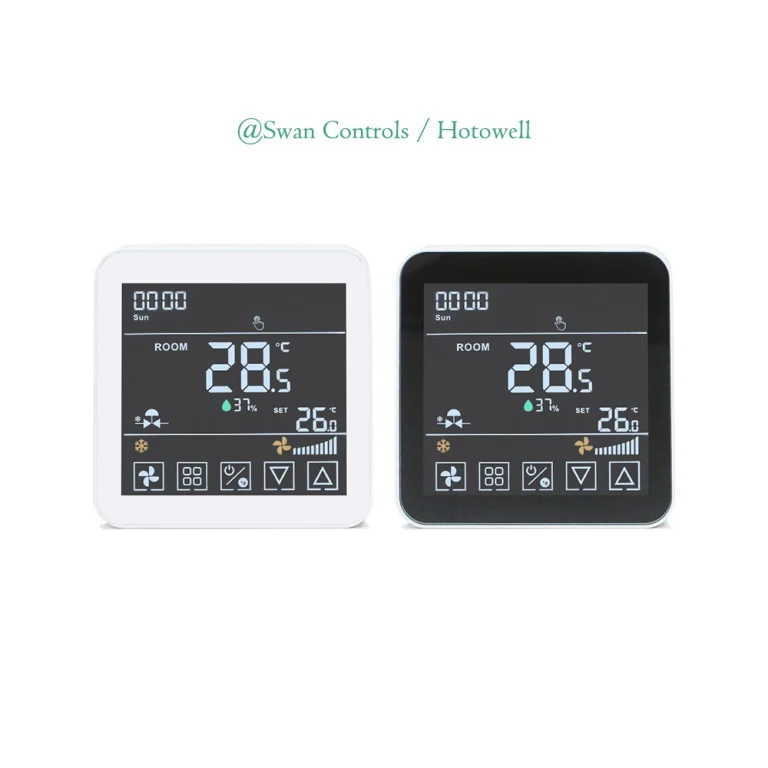
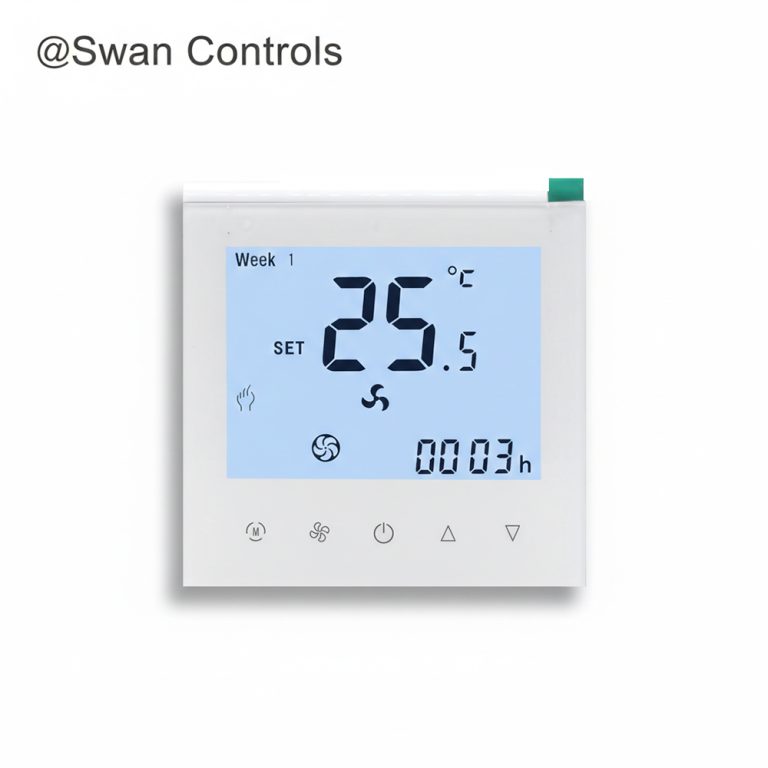
Two thermostats may look almost identical from the front display and both support wifi app control, but their internal control logic can be completely different. Without confirming the HVAC configuration first, customers may spend time comparing prices, discussing packaging, or arranging samples before discovering that the selected model does not fit the actual project.
Quick Import Matching Table Based on Different Systems
The table below helps us quickly screen suitable thermostat directions before sample testing and OEM discussion.
| Project Requirement | Suggested Model | Why This Direction Fits |
|---|---|---|
| 2-pipe FCU with simple local schedule | HTW-WF11-FC-2 Standalone programmable thermostat |
Suitable when local scheduling is more important than app control and unnecessary WiFi cost should be avoided. |
| 2-pipe FCU with app operation | HTW-WF01-FC-2W WiFi thermostat for 2-pipe FCU |
Suitable for remote app control, smart-home positioning, and connected apartment projects. |
| 4-pipe FCU with WiFi control | HTW-EB-FC-4W WiFi thermostat for 4-pipe FCU |
Helps avoid incorrect heating and cooling control logic in 4-pipe applications. |
| EC fan or 0–10V modulating valve project | HTW-FC09-FVMN-24WF EC fan and modulating output thermostat |
Suitable for projects requiring EC fan control, 0–10V valve output, and 24V applications. |
| Hotel, office, or apartment project with central control needs | HTW-FC08-ECNW WiFi + Modbus project thermostat |
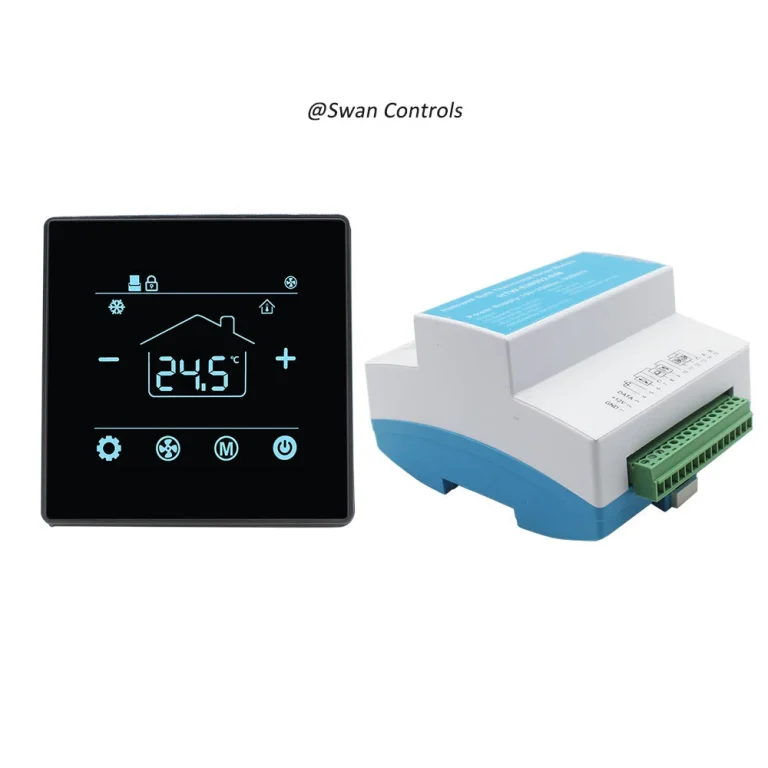
Supports project-level functions such as Modbus, keycard, external sensor, and wider system integration. |
| 3-speed fan project with 2/4-pipe control, WiFi, Modbus, and remote sensor support | HTW-WF11-FC-4ENS1W WiFi + Modbus FCU thermostat |
Suitable for projects requiring flexible FCU control, communication support, and remote sensing functions. |
| BMS-focused project without WiFi demand | HTW-WF11-FC-4ENS1 Modbus thermostat without WiFi |
Keeps the product practical when BMS communication matters more than app-based smart functions. |

Understand the Overlap: Wifi Thermostat Usually Include Programming
After the system direction is clear, let‘s look at two concepts that are often misunderstood.
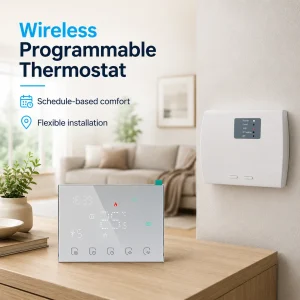
In fan coil thermostats, a programmable thermostat means the device supports local schedule control (e.g., weekday/weekend time periods). A WiFi thermostat typically includes the same programmable functions plus remote app operation.
In other words, WiFi models contain programming by default. The real question is not “WiFi or programming” — it’s “do we need remote control, or is local scheduling enough?”
-
Choose a programmable (non-WiFi) thermostat when: the room follows a regular timetable (office, budget apartment) and you want to avoid unnecessary WiFi cost.
-
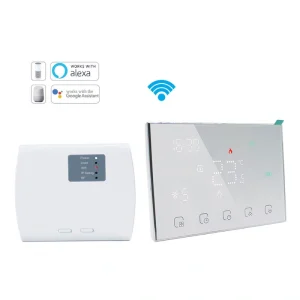
Choose a WiFi thermostat when: remote adjustment, app operation, or smart-home positioning is a selling point for the end user.
Both options can work. But confusing the overlap often leads buyers to pay for WiFi they don’t need, or to skip programming they actually require.
| Feature | Programmable (non-WiFi) Thermostat | WiFi Thermostat |
|---|---|---|
| Local schedule (7-day programmable) | Yes | Yes (included) |
| Remote App control | No | Yes |
| Best for | Offices, basic apartments, cost-sensitive projects | Smart homes, hotels, remote-operated buildings |
| Extra cost | Lower | Higher |
Check Basic Commercial Conditions Before Importing
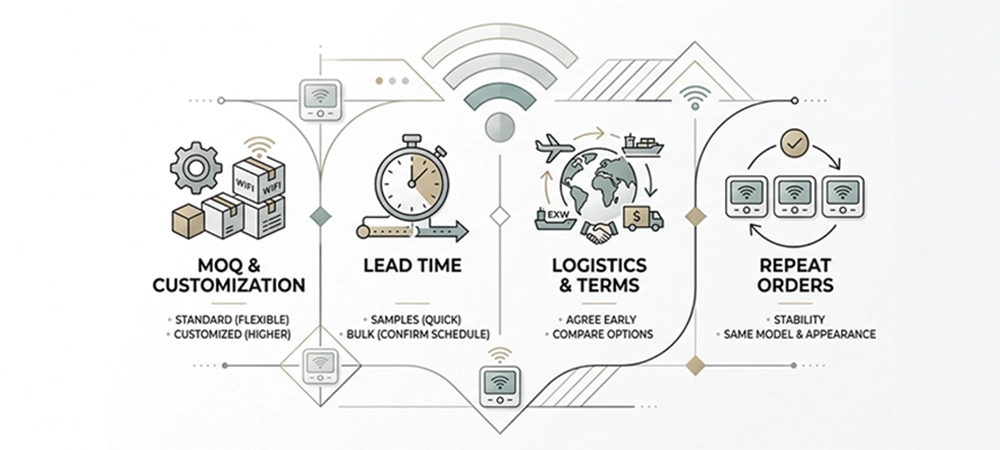
Once the product type is clear, we should confirm commercial conditions because they affect stock planning, quotation, delivery promises, and repeat orders. MOQ should be checked first. A standard model normally has more flexible ordering conditions than a customized model. If the customer needs logo printing, private label, special packaging, manual changes, or model code adjustment, MOQ may be higher.
Lead time should also be confirmed early. Standard samples are usually easier to prepare than customized models. Bulk production depends on quantity, stock status, order season, and packaging requirements. We suggest confirming the real production schedule before promising delivery dates to local customers.
Payment method, trade terms, and transportation should be agreed before order confirmation. Importers may need to compare EXW, FOB, courier delivery, air shipment, or sea freight based on order size, urgency, customs process, and warehouse planning. For a wifi thermostat product line, repeat-order stability is also important. We should confirm whether the same model, appearance, packaging, manual, and parameter logic can be maintained in future orders.
Confirm Market-Ready Details Before Importing
A product is not ready for import only because the sample works. We also need to confirm whether the product is ready for local sales, installation, and documentation use.
Voltage is one of the first details to check. Many fan coil thermostats use wide voltage input, but we still need to confirm the exact power supply and output requirements. Some projects may need 24V output, dry contact, relay output, or 0–10V signal. These details must match the installation site.
Language is also important. In Europe, the Middle East, and South America, our customers may need English, Spanish, Portuguese, Arabic, or other language support depending on sales channel. A clear manual reduces installer confusion and helps distributors answer local questions faster.
Labels, packaging, and model naming should be consistent. The model on the carton, product label, invoice, manual, and website should not create confusion. For a distributor, this affects warehouse control and sales communication. For an OEM customer, it affects brand presentation.
Certification and compliance files should be discussed before bulk ordering. In Europe, CE-related documentation, RoHS information, EMC-related files, and Low Voltage Directive relevance may be important for sales and project review. IEC 60730-2-9 is also commonly relevant to automatic electrical temperature sensing controls. Customers do not need to discuss every standard in the first email, but they should ask what files are available.
Product photos, packing files, wiring diagrams, and specification sheets are also useful. They help customers prepare catalogues, online listings, tender documents, installer guidance, and after-sales support materials. A wifi thermostat with poor documents may create more work for the local importer than a simpler model with complete files.
Decide Whether OEM Is Necessary
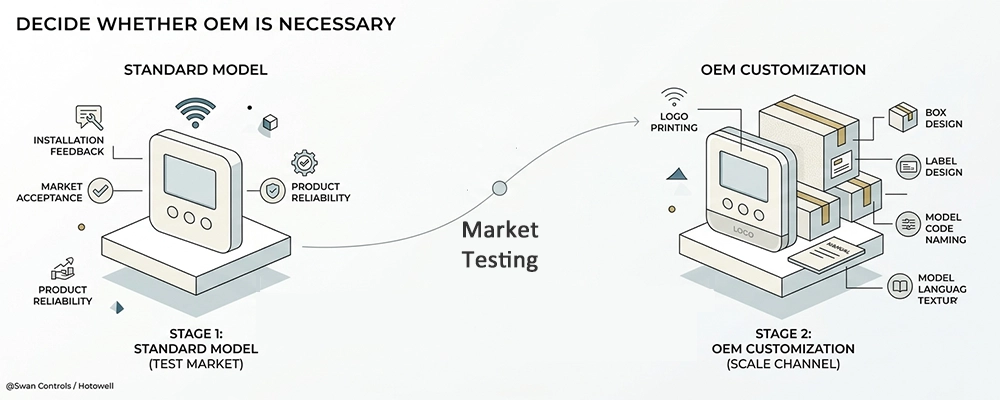
OEM can add value, but it should match the customer’s stage. For a new importer, a standard model may be the safer first step. The customer can test installation feedback, market acceptance, pricing, packaging expectation, and product reliability before investing in a full private-label plan.
OEM becomes more useful when the customer has a clear channel and stable demand. Common OEM options may include logo printing, label design, box design, manual adjustment, model code naming, default settings, and packaging language. These details can help a distributor build a more professional local product range.
However, we do not suggest starting with complex customization too early. A new market should first confirm whether the selected wifi thermostat or programmable thermostat fits real HVAC systems and customer expectations. Once product-market fit is clear, OEM work becomes easier and safer.
At Swan Controls, we can discuss standard model supply, OEM packaging, manual support, and project documentation according to order quantity and target market.
Sample Testing Should Match Real Installation
Sample testing should not stop at checking appearance and screen brightness. We suggest testing the sample as a real HVAC control product before bulk import.
For a fan coil thermostat, the customer should test power input, fan speed output, valve output, heating and cooling logic, temperature display, setpoint adjustment, wiring terminals, schedule settings, app operation where relevant, and manual clarity. If the model includes Modbus, keycard, external sensor, EC fan control, or 0–10V output, these should also be checked.
For a wifi thermostat, app pairing is only one part of the test. We also suggest checking whether local control still feels clear, whether the display is easy to read, whether settings are easy to understand, and whether the manual explains the main operations well.
For a programmable thermostat, customers should test the schedule logic carefully. The user should understand how to set time periods, working days, rest days, temperature setpoints, and manual override. If the schedule function is confusing, the distributor may receive unnecessary support questions later.
A useful test method is to let a local installer read the wiring diagram and manual first. If the installer can understand the document quickly, the product is more ready for local sales. If not, the manual or model choice may need adjustment before bulk import.
Plan for After-Sales Support Before the Container Arrives
Once the product type, commercial terms, documents, and sample testing are confirmed, we should not stop there. From our experience at Swan Controls, importers who plan for after‑sales support before the product arrives face far fewer operational headaches than those who only start thinking about it after receiving customer complaints.
We recommend checking three support areas early.
First, common troubleshooting scenarios. Even with a well‑tested wifi thermostat, installers may struggle with wiring mismatches, app pairing failures, or temperature reading discrepancies. We suggest preparing a short internal FAQ or video links before shipping.
Second, spare part strategy. A small percentage of units may develop display issues, relay failures, or sensor drift over time. We advise adding 5–8% spare units of the same model in the first bulk order, rather than assuming replacement stock can be ordered separately later. From our perspective, this is not an extra cost — it is a buffer that keeps the local customers satisfied while we handle the next production batch.
Third, local installer feedback loop. We should ask our first few project partners to share what confused them during installation. This feedback helps us adjust manual wording, label clarity, or even default settings for future OEM orders. At Swan Controls, we treat this input as part of product matching.
By planning these three points before the container departs, we help our importers reduce support tickets, protect their brand reputation, and build smoother reorder cycles.
Common Buyer Mistakes
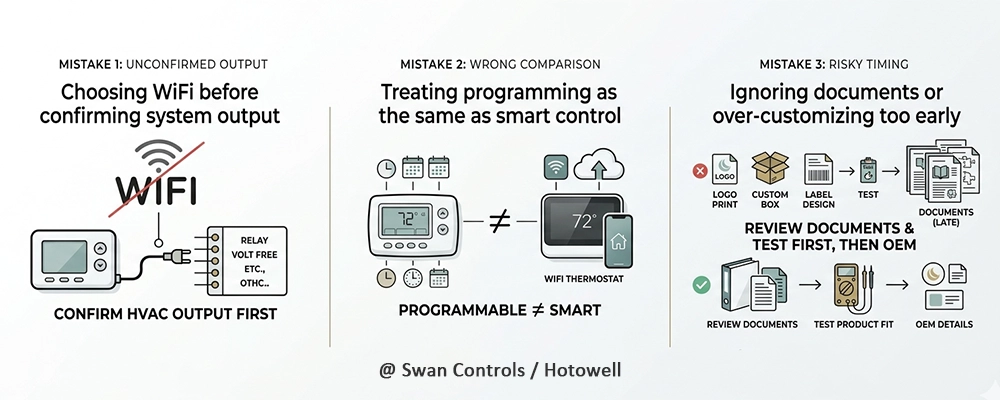
Choosing WiFi before confirming system output
The most common mistake is choosing a connected model before confirming the HVAC output. If the system needs 4-pipe control, EC fan signal, or 0–10V valve output, a basic model may not work. The consequence is installation delay, wrong stock, and possible product return.
Treating programming as the same as smart control
A programmable thermostat and a WiFi model are related but not identical. Programming is mainly about schedule control. WiFi is mainly about app connection and remote operation. If these two concepts are mixed together, the final model may not match the real sales channel.
Ignoring documents or over-customizing too early
Some customers ask for manuals, wiring diagrams, and certificates only after the bulk order is confirmed. Others start with logo, box, and label details before the model is tested. Both approaches are risky. We suggest reviewing documents and product matching first, then moving to OEM details.
Real-World Import Cases
European distributor building a connected control range
A European distributor may want to add connected fan coil thermostats to its product line. In this case, we suggest confirming CE-related files, RoHS information, voltage, manual language, wiring diagram, packaging style, and model consistency first. If the product will be sold as a modern smart range, WiFi can be useful. If the product will enter project supply, Modbus or clear wiring support may matter more.
Middle East hotel or apartment project
In a hotel, apartment, or serviced building project, the customer may care about stable operation, simple user interface, and optional central control. In some projects, keycard, Modbus, or external sensor support may be more important than app control alone. HTW-FC08-ECNW or HTW-WF11-FC-4ENS1W may be discussed when WiFi and communication functions are required. If the project does not need WiFi, HTW-WF11-FC-4ENS1 may be considered.
South American importer testing wholesale demand
A South American importer may prefer practical models, clear documents, stable supply, and competitive pricing. A simple product range may be better than a complex product family at the beginning. The importer can test standard models first, then decide whether to add logo, local-language manual, box design, or private model codes later.
FAQ
1. What should buyers confirm first before importing a wifi thermostat?
Buyers should first confirm the HVAC system type and control requirement. For fan coil projects, this means checking 2-pipe or 4-pipe system type, 3-speed fan or EC fan control, on/off valve or 0–10V valve control, voltage, wiring terminals, and whether Modbus, keycard, or external sensor functions are needed.
2. Is a programmable thermostat still useful if WiFi models are available?
Yes. A programmable thermostat is still useful when the room follows a regular schedule and the user does not need app control. It can support local time-period control and simple daily operation. For some offices, apartments, and cost-sensitive projects, this may be more practical than choosing WiFi only for marketing appeal.
3. Should importers choose WiFi for every thermostat order?
Not always. WiFi is useful when remote control, app operation, or smart product positioning is required. However, buyers should not choose WiFi if the target project only needs stable local control, Modbus communication, or a lower-cost standard model. The function should match the real sales and installation need.
4. What documents should be checked before bulk ordering?
Buyers should check user manuals, wiring diagrams, technical specifications, product photos, packaging files, label information, CE-related documents, RoHS information, and any available test reports. These documents help with local sales, installation training, project review, and after-sales support.
5. When should buyers consider OEM packaging?
OEM packaging is worth considering when the buyer has a clear brand plan, stable sales channel, and enough order quantity. For a new market, it is often safer to test standard samples first. After confirming market feedback, buyers can discuss logo, label, box, manual, model code, and default setting options.
References / Sources
Programmable Thermostats | U.S. Department of Energy | Energy Saver
Thermostats and Heating Controls | Energy Saving Trust | UK Energy Saving Trust
Smart Thermostats | ENERGY STAR | U.S. Environmental Protection Agency
Commission Regulation (EU) No 813/2013 | European Commission
Directive 2014/30/EU on Electromagnetic Compatibility | European Parliament and Council
Directive 2014/35/EU on Low Voltage Electrical Equipment | European Parliament and Council
Directive 2011/65/EU on RoHS | European Parliament and Council
IEC 60730-2-9 Automatic Electrical Temperature Sensing Controls | International Electrotechnical Commission
ASHRAE Handbook—HVAC Applications | ASHRAE
Final Note
Importing a wifi thermostat is not only a question of app control. We suggest confirming the HVAC system, function boundary, commercial conditions, market-ready documents, OEM need, and sample testing process before bulk ordering. A programmable thermostat may be enough for schedule-based rooms, while a connected model is more suitable when remote operation and smart product positioning are real selling points. If you are preparing a project, wholesale, or OEM order, please feel free to get in touch with us to confirm the suitable model, control logic, wiring requirement, customization scope, and project documents.
Copyright © Swan Controls / Hotowell. All rights reserved. This article is written and published by Swan Controls, an affiliate of Hotowell.