“The thermostat is set correctly, so why does the room still feel wrong?”
“Because the number on the screen is only part of the story.”
That is a common problem in real projects. A room may feel too warm at one time and too cool at another. The system may start and stop too often. The energy bill may stay high even when people think they are using careful thermostat settings. In many cases, the thermostat is not broken. The issue is that the settings do not match the room, the system, or the way the space is used.
A thermostat controls more than one temperature point. It also affects runtime, recovery, cycling, setback, and how the system responds during occupied and unoccupied hours. That is why thermostat settings can directly change comfort, stability, and energy use. DOE says that simply turning the thermostat back 7°–10°F for 8 hours a day can save as much as 10% a year on heating and cooling, while ENERGY STAR says certified smart thermostats save about 8% of heating and cooling bills on average.
Quick Summary
Thermostat settings do not only change the temperature target. They also shape how often the system runs, how stable the room feels, and how much energy the building uses. A room thermostat with the wrong settings can still make the room feel uneven, increase cycling, and waste energy, even if the hardware itself is suitable.
Quick Summary: The Four Settings That Matter Most
Most projects are affected most by four setting groups: the main setpoint, the day and night schedule, the allowed temperature swing or response pattern, and the operating mode chosen for the actual HVAC application. Smart thermostats and programmable thermostats often add more convenience, but the core logic is still simple. The thermostat decides when to start, when to stop, and when to recover. Many smart thermostats learn temperature preferences and automatically create energy-saving schedules for sleeping or away periods.
Why Thermostat Settings Matter More Than Many Buyers Expect
Many buyers treat thermostat settings as a small user detail. They focus on hardware first, then think the settings can be adjusted later with little effect. In practice, the settings are part of the control system. They influence when heating or cooling starts, how long it stays on, how quickly the room returns to the target condition, and how often the equipment cycles. In a residential room, that changes comfort. In a hotel project, that changes guest experience and operating cost. In a commercial room with valves or fan coils, that can change control stability and complaint rates.
This is why a thermostat should not be viewed only as a wall display. It is a decision point. A room thermostat set too aggressively may chase the target too often. A thermostat set too loosely may let the room drift too far before it reacts. A thermostat with a poor daily schedule may save energy on paper but reduce comfort in real use. On the other hand, a thermostat with balanced settings can keep the room more even and reduce unnecessary runtime at the same time.
Research and program guidance support this practical view. The value of certified smart thermostats comes from field-proven savings and better temperature management, not just remote control. Many smart thermostats can learn preferences and adjust to energy-saving temperatures when occupants are asleep or away. In other words, the setting logic is central to the product value.
Comfort Starts with the Right Setpoint, Not the Most Extreme One
One of the most common mistakes is to think that a more extreme setpoint creates faster or better comfort. Many users lower the cooling setpoint too far or raise the heating setpoint too high because they want the room to react faster. In most systems, that does not improve comfort in a smart way. It often just increases runtime and can make the room overshoot or feel uneven over time.
Comfort is not only one number. Thermal comfort depends on a group of factors, including temperature, humidity, air speed, thermal radiation, clothing, and activity level. That means a “correct” thermostat setting depends on the type of room, how the room is used, how quickly the system responds, and what kind of HVAC equipment is serving the space.
For a home, the right setpoint is usually the lowest comfortable heating setting or the highest comfortable cooling setting that still gives a good indoor feel. For heating, it is generally better to keep the thermostat as low as is comfortable when people are home and awake, then use setback when they are asleep or away. That is a useful rule because it is practical, simple, and based on real operation rather than theory.
For B2B buyers and project planners, this also matters during selection. A room thermostat for a bedroom, a boiler zone, a hotel guest room, or a commercial valve-control room may all be described with similar language, but the comfort target is not always the same. A product page should therefore help the buyer think about the result the project needs, not just the technical format of the thermostat.
Stability Depends on More Than the Setpoint
Comfort is what people feel. Stability is how consistently the system holds that feeling. These two are related, but they are not identical. A thermostat can show the target temperature and still produce an unstable room if the control logic is too aggressive, too delayed, or poorly matched to the HVAC application.
In practical terms, stability is affected by how far the room is allowed to drift before the thermostat reacts, how quickly the HVAC system responds, and whether the schedule or recovery logic fits the building use pattern. If the thermostat reacts too often, the equipment may cycle more than necessary. If it reacts too slowly, room conditions may swing too far and cause discomfort. For a fast electrical system, a certain strategy may work well. For water heating, hydronic loops, or valve-based room control, the same strategy may feel unstable because the response time is different.
This is where many thermostat articles stay too shallow. They say “set the thermostat correctly” but do not explain that stability is really about matching the thermostat settings to the system behavior. A boiler thermostat may need stable heating demand with fewer unnecessary interruptions. A water heating thermostat may need a smooth daily routine. A thermostat connected to a PICV application may need settings that support steady control instead of fast correction. A hotel room thermostat may need energy-saving logic that still avoids guest discomfort when someone returns to the room.
In other words, thermostat settings do not act alone. They work with equipment response. That is why the same setting can feel stable in one project and unstable in another.
How Daily Schedules Affect Both Comfort and Energy Use
Schedules are one of the clearest examples of how thermostat settings influence both comfort and energy use. A programmable thermostat or smart thermostat lets users create different temperature targets for occupied and unoccupied periods. This seems simple, but the impact is large because schedule changes influence runtime over many hours, every day.
Schedule quality matters because the main benefit of a thermostat is not keeping one constant number all day. It is allowing comfort when the space is used and reducing waste when the space is empty. Good schedule settings are not only about convenience. They are one of the main ways a thermostat reduces energy waste.
| Setting Approach | Comfort Result | Stability / Energy Result |
|---|---|---|
| Constant all-day comfort setpoint | Usually steady when occupied | May increase runtime and energy use |
| Day/night setback | Good balance when recovery is reasonable | Often improves energy savings |
| Aggressive setback | Can feel slow to recover | May save energy, but comfort can suffer |
| Poorly timed schedule | Often causes complaints at occupancy change | Can reduce efficiency and feel unstable |
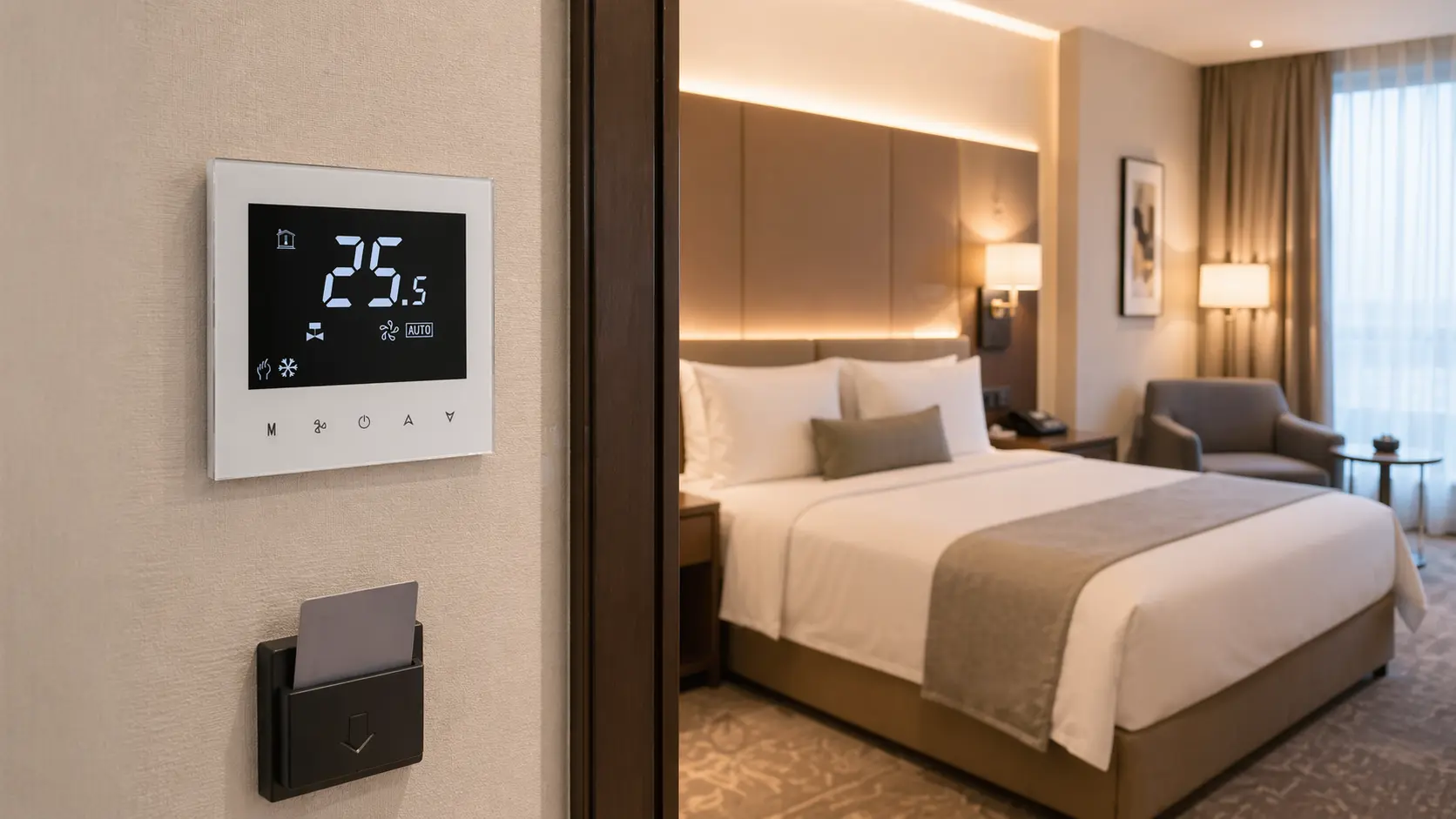
The right schedule is therefore not the most aggressive one. It is the one that fits the room use pattern and gives comfortable recovery at the right time. For a bedroom, that may mean one sleep setting and one wake setting. For an office, it may mean weekday occupancy settings with weekend setback. For a hotel room, it may mean automatic setback linked to keycard logic rather than fixed time schedules. The logic should follow the room use, not just the installer’s habit.
Wrong Settings Can Reduce Comfort and Still Increase Energy Use
Many people assume that if comfort gets worse, energy use must at least go down. Real systems do not always behave that way. Poor thermostat settings can reduce comfort and still use more energy. This happens when the setting logic causes longer runtime, repeated correction, poor schedule timing, or unnecessary manual overrides.
A common example is the user who changes the setpoint again and again because the room does not respond quickly enough. This can create a cycle of overcorrection. Another example is an aggressive setback that leaves the room too cold or too warm before occupancy, then forces a longer recovery period. A third example is when a thermostat is left at one comfort setting all day in a space that is empty for many hours. In that case, comfort is maintained when no one benefits from it, so energy is used without clear value.
Savings can vary based on climate, comfort preferences, occupancy, and HVAC equipment. This is important because it reminds buyers that savings are not automatic from the thermostat name alone. The actual settings, room use pattern, and system type still matter.
Different HVAC Applications Need Different Thermostat Setting Logic
One of the biggest practical errors in the market is to treat all thermostat settings as universal. They are not. Different HVAC applications respond differently to the same setting strategy. Buyers should therefore think about settings together with system type.
Boiler heating projects
Boiler applications often benefit from stable demand logic rather than dramatic setpoint changes. In many cases, the goal is steady indoor heating, not rapid temperature chasing. For these projects, a dedicated 220V boiler thermostat with Modbus or a house thermostat for water heating and boiler heating is often more suitable than a thermostat selected only for appearance.
Water heating applications
Water heating usually responds more slowly than direct electrical control. That means the best thermostat settings are often moderate and consistent rather than extreme. A 3A water heating thermostat used with sensible schedules can give better comfort and more even energy use than a thermostat that is frequently adjusted by hand.
PICV and commercial room control
Commercial rooms with PICV logic are often more sensitive to control stability than people expect. A thermostat setting strategy that creates frequent corrections can lead to complaint cycles, especially if the room load changes through the day. In those projects, stable setpoints and the right control logic are more important than aggressive user adjustment. A 24VDC output PICV thermostat with Modbus is often a better fit where commercial room control and integration matter.
Hotel guest room HVAC
Hotel rooms need a different balance again. Guests expect comfort quickly, but operators also need energy control during vacancy. In this case, the thermostat settings should work with occupancy logic, not against it. A keycard HVAC thermostat for 2-pipe and 4-pipe hotel rooms is often more suitable when energy-saving setback is part of the project design.
These examples show the real lesson. There is no single “best thermostat setting” for every system. The better question is: what setting logic best fits this application?
Smart Thermostat and Programmable Thermostat Features Help Only When the Logic Is Right
Smart thermostat and programmable thermostat features are useful, but they are not magic. They improve results when the room, schedule, and application are understood correctly. They do not solve every control problem automatically.
Common advantages include learning temperature preferences, creating schedules, geofencing, and updating control behavior over time. Those features are valuable because they support better settings over the day. But the important point is this: they support good control logic; they do not replace it. A smart thermostat in a badly matched project can still produce poor comfort or poor savings.
For buyers, this means the product choice and the setting strategy should be discussed together. A thermostat supplier or manufacturer should not only answer whether the thermostat has WiFi or Modbus. They should also help explain how the thermostat will actually be used in the target room and target schedule.
A Practical Thermostat Setting Guide for Comfort, Stability and Savings
The best way to improve performance is not to guess. It is to follow a short setting process and adjust from real room behavior.
- Confirm the HVAC application first. Boiler, water heating, hotel room, PICV, or another control type.
- Start from a moderate comfort setpoint. Do not begin with an extreme target.
- Use a simple day and night schedule. Let occupied and unoccupied periods work differently.
- Avoid frequent manual overrides. Constant adjustment often reduces stability.
- Watch how the room actually behaves. Comfort complaints matter more than the screen number alone.
- Review recovery timing. If the room is still uncomfortable when people arrive, the schedule may be wrong.
- Match the strategy to the system response speed. Slow systems often need smoother logic.
- Adjust step by step. One change at a time is easier to evaluate than many changes together.
This is simple advice, but it works. The most stable projects usually come from calm, measured adjustments rather than constant correction.
Expert Commentary & Analysis
Industry guidance has moved in a clear direction. Thermostats are no longer discussed only as simple switches. They are increasingly treated as active control devices that shape comfort and energy behavior over time. This shift is visible in guidance that focuses on schedule quality, setback logic, and actual field performance rather than only on nominal thermostat features.
From a project point of view, this means buyers should stop asking only, “What temperature should I set?” A better question is, “What control result do I want from this thermostat in this room?” In some projects, that means steady comfort with modest energy savings. In others, it means stronger setback during vacancy. In hotel HVAC, it may mean protecting comfort during occupancy but reducing waste when the room is empty. In PICV and commercial room control, it may mean keeping conditions stable enough to reduce complaints.
We often see this in real thermostat applications. Boiler and water heating projects usually respond better when settings are stable and practical. Hotel and commercial projects usually perform better when thermostat settings are tied to room use and control logic, not only to a single display temperature. That is why clear product pages and clear application advice matter. A buyer choosing between a boiler thermostat, a water heating thermostat, a PICV thermostat, or a hotel room thermostat should be guided by control logic as much as by product format.
Real-World Cases and User Feedback
Case 1: Boiler heating user wanted faster comfort
A homeowner kept raising the heating setpoint higher because the room felt slow in the morning. The result was longer runtime and uneven room feel later in the day. After changing to a more moderate setpoint with a better wake schedule, comfort improved and the system felt more stable. The key lesson was simple: faster comfort came from better timing, not from a more extreme thermostat setting.
Case 2: Hotel room energy-saving logic
A hotel project wanted to reduce vacancy energy use without creating guest complaints. A fixed comfort setting all day was simple, but it wasted energy. A more suitable approach linked thermostat behavior to room use so that the room returned to comfort when needed and reduced energy use when empty. In this kind of application, the thermostat settings are part of operations, not just part of room comfort.
Case 3: Commercial room with valve-based control
In a commercial room control project, users complained that the room felt inconsistent even though the thermostat looked correct. The issue was not the hardware alone. The room needed a more stable control strategy and less frequent manual override. After the settings were simplified and matched better to the room use, complaint frequency dropped.
User feedback pattern: In many real projects, people do not ask for a “more advanced thermostat.” They ask for a room that feels more even, recovers at the right time, and does not waste energy. That is why thermostat settings matter in practical terms. They directly shape the user experience.
Scientific Data: What the Numbers Suggest
Several well-known sources support the idea that thermostat settings have measurable impact. Daily temperature setback can reduce annual heating and cooling use, and certified smart thermostats have also shown average savings in field studies. At the same time, accepted comfort frameworks remind us that indoor comfort is not set by temperature alone. Temperature works together with humidity, air speed, radiation, clothing, and activity. This explains why two rooms with the same thermostat setting can still feel different.
These sources point to one clear conclusion. Better thermostat settings can improve performance, but only when they fit the room, the system, and the occupancy pattern. Settings are not isolated numbers. They are part of a control strategy.
Five Common Thermostat Setting Mistakes
- Setting the temperature too high or too low in the hope of faster response.
- Using one fixed comfort setting all day in rooms that are empty for long periods.
- Changing the thermostat by hand too often instead of letting the schedule work.
- Using aggressive setback in a system that recovers slowly.
- Applying the same thermostat logic to boiler, water heating, hotel, and commercial control projects.
If these mistakes are corrected, many comfort and energy complaints become easier to solve.
Frequently Asked Questions
1. What is the best thermostat setting for comfort and energy saving?
The best thermostat setting is usually the lowest comfortable heating setting or the highest comfortable cooling setting, combined with a schedule that reduces runtime when the room is unoccupied. The right answer depends on the HVAC system, the room use pattern, and how quickly the system responds.
2. Do lower or higher thermostat settings always save more energy?
No. Extreme settings do not always improve results. In many cases, they increase runtime or reduce comfort without giving better control. Moderate setpoints and sensible schedules are usually more effective than aggressive manual adjustment.
3. Why does my room feel unstable even when the thermostat setting looks correct?
A room can still feel unstable if the thermostat schedule, response pattern, or control strategy does not match the room and the HVAC system. Stability depends on more than the screen number. It also depends on how the system reacts over time.
4. How do programmable thermostat schedules affect comfort?
Programmable thermostat schedules affect comfort by changing when the room moves between occupied and unoccupied temperature targets. A well-timed schedule can keep the room comfortable when needed and reduce energy use during sleeping or away periods. A poorly timed schedule can make the room feel late, uneven, or slow to recover.
5. Can thermostat settings affect boiler, hotel, or commercial room control performance?
Yes. Thermostat settings can affect how stable the room feels, how often equipment runs, and how much energy is used in boiler heating, hotel guest room HVAC, and commercial valve-based room control. Different applications often need different thermostat setting logic.
Thermostat settings absolutely affect comfort, stability, and energy use. The key is not to chase the most extreme temperature. It is to choose practical setpoints, sensible schedules, and setting logic that match the actual HVAC application. When the settings fit the room and the system, comfort usually becomes more even and energy use becomes more controlled.
References / Sources
- U.S. Department of Energy, Programmable Thermostats
- U.S. Department of Energy, Fall and Winter Energy-Saving Tips
- ENERGY STAR, Smart Thermostats
- ENERGY STAR, Smart Thermostats FAQ
- ENERGY STAR, Technical Bulletin: ENERGY STAR Certified Smart Thermostats
- ENERGY STAR, Smart Thermostat Best Practices Guide
- ENERGY STAR, Smart Thermostat Fact Sheet
- ASHRAE, Standard 55 Fact Sheet
- ASHRAE, Thermal Environmental Conditions for Human Occupancy
- ENERGY STAR, Low- to No-Cost Tips for Saving Energy at Home