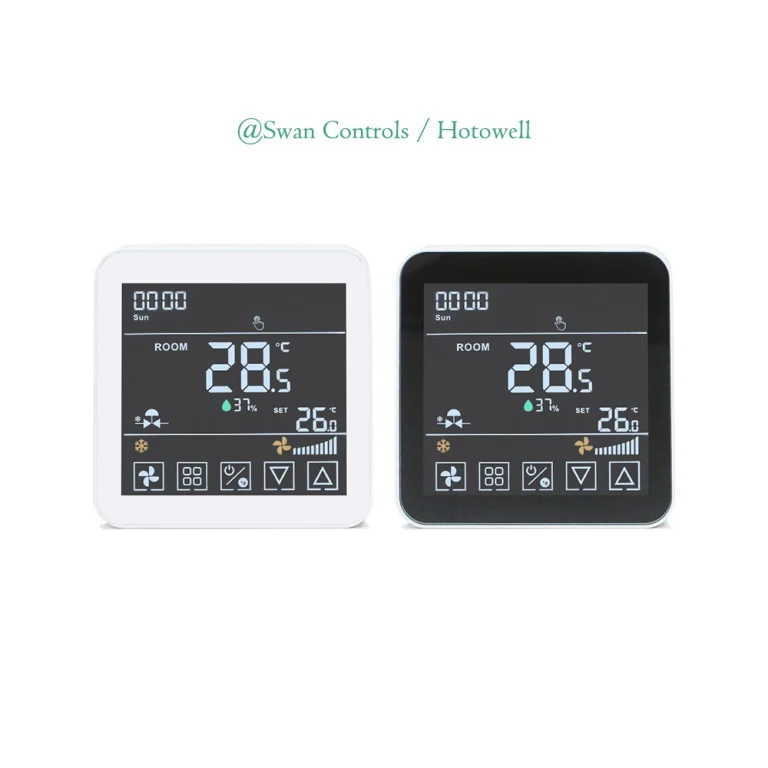
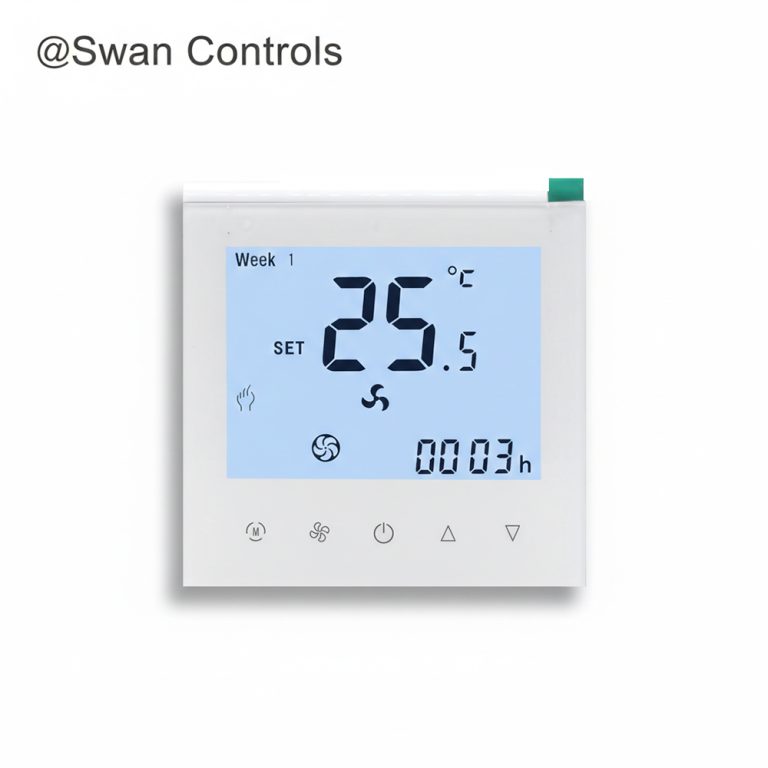
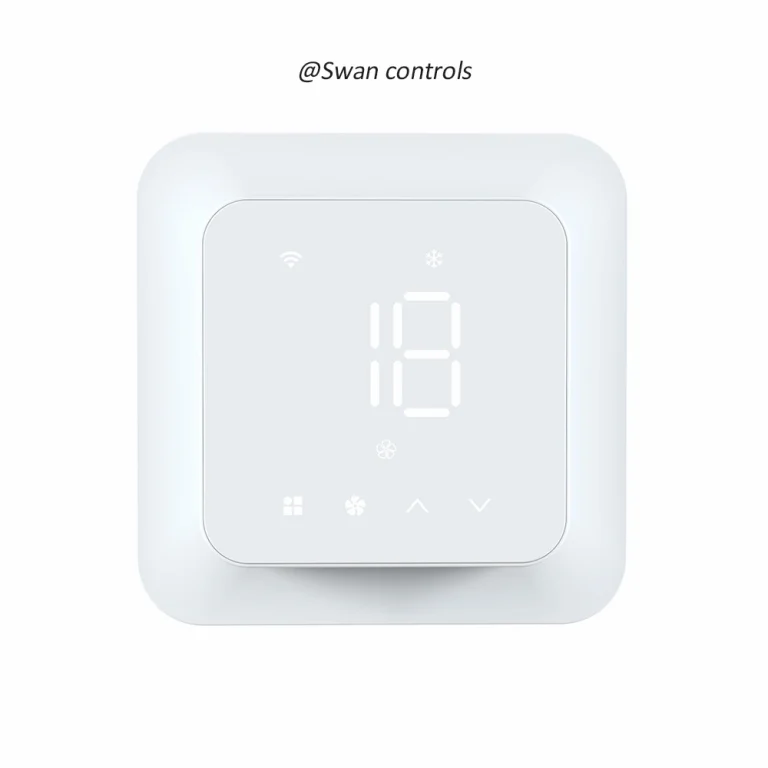
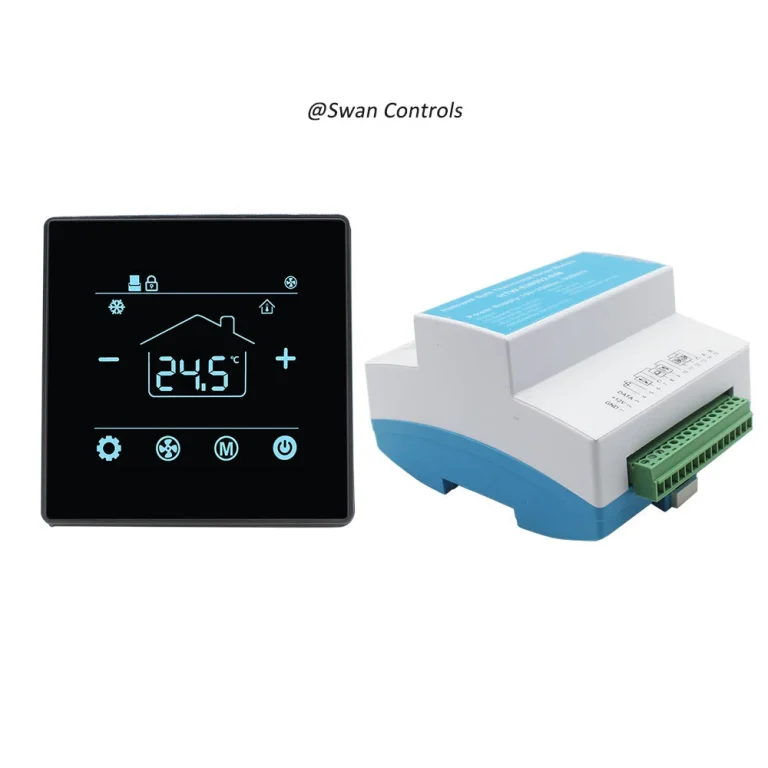
“We need a thermostat for apartments. Can one model fit all rooms?”
“Our office works from Monday to Friday. Should we use a 7 day schedule?”
“The client wants energy saving, but the system must stay easy to use.”
These are common questions in HVAC projects. A programmable thermostat looks simple, but the selection is not always simple. The wrong model may still turn heating or cooling on and off. But it may not fit the building schedule, wiring, user habits, or control needs.
For residential projects, buyers usually care about comfort, easy operation, and stable daily use. For commercial projects, buyers also need schedule control, reliability, installation consistency, and sometimes integration with a wider HVAC plan.
This guide explains how to choose the right programmable thermostat for both commercial and residential projects. It also explains when a 7 day programmable thermostat is the better choice, and what buyers should confirm before placing an order.
Start with the Project Type
The first step is to define the project type. A home, hotel, apartment, office, and shop may all need temperature control. But they do not use the thermostat in the same way.
A residential user often wants simple comfort. They may want a warm room in the morning, lower energy use during the day, and stable comfort at night. A commercial user often needs more predictable control. The system may need to follow working hours, weekend shutdown, or room occupancy plans.
This is why project type matters before price comparison. A low-cost thermostat may look attractive. But if it does not match the project schedule, it may cause complaints later.
Common project differences include:
- Homes need simple daily control and easy operation.
- Apartments need stable models that different users can understand.
- Offices need schedules that match working hours.
- Hotels need comfort control with low complaint risk.
- Small shops need easy programming and reliable switching.
For a residential project, a simple programmable room thermostat may be enough. For a commercial project, the buyer should check schedule flexibility, relay load, system type, and long-term reliability more carefully.
Understand What a Programmable Thermostat Does
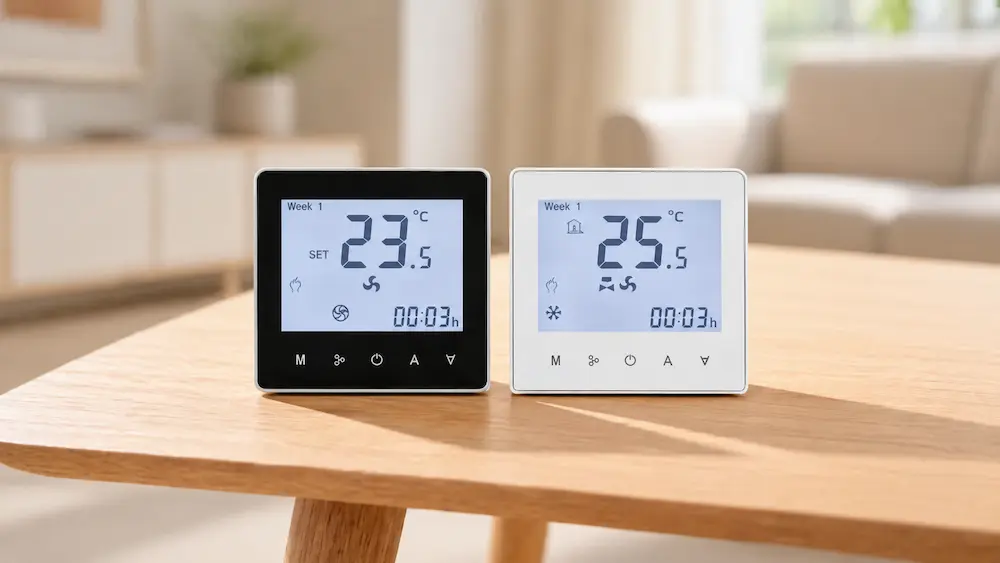
A programmable thermostat controls heating or cooling based on a preset schedule. It does not only hold one fixed temperature. It changes the setpoint according to time and day.
This helps the HVAC system match real use. For example, the thermostat can keep the room comfortable in the morning, reduce operation during empty hours, and return to comfort before people come back.
Basic functions usually include:
- Time-based temperature schedule
- Day and night temperature settings
- Heating or cooling control
- Manual override
- Simple display and button operation
A programmable thermostat is different from a smart thermostat. A smart thermostat may use Wi-Fi, app control, or cloud service. A programmable model can work without internet. This is useful in many projects where simple and stable control is more important than remote control.
For many buyers, this is an advantage. The product is easier to install. It is easier to explain. It also avoids problems caused by unstable networks or app setup.
Know When to Choose a 7 Day Programmable Thermostat
A 7 day programmable thermostat allows a different schedule for each day of the week. This is useful when the building does not use the same routine every day.
For example, a home may have a different weekend pattern. An office may close early on Friday. A shop may open longer on Saturday. A 7 day model gives better control for these cases.
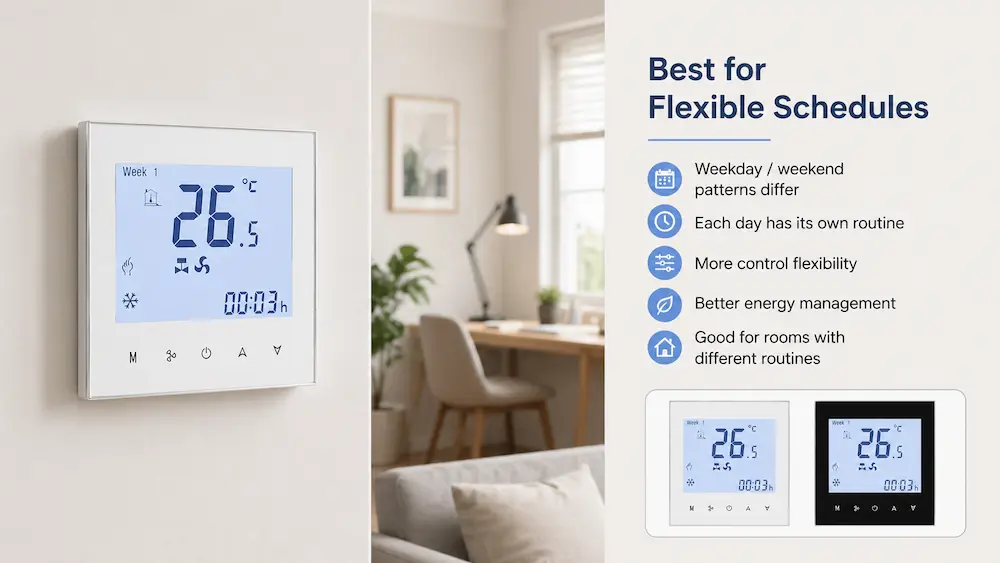
This model is usually more suitable when:
- Weekday and weekend schedules are different.
- Each day has a separate use pattern.
- The user wants more control flexibility.
- The project needs better energy management.
- Different rooms have different daily routines.
A simpler programmable thermostat may work well for fixed schedules. But a 7 day programmable thermostat is often the better choice for mixed-use buildings, modern homes, small offices, and apartments with flexible lifestyles.
For commercial buyers, it also gives stronger product positioning. It is easier to explain as a flexible energy-saving control solution.
Check HVAC System Compatibility First
Compatibility is more important than appearance. A good-looking thermostat is not useful if it does not match the HVAC system.
Before choosing a model, buyers should confirm the system type. A thermostat for boiler heating may not fit a fan coil unit. A fan coil thermostat may not fit a simple heating-only system. A programmable thermostat must match the control logic.
Key items to confirm include:
- Heating only, cooling only, or heating and cooling
- Fan coil unit, boiler, heat pump, or electric heating
- On/off control or modulating control
- Relay output type
- Sensor type and control range
For residential heating, the control may be simple. For commercial HVAC systems, the control may include fan, valve, or multi-stage logic. The buyer should not assume that one programmable thermostat fits every application.
A professional thermostat supplier should provide application guidance. This helps avoid wrong selection before ordering samples or bulk quantity.
Confirm Voltage and Wiring Before Ordering
Voltage mismatch is a common cause of failure. It can damage the thermostat or make the system unstable.
Some projects use 24V control. Some use 110V or 230V. Some markets use different terminal names. The buyer must confirm the wiring before order confirmation.
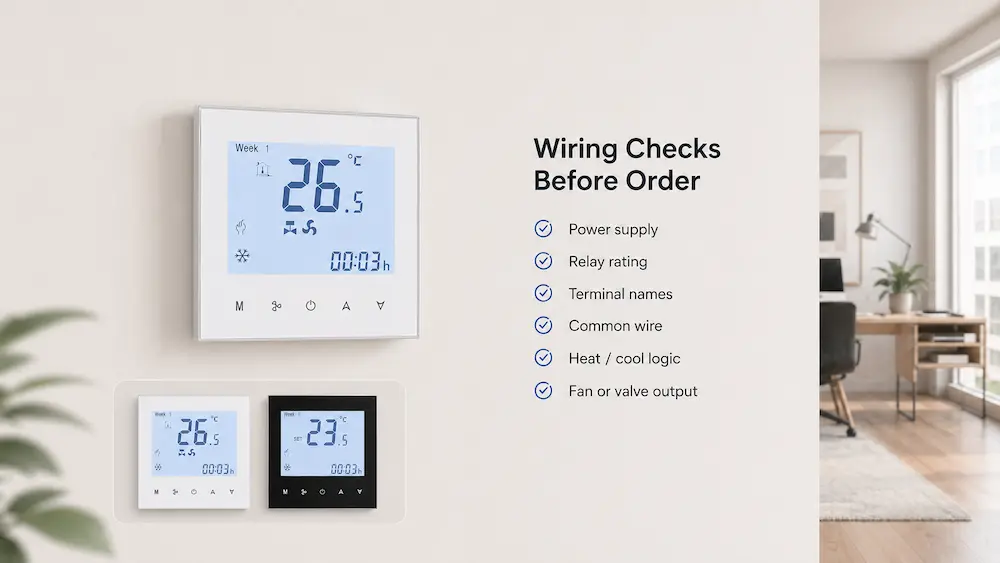
Important wiring checks include:
- Power supply voltage
- Relay output rating
- Terminal definition
- Common wire requirement
- Heating and cooling output logic
- Fan or valve control terminals
For residential projects, installers may expect simple wiring. For commercial projects, wiring needs more consistency across many rooms. A small wiring mistake repeated across 100 rooms can become a large service problem.
Buyers should ask the manufacturer for a clear wiring diagram. The diagram should match the actual project system. It should not be only a general manual page.
Compare Residential and Commercial Selection Priorities
Residential and commercial buyers often ask different questions. A home user may ask, “Is it easy to use?” A commercial buyer may ask, “Can it work reliably across many rooms?”
| Selection Point | Residential Project | Commercial Project |
|---|---|---|
| Main priority | Comfort and easy operation | Stable control and lower maintenance |
| Schedule need | Morning, evening, weekend | Working hours and shutdown periods |
| User type | Homeowner or tenant | Staff, guest, or facility team |
| Best option | Simple programmable room thermostat | 7 day programmable thermostat with stable relay |
| Main risk | User confusion | Repeated service complaints |
This comparison shows why the same thermostat may not be ideal for every project. A residential model should be easy to understand. A commercial model should be durable, clear, and suitable for repeated use.
Look at User Experience, Not Only Functions
A programmable thermostat may have many functions. But if users cannot set it easily, complaints will increase.
Simple operation is very important. This is especially true in apartments, rental homes, hotels, and small offices. Users may not read a long manual. They expect the thermostat to be clear.
Good user experience includes:
- Clear display
- Simple schedule setting
- Easy manual override
- Readable icons
- Logical button layout
- Stable screen response
A complicated product can create a new problem. Users may set the wrong schedule. They may turn off the program by mistake. They may complain that the system is not working, even when the thermostat is working correctly.
For commercial projects, simple use also reduces training time. The facility team can explain the product faster. This lowers service pressure after installation.
Evaluate Energy Saving Potential
Energy saving is one of the main reasons to choose a programmable thermostat. But energy saving does not come from the product name alone. It comes from correct schedule settings and proper installation.
A good schedule reduces heating or cooling when the room is empty. It also avoids keeping the room at full comfort level all day.
Useful energy-saving settings may include:
- Lower heating demand during empty hours
- Higher cooling setpoint during empty hours
- Earlier start before occupancy
- Night setback for sleeping hours
- Weekend schedule for low-use periods
For residential projects, energy saving should not make comfort worse. A very large setback may save energy during empty hours, but it may take too long to recover. For commercial projects, the schedule should match real working hours. Otherwise, users may override the thermostat and cancel the benefit.
A 7 day programmable thermostat is useful because it gives better schedule control. It helps the user avoid one fixed setting for the whole week.
Scientific Data
The data below gives practical reference values for choosing and applying a programmable thermostat. These values are common engineering reference ranges. Actual results depend on building insulation, HVAC capacity, sensor position, wiring, and user settings.
| Data Item | Typical Reference Range | Buyer Meaning |
|---|---|---|
| Room temperature control accuracy | ±0.5°C to ±1.0°C | Better accuracy improves comfort stability. |
| Acceptable comfort deviation | About ±1.0°C to ±2.0°C | Larger deviation may cause user complaints. |
| Poor sensor location error | 2°C to 3°C possible | Wrong placement can affect control results. |
| Practical setback range | 2°C to 4°C | Useful for energy saving without slow recovery. |
| Typical quiet room fan noise | 30 dB to 45 dB | Lower noise is better for homes and hotels. |
| Relay mechanical life reference | 100,000 to 1,000,000 cycles | Higher cycle life supports long-term reliability. |
| Schedule periods per day | 4 to 6 periods common | More periods allow better daily control. |
These data points help buyers make better choices. Control accuracy affects comfort directly. A room that drifts by 3°C may feel clearly wrong. A thermostat with better sensing and correct placement gives a more stable result.
The setback range also matters. A 2°C to 4°C setback is often practical. It can reduce energy use during empty hours while keeping recovery time reasonable. A larger setback may not always be better. It may make the room uncomfortable when users return.
Relay life is important for long-term projects. A thermostat may switch many times each day. Higher relay life helps reduce service risk, especially in commercial buildings with many installed units.
Fan noise also matters when the thermostat is used with fan coil systems. Lower fan speed can improve comfort in bedrooms, hotel rooms, and quiet offices. A programmable schedule can reduce unnecessary fan operation during low-use periods.
Common Mistakes Buyers Should Avoid
Many thermostat complaints can be avoided before purchase. The most common mistakes are simple, but they are costly when repeated across a project.
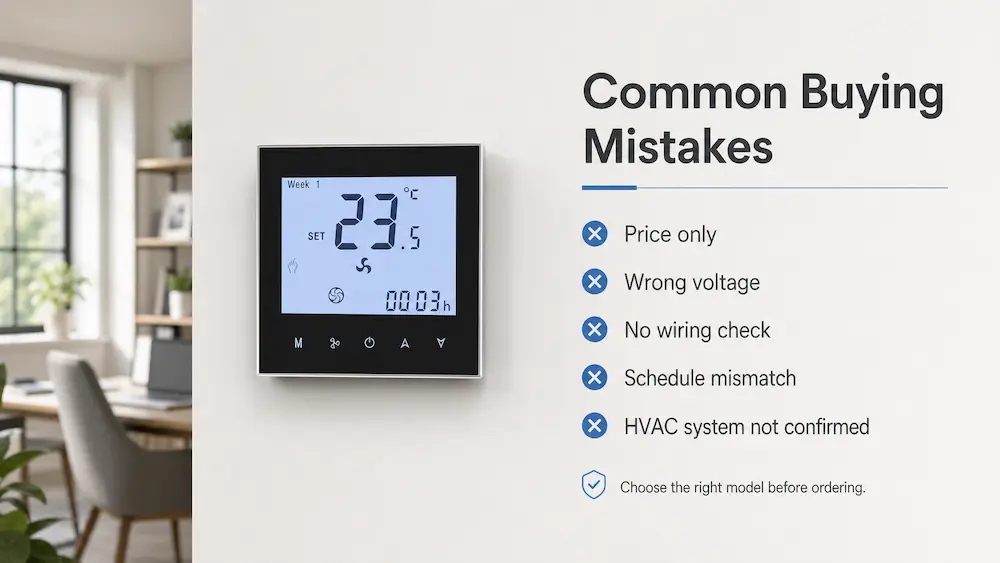
- Choosing by price only
- Ignoring voltage compatibility
- Not checking wiring diagrams
- Choosing a fixed schedule for a flexible building
- Using a complex model for simple users
- Ignoring relay capacity and output type
- Not confirming the HVAC system before purchase
For residential projects, the biggest risk is user confusion. For commercial projects, the biggest risk is large-scale repetition. One wrong choice may affect many rooms.
To reduce risk, buyers should confirm the system, schedule, wiring, voltage, and user group first. Then they can compare appearance, price, and custom options.
Practical Cases
Case 1: A residential apartment project needed simple schedule control. The buyer first considered a basic manual thermostat. After reviewing user habits, they selected a programmable thermostat. Tenants could set morning and evening comfort periods. The project had fewer comfort complaints.
Case 2: A small office used the same comfort setting all day and night. Energy cost was higher than expected. A 7 day programmable thermostat was installed. The schedule reduced operation after office hours and kept comfort during working time.
Case 3: A light commercial project had different working hours on weekdays and weekends. A simple weekday/weekend model was not flexible enough. A 7 day programmable thermostat gave separate schedules for each day. The system matched the real business routine better.
These cases show that the right thermostat is not always the most advanced model. It is the model that fits the real project pattern.
Expert Insights
Programmable thermostats remain useful because they are simple and stable. Many buyers do not need app control or cloud control. They need a thermostat that follows a schedule and works every day.
In residential markets, ease of use is the main value. In commercial markets, consistency and maintenance control are more important. A 7 day programmable thermostat can serve both needs when the interface is clear and the wiring is correct.
For manufacturers and suppliers, the best product positioning is not only “programmable.” It should explain the project value. The product should help buyers reduce energy waste, lower complaints, and simplify daily control.
For OEM or wholesale buyers, documentation is also important. A good thermostat should come with clear wiring diagrams, user instructions, and application guidance. This helps the buyer sell and install the product with less risk.
Final Selection Checklist
Before choosing a programmable thermostat, buyers can use this checklist.
| Check Point | Why It Matters | Recommended Action |
|---|---|---|
| Project type | Residential and commercial needs differ. | Define use scenario first. |
| Schedule pattern | Different routines need different programming. | Choose 7 day model for flexible schedules. |
| HVAC compatibility | Wrong control type causes failure. | Confirm system before order. |
| Voltage and wiring | Mismatch may damage products. | Check wiring diagram with supplier. |
| User interface | Complex setup causes complaints. | Choose clear display and simple buttons. |
| Reliability | Long-term use needs stable parts. | Check relay rating and quality. |
This checklist is useful for distributors, contractors, and project buyers. It helps compare models based on real project value, not only price.
Related products reference:
Modbus Thermostat for BMS Systems
FAQ
1. What is a programmable thermostat?
A programmable thermostat is a thermostat that follows preset temperature schedules to control heating or cooling automatically.
2. Is a 7 day programmable thermostat better?
It is better when each day has a different routine or when the project needs more flexible schedule control.
3. Can a programmable thermostat save energy?
Yes, it can reduce unnecessary heating or cooling when the room is empty or during low-use periods.
4. Can I use the same programmable thermostat for home and office projects?
Sometimes yes, but buyers must confirm system type, voltage, wiring, schedule needs, and user operation habits.
5. What should I check before buying a programmable thermostat?
Check HVAC compatibility, voltage, wiring terminals, schedule type, relay rating, display, and supplier support.
The right programmable thermostat should match the project before it matches the price. Residential buyers should focus on comfort and easy use. Commercial buyers should focus on schedule flexibility, wiring consistency, and long-term reliability. A 7 day programmable thermostat is usually the safer choice when weekly routines are different.
References / Sources
- U.S. Department of Energy, Energy Saver — Programmable Thermostats
- U.S. Department of Energy, Energy Saver — Thermostat Operation and Setback Guidance
- ENERGY STAR — Smart Thermostats Product Criteria and Energy Saving Guidance
- ASHRAE — ASHRAE Handbook: Fundamentals, Thermal Comfort and Heat Balance
- ASHRAE — Guideline 36, High-Performance Sequences of Operation for HVAC Systems
- ASHRAE — Fundamentals of HVAC Control Systems
- Honeywell Home — 7-Day Programmable Thermostat User Guide
- Honeywell Home — Programmable Thermostat Installation Instructions
- Carrier — Programmable Thermostat Owner’s Manual and HVAC Control Guidance
- Trane — Programmable Thermostat and Building Comfort Control Resources
- Johnson Controls — Building Automation and Room Control Application Materials
- Siemens Building Technologies — Room Thermostat and HVAC Control Literature
- Schneider Electric — Room Control and Building Management System Resources
- Danfoss — Room Thermostat and Heating Control Technical Publications
- National Institute of Standards and Technology (NIST) — Building Energy and Control Performance Research