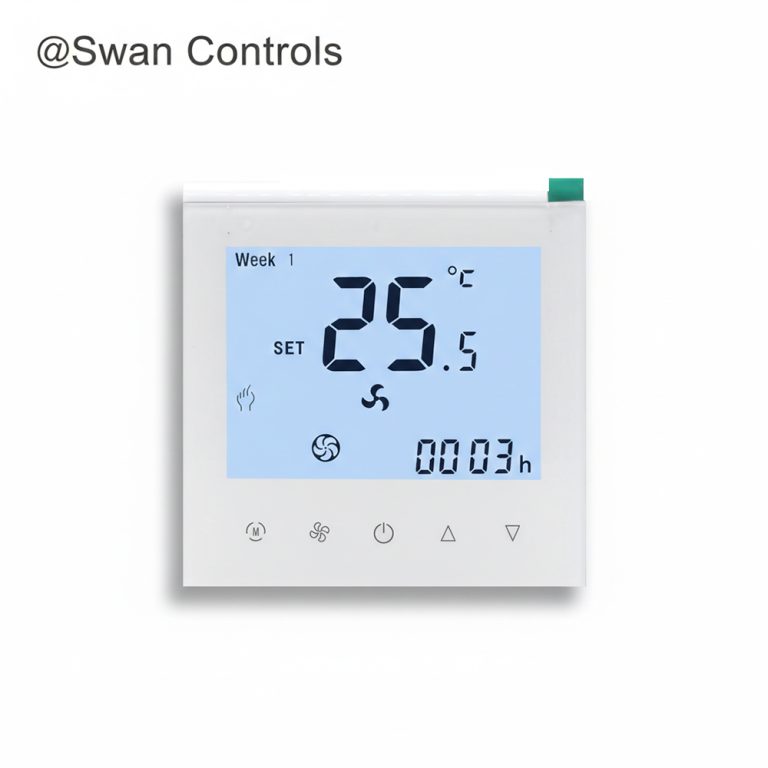
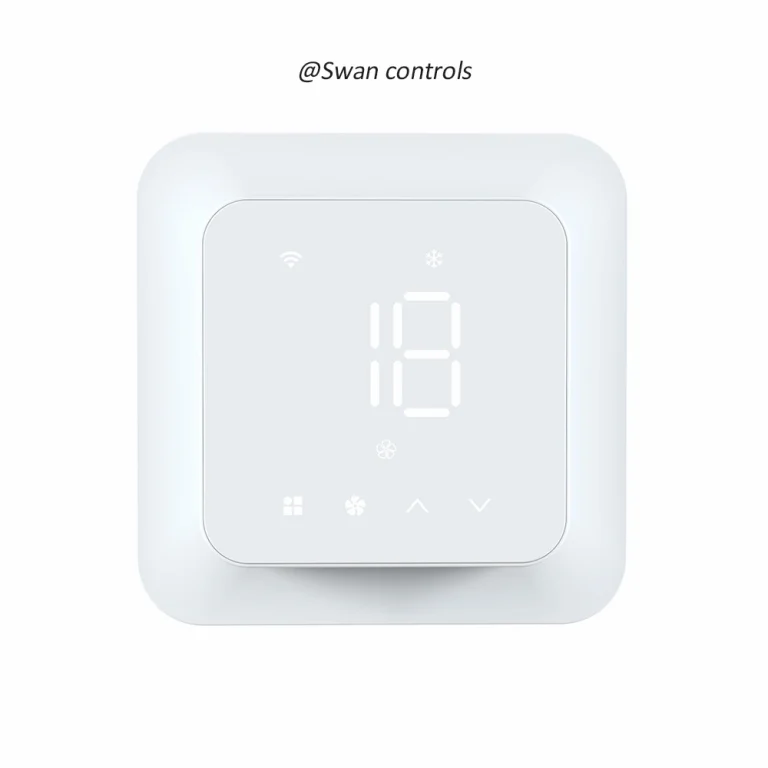
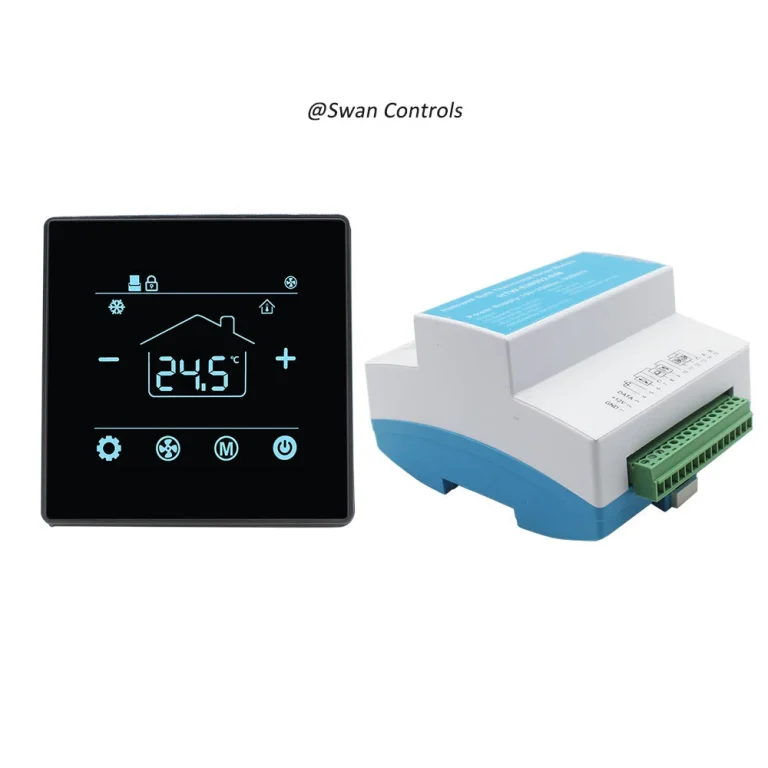
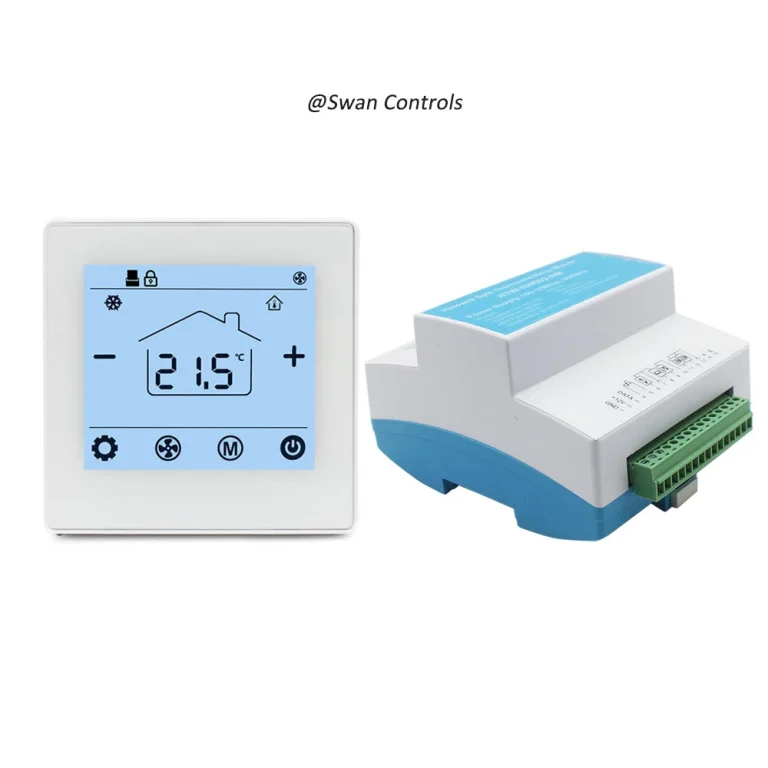
Quick Summary
Importing a BACnet thermostat is not only a price and lead-time decision. The key question is whether the product can be sold, installed, explained and supported in the target market.
The so-called “BACnet thermostat” used in this article is a fan coil thermostat with BACnet communication, as we at Swan Controls (an affiliate of Hotowell) specialise more in FCU and heating thermostats. However, the same logic may be useful when importing other HVAC thermostats.
Why This Import Decision Needs More Than a Datasheet
BACnet is a standard protocol widely used in building automation because it helps control devices from different brands talk to each other. Defined by ASHRAE Standard 135 and ISO 16484-5, it sets the rules for how building systems monitor and control networks. For importers, this means a “BACnet thermostat” is not just a marketing label; it comes with strict project requirements.
In real projects, a BACnet thermostat is usually used as a room controller for fan coil units (FCU) in commercial buildings like hotels, offices, schools, and clinics. Buyers do not choose this product just for its nice screen or modern look. They buy it because it must connect and work smoothly with a central Building Management System (BMS).
However, during import discussions, many buyers still treat it like a simple product, asking only basic questions:
What is the unit price? What is the MOQ? Can we print our logo? How fast can you ship samples?
These basic questions are necessary, but they do not decide if the product will work well in the local market. Because of its technical nature, importing a BACnet thermostat means we must look beyond the price and think about the whole sales and installation chain: the sales team needs to explain the product clearly, the installer needs easy wiring guides, the BMS engineer needs a point list, and the support team needs a simple way to find and fix site problems.
To avoid problems and make sure our import becomes a repeatable business—not just a one-time sample—we must check the technical details before ordering. This means confirming the fan coil system type, voltage, valve and fan types, installation methods, and OEM details. Getting these technical details right is the real foundation, and this successful business begins with confirming the target market and sales channel.
Confirm the Target Market and Sales Channel
Before selecting the final model, the importer should decide who will buy and use the product. A contractor, BMS integrator, HVAC distributor, hotel project owner and OEM customer may all ask different questions.
A BMS integrator will care about the communication type, address setting, baud rate, point list and read/write permissions. An HVAC distributor may care more about photos, feature tables, packaging, model difference and stable supply. A hotel project contractor may focus on room control, simple operation, temperature limits and maintenance. An OEM partner may care about logo, label, manual, box, barcode and model naming.
If the target market is mainly home users, this product may not be the best first choice. Many home buyers search for app control and easy phone operation. In that case, a WiFi room thermostat may be easier to promote. If the target market is project-based and already involves contractors or BMS engineers, then a BMS thermostat has a clearer role.
The import plan should also consider whether the product will be sold under the buyer’s own brand, as a project item, or as a wholesale stock item. Each route needs a different preparation package. A branded product needs strong visual materials. A project item needs technical files. A wholesale item needs clear labels, stable model codes and simple reorder information.
| Sales channel | Main buyer concern | What to prepare before import |
|---|---|---|
| HVAC distributor | Easy explanation and repeat sales | Datasheet, product photos, feature table, model comparison |
| BMS integrator | Communication and commissioning | BACnet point list, wiring diagram, parameter guide |
| Hotel project contractor | Room control and service support | Installation guide, user manual, function explanation |
| Office or apartment project | Stable control and central monitoring | Model sheet, BMS data list, default setting record |
| OEM partner | Brand identity and repeatable orders | Logo, label, manual, box, barcode, model code |
This table helps the importer avoid one common mistake: using one product message for every buyer. A fan coil thermostat can fail commercially if the sales channel is not clear.
Check Whether the Product Is Ready for Local Sales
A sample may work well, but still be difficult to sell. This happens when the importer has no simple sales files, no clear model explanation, no comparison with other models and no local-language support.
For this product, the sales team should be able to answer several basic questions. What fan coil system does it support? Is it for 2-pipe or 4-pipe control? Does it support 3-speed fan or EC fan? Is the valve output on/off or analogue? Does it use BACnet MS/TP? What type of project should choose it? How is it different from a normal fan coil thermostat?
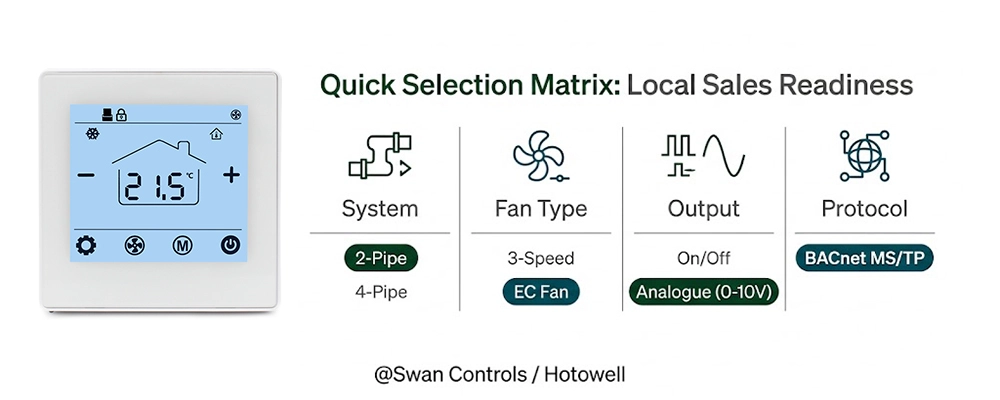
These answers should not be hidden inside a long manual. They should be visible in the datasheet, model table and sales presentation. If the local team cannot explain the room thermostat quickly, contractors may lose confidence.
A good sales package does not need to be large. It should include product photos, a short feature table, wiring summary, model code explanation, suitable project types and simple comparison notes. The more similar the models look from the front, the more important this explanation becomes.
Different thermostat lines may look similar, but the project value is different. If the sales team calls every model “smart control”, the buyer may choose the wrong model.
Make Installation Documents Clear Before Bulk Orders
Sales materials help the product enter the market. Installation documents help the product survive the project site.
A room thermostat may look simple on the wall, but site questions often start from wiring, output, parameter settings and communication. If the installation guide is unclear, the importer will receive repeated messages from installers. This increases support cost and slows down projects.
For a fan coil thermostat with BACnet communication, the document package should explain power supply, fan output, valve output, sensor input, communication wiring and basic parameter settings. It should also explain how to set the device address and how to confirm normal operation after installation.
The BMS side also needs clear information. BACnet International explains BACnet as a global data communication standard for building automation and control networks, with vendor-independent interoperability as a key value. But interoperability still needs practical project information. The integrator needs to know what points are available, which points are read-only, which points can be written, and what settings must match on site.
This is why a point list is not an optional file for project sales. It is part of the product’s market readiness. Without it, the local team may sell the product first and then struggle during commissioning.
Confirm Packaging, Labels and Manual Requirements
Packaging is not only about appearance. For importers, packaging and labels affect storage, installation, sales and repeat orders.
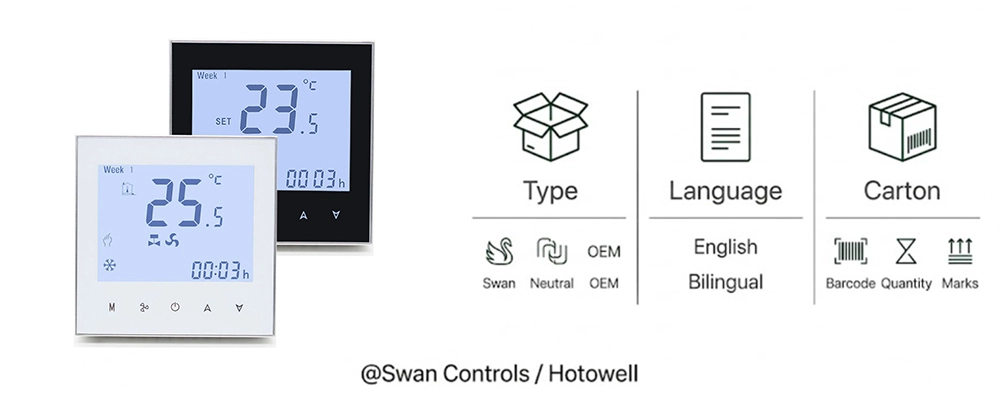
Before importing, the buyer should decide whether the BACnet thermostat will use Swan Controls packing, neutral packing or OEM packing. If OEM branding is needed, the logo position, front panel marking, rating label, box design and manual cover should be confirmed early. These items are easier to adjust before bulk production than after production starts.
The rating label should match the exact model version. Voltage, model code and basic product information must not create confusion. The box label should help the warehouse identify the right room thermostat quickly.
Manual language is also part of market fit. Some markets can accept English manuals. Some markets need bilingual manuals. Some project buyers may need installation notes written in very simple English because the installer is not a native speaker. For export sales, simple wording is often better than technical language that looks impressive but is hard to follow.
Barcodes, packing quantity and carton marks should also be confirmed before bulk order. These small details help the importer build a stable HVAC thermostat system.
Use Model Positioning to Avoid Wrong Import Choices
Importers often ask whether they should choose the highest configuration. The better question is whether the configuration matches the sales channel and project type.
The following table gives a simple model-positioning view. It helps separate standard local control, WiFi control, Modbus communication and BACnet communication instead of treating them as one product group.
| Model | Main configuration | Suggested import positioning |
|---|---|---|
| HTW-WF11-FC-2 | 3-speed fan, 2-pipe on/off valve control, programmable | For simple local FCU projects that do not need app or BMS control. |
| HTW-WF01-FC-2W | 3-speed fan, 2-pipe on/off valve control, WiFi | For projects where app control is useful but BMS integration is not required. |
| HTW-WF11-FC-4ENS1W | 3-speed fan, 2/4-pipe on/off valve control, Modbus, WiFi | For FCU projects needing flexible control with WiFi and Modbus. |
| HTW-FC08-ECNW | EC fan, WiFi, Modbus, keycard, external sensor, 2/4-pipe on/off valve control | For higher function FCU projects with EC fan and extended control needs. |
| HTW-WF11-FC-2EN | RS485 Modbus control with external sensor, without WiFi | For projects needing Modbus communication and external sensor support without app control. |
| HTW-WF11-FC-EB | BACnet 2/4-pipe FCU control with external sensor, without WiFi | For BMS projects needing BACnet connection and FCU control. |
This table helps prevent over-positioning. A BACnet thermostat is useful when the project needs BMS connection. A WiFi model is useful when the user needs app access. A Modbus model may fit another control system. A simple programmable fan coil thermostat may be enough for local FCU control. The best import choice is the model that the local market can understand, install and reorder.
Turn Sample Testing Into a Bulk Order Standard
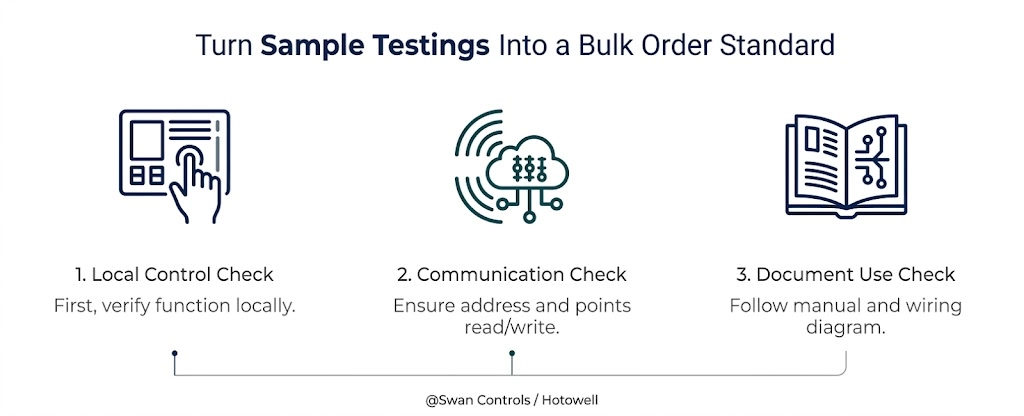
Sample testing should not only check whether the screen works. It should create the standard for the future order.
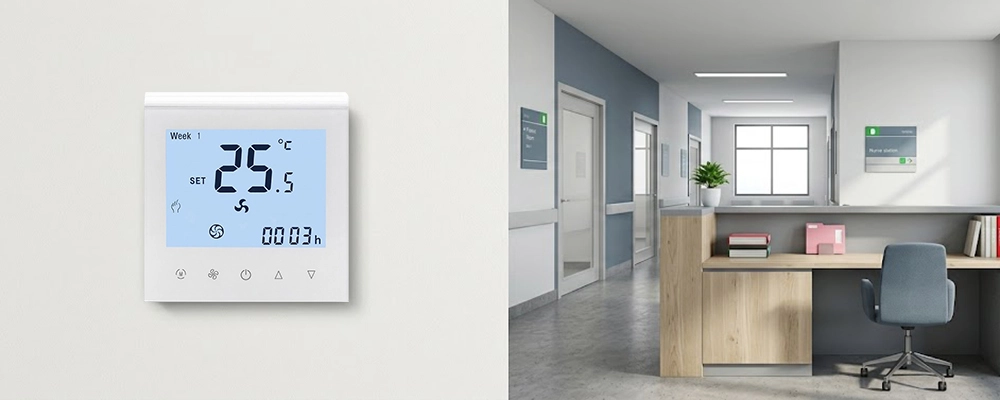
The first test should be local control of the BACnet thermostat. The buyer should check power supply, fan output, valve output, mode change, setpoint setting, sensor reading and parameter adjustment. If local control is not right, communication will not fix the project.
The second test should be communication. The local team should check address setting, point reading, point writing and BMS display where possible. ASHRAE Guideline 13 is written for BAS designers, contractors and building owners who need to specify control and energy management systems. This reminds importers that building control projects depend on clear specification, not only device selection.
The third test should be document use. Ask the local engineer or sales support person to follow the manual and wiring diagram. If the document is not clear during sample testing, it will not become clearer on a busy jobsite.
After sample approval, the importer should record the approved version. This may include default parameters, label design, manual version, point list version, box design, barcode and model code. This record becomes the bulk order standard.
Define After-Sales Boundaries Early
After-sales problems are not always product defects. A project issue may come from wiring, address conflict, baud rate setting, wrong point mapping, incorrect parameter setting, wrong FCU output or installer operation.
The importer should prepare a simple support process before the bulk order. If the BMS cannot read the BACnet thermostat, first check power, RS485 wiring, address, baud rate and point list. If the fan does not run, first check fan type, output terminal and parameter setting. If the room temperature looks wrong, check sensor position, calibration and installation environment.
This process does not remove the manufacturer’s responsibility. It helps the importer filter common site questions before sending everything back to the supplier. For Swan Controls, support works best when the buyer shares the system type, wiring condition, communication request and document version.
Common Import Mistakes to Avoid
The first mistake is buying the most complex BACnet thermostat without a clear market reason. This may increase cost and make the product harder to explain.
The second mistake is mixing WiFi, Modbus and BACnet as if they mean the same thing. They do not. WiFi is mainly for app access. Modbus and BACnet are mainly for system communication. A local sales team should understand this difference before promoting the product.
The third mistake is leaving OEM materials too late. Logo, box, label, manual, barcode and model code should be discussed while samples are being tested.
The fourth mistake is ignoring the manual. A good manual reduces training time and support pressure. The fifth mistake is selling the BACnet thermostat without a clear project boundary. This article mainly discusses fan coil systems, not every HVAC system.
What We Recommend Before Importing
Before importing, we suggest preparing a short project and market file. It can be simple. It should include the target market, sales channel, expected buyer type, FCU system, voltage, communication request, packing preference, manual language, OEM scope and estimated quantity.
With this information, we can help check whether the chosen model fits the import plan. Sometimes the answer is a BACnet model. Sometimes a Modbus model, WiFi model or simple programmable controller is more suitable.
For OEM and wholesale partners, this early check helps align product name, documents, label, box, default settings and sample test results before production. The goal is to make the BACnet thermostat or BMS thermostat easier to sell, install and reorder.
Frequently Asked Questions
What should buyers confirm before importing a BACnet thermostat?
They should confirm the target market, sales channel, FCU system, voltage, communication needs, point list, documents, packaging, label content, OEM scope and sample test plan. This helps make the product ready for sales and project delivery.
Is this type of product suitable for all HVAC systems?
No. This article mainly uses fan coil systems as the example. A product designed for FCU control should not be used for boilers, underfloor heating, heat pumps or other systems unless the control logic is confirmed.
Do importers need a BACnet point list before bulk orders?
Yes. The point list helps the BMS integrator understand what data can be read or written. It also helps the importer avoid wrong promises during sales and commissioning.
Can a BACnet model replace a WiFi model?
Not directly. BACnet is mainly for BMS communication. WiFi is mainly for app access. The right choice depends on whether the project needs central building management or user-side remote control.
What OEM items should be confirmed before production?
Common OEM items include logo, front panel marking, rating label, box, manual, barcode, model code, datasheet, product photos and default parameters. Special firmware or new control logic should be treated as deeper customisation.
Why is sample testing important before bulk import?
Sample testing helps confirm local control, communication, documents and installation details. It also helps the buyer lock the approved manual, label, point list, default settings and packing method for repeat orders.
How can Swan Controls support importers?
Swan Controls can support model selection, product documents, OEM preparation, wiring information and project discussion. Clear project information from the buyer helps us recommend the right platform and reduce avoidable order mistakes.
Final Note / Practical Takeaway
Importing a BACnet thermostat should be treated as market preparation, not only product purchasing. The right product should be easy to explain, install, support and reorder. Before bulk orders, buyers should confirm the sales channel, documents, OEM scope, sample standard and after-sales boundary.
References / Sources
BACnet: A Data Communication Protocol for Building Automation and Control Networks | Standing Standard Project Committee 135 | ASHRAE | ANSI/ASHRAE Standard 135
Building Automation and Control Systems — Part 5: Data Communication Protocol | ISO/TC 205 | International Organization for Standardization | ISO 16484-5
About the BACnet Standard | BACnet Committee | BACnet.org | BACnet Standard Information
BACnet Overview and Interoperability Information | BACnet International | BACnet International | Building Automation and Control Network Resources
Specifying Building Automation Systems | ASHRAE Guideline Project Committee 13 | ASHRAE | ASHRAE Guideline 13
ASHRAE Handbook—HVAC Applications | ASHRAE Technical Committees | ASHRAE | ASHRAE Handbook Series