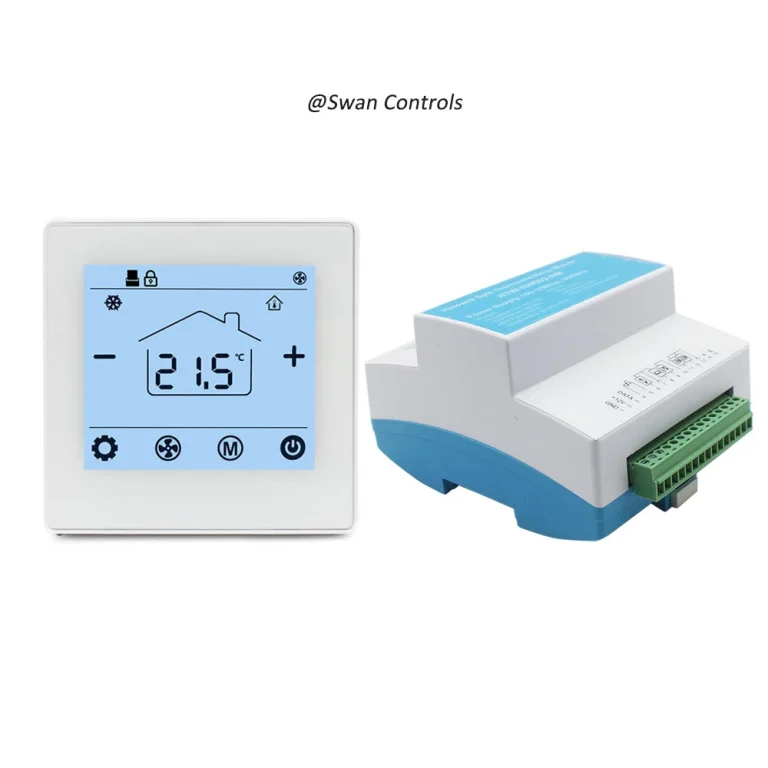
“We need a Modbus thermostat for this building. Can we use the same model everywhere?”
“Not always. A hotel room, an office area, and an apartment may all use fan coil control, but the operating logic, control priorities, and management needs are often different.”
That is the real question behind many HVAC thermostat projects. Buyers often start with a product list and look for one Modbus thermostat that seems flexible enough for every application. On paper, that sounds efficient. In practice, it often leads to a mismatch. The thermostat may work, but the project may still feel less suitable than expected because the use case was not defined clearly enough at the start. A hotel usually cares more about occupancy-related control, central supervision, and simplified guest operation. An office often values consistency, visibility, and easier management across multiple spaces. An apartment may focus more on local comfort and straightforward room control. These differences change what the thermostat really needs to do.
This is why the same Modbus thermostat is not always the best answer for every building type. A Modbus thermostat is not only a wall device. It is part of a wider control structure. Modbus itself is an application-layer communication protocol for client/server messaging, and in serial HVAC applications it is very often carried over RS485. That means the value of a Modbus thermostat is not only in local adjustment. It is in how the thermostat fits into a wider control, management, and maintenance logic. When the project type changes, the practical value of certain thermostat features also changes. That is what this article will explain. It will show what stays the same, what changes, and how to make better project decisions for hotels, offices, and apartments.
Quick Summary: What Usually Changes Between Hotels, Offices and Apartments
Four things usually change most. First, the control priority changes: hotels often prioritise guest simplicity and room supervision, offices prioritise central consistency, and apartments prioritise direct comfort. Second, the useful level of Modbus communication changes: some projects need deep integration, others mostly need stable room thermostat control with communication available. Third, the FCU output type may matter differently depending on whether the project is 2-pipe, 4-pipe, or more advanced modulating control. Fourth, the commercial value of extra features changes: a feature that is very useful in an office BMS project may be unnecessary in a simple apartment application.
What a Modbus Thermostat Really Adds to an FCU Project
Before comparing use cases, it helps to define what a Modbus thermostat really adds. A normal room thermostat controls the room locally. A Modbus thermostat can still do that, but it also adds communication capability. The Modbus protocol defines a standardised way for devices to exchange data and commands. In HVAC projects, that often means the thermostat can be read, managed, commissioned, or supervised through a wider system rather than only by pressing buttons on the wall unit.
In FCU projects, that communication value matters most when the thermostat is not acting as an isolated room device. It matters when the thermostat must fit into a broader building logic. That is why Modbus thermostat demand is especially natural in multi-room commercial projects, BMS-managed sites, and projects where maintenance teams need clearer visibility over room-level HVAC status.
But this does not mean every Modbus thermostat project has the same requirements. The use case still decides which features are actually valuable. A thermostat that is very suitable for a hotel may be less appropriate for an apartment. A thermostat that is ideal for an office may include functions that are unnecessary in a small standalone residential project. So the best way to evaluate a Modbus thermostat is not only by asking whether it communicates. It is by asking how that communication will actually be used in the building.
Why Use Case Matters More Than Product Category
Many buyers start by asking for a Modbus thermostat as if that category alone defines the solution. It does not. The term tells you something important about communication, but not enough about the real project logic. Two projects may both ask for a Modbus thermostat and still need quite different things. One may only need room temperature visibility across many office zones. Another may need guest-room control plus occupancy-related energy management. Another may simply want a room thermostat with future-ready communication in an apartment development.
That is why the most useful project question is not “Which Modbus thermostat is best?” The better question is “What changes in this use case?” Once that question is asked properly, the thermostat shortlist often becomes much more reasonable.
| Use Case | Main Priority | What Modbus Usually Adds |
|---|---|---|
| Hotel | Guest simplicity and room supervision | Central visibility, easier room management, project coordination |
| Office | Consistency and BMS alignment | Zone-level visibility, maintenance clarity, structured integration |
| Apartment | Local comfort and daily usability | Future integration option or structured room control where needed |
Modbus Thermostat in Hotels: What Usually Matters Most
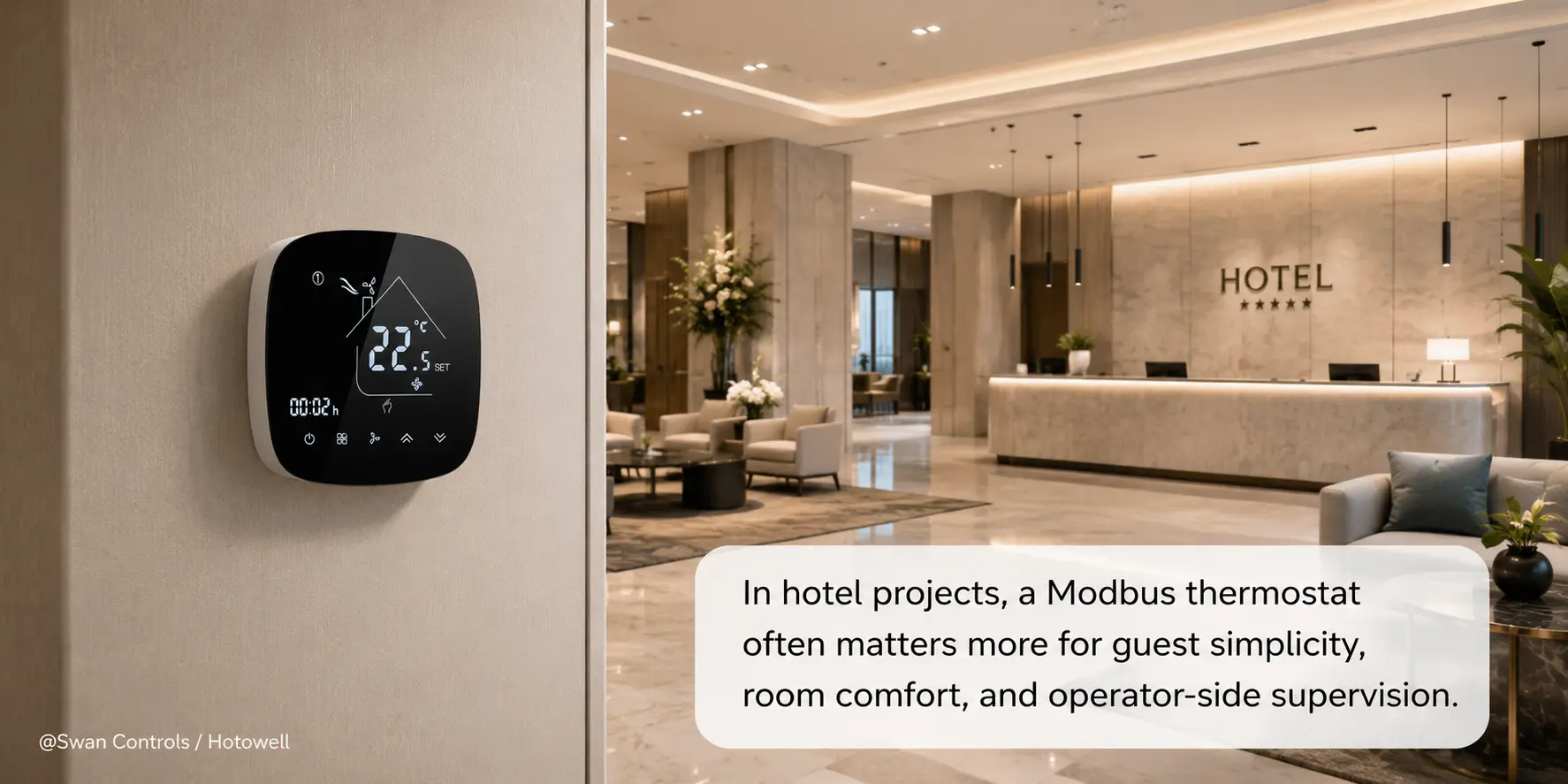
Hotel projects often give the thermostat a very specific role. The room must be easy for guests to use, but the building operator also wants more than local control. The thermostat must fit guest expectations, support stable room comfort, and still contribute to broader room-management logic. This is where a Modbus thermostat often becomes useful, not because guests care about Modbus itself, but because the building operator cares about room-level visibility and more structured control.
In hotel FCU projects, thermostat value is often shaped by three practical concerns. The first is guest simplicity. The interface should not feel overcomplicated. The second is supervision. The operator may want clearer visibility across rooms. The third is energy-related room management. Some hotel projects also combine thermostat control with keycard logic, occupancy-related savings, or stronger room-level management structures. In those cases, communication becomes more valuable because the thermostat is part of the room-management design, not just a comfort dial.
This is why a Modbus thermostat in a hotel often needs to be judged not only by room temperature control, but also by how it supports the operator’s workflow after handover. A thermostat that works perfectly as a local room thermostat may still be the wrong hotel choice if it provides weak visibility for a broader room-control strategy.
Modbus Thermostat in Offices: What Usually Changes
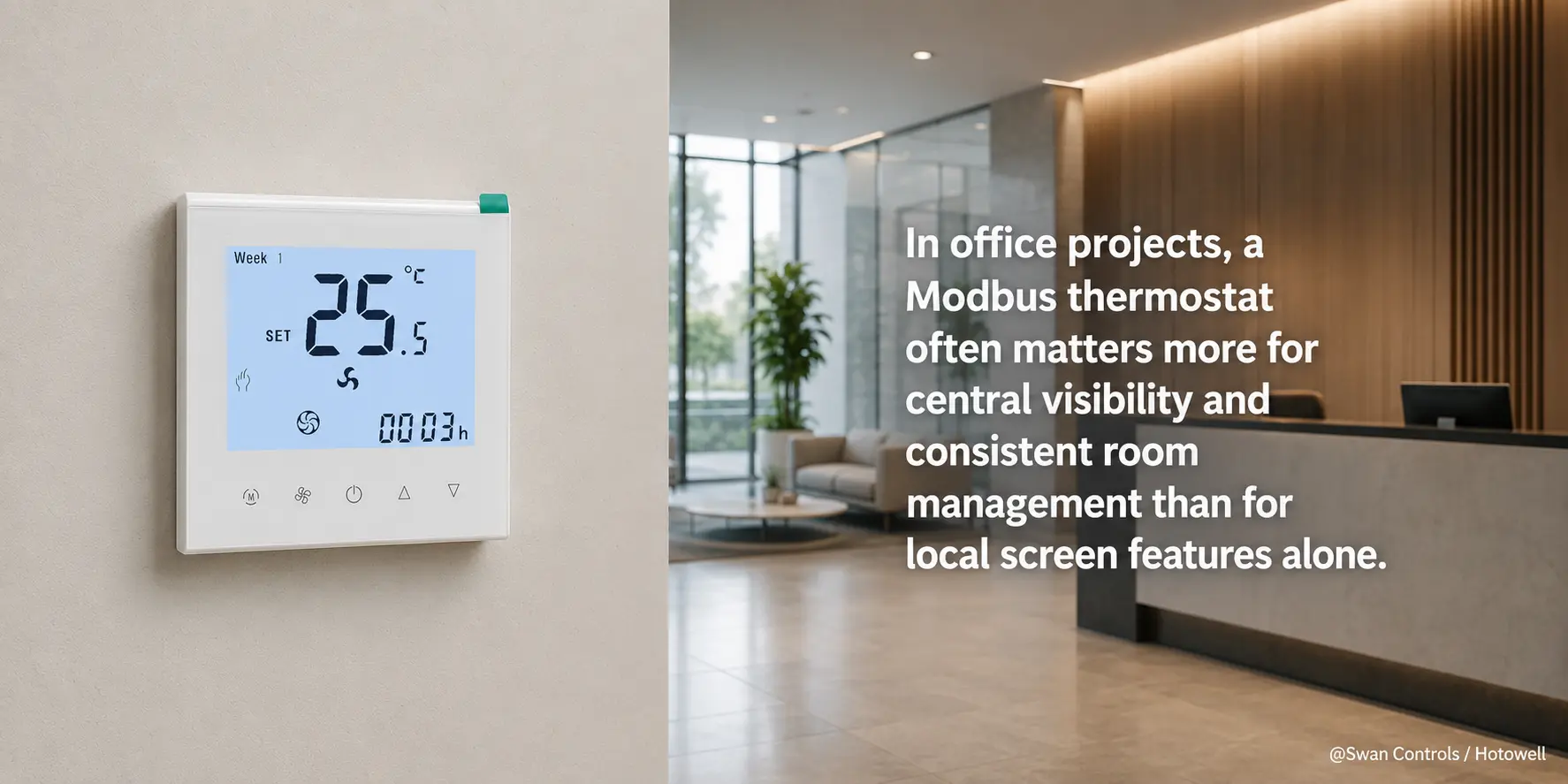
Office projects usually shift the priority from guest interaction to management consistency. The thermostat still needs to control comfort, but the building team often cares more about repeatability, visibility, and easier supervision across many zones or rooms. This is where Modbus often feels more obviously justified.
In an office building, a thermostat is less often judged by the emotional quality of user interaction and more often judged by how well it fits the wider system. If the facility team needs clear room-level status, easier commissioning, or more structured long-term access, communication becomes a practical benefit. A Modbus thermostat can help create a more manageable control environment because it is easier to include in a standardised room-control framework.
This does not mean every office needs the most advanced thermostat. It means the value of communication and central visibility is often stronger than in simpler residential scenarios. In office applications, a thermostat that communicates well may create more operational value than a thermostat with a more attractive local interface but weaker integration logic.
Modbus Thermostat in Apartments: What Usually Matters More
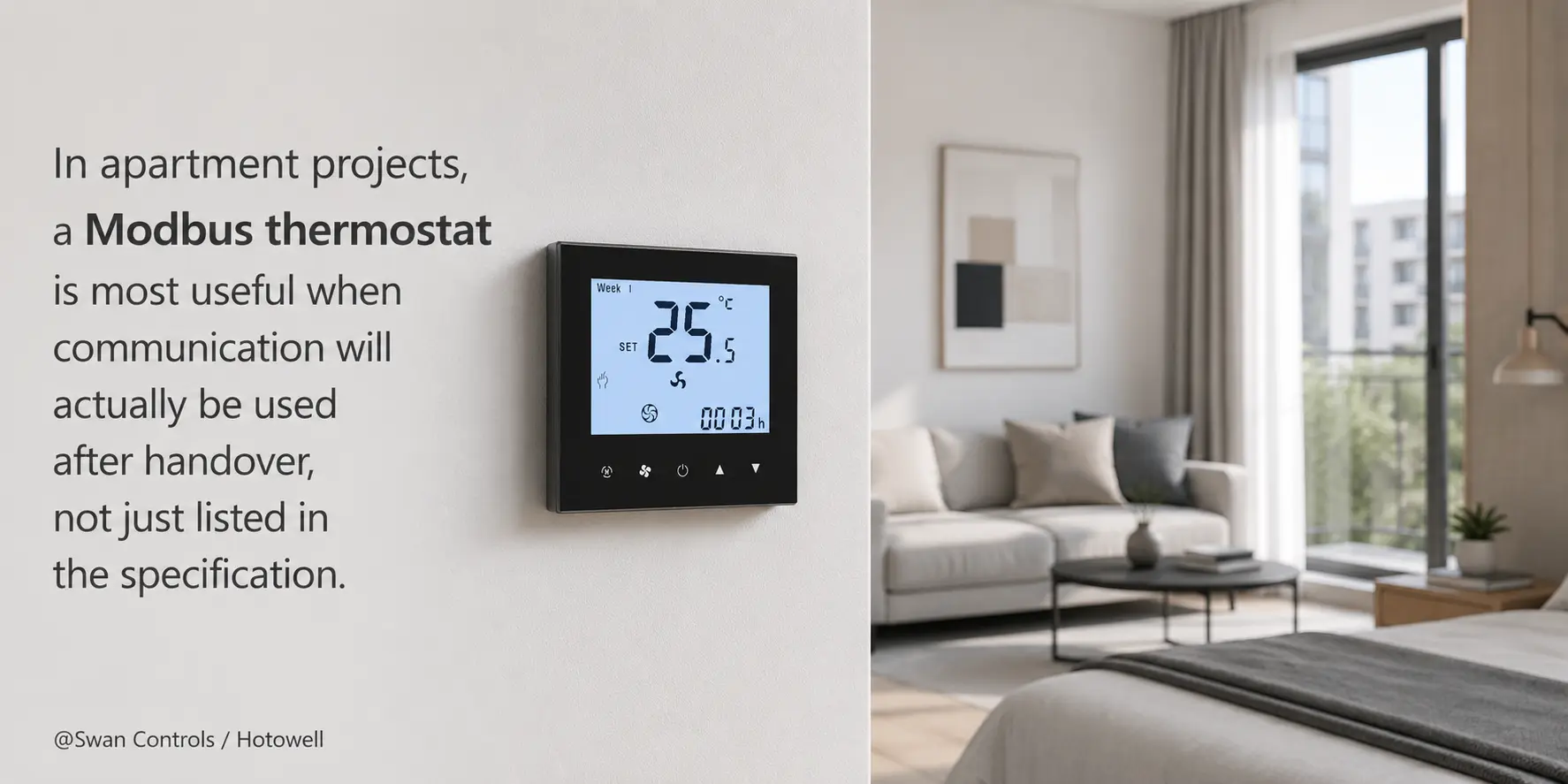
Apartment projects often look simpler on paper, but they still require careful judgment. In many apartments, the strongest priority is practical room comfort and straightforward use. If the thermostat is mainly there to let residents manage temperature locally, the value of a Modbus thermostat may be lower unless the development also has a broader central-management plan.
That does not mean Modbus is never useful in apartment projects. It can still make sense where developers want structured room-control capability, future-ready communication, or more standardised control architecture across multiple units. But compared with hotels or offices, the communication value may be less obvious to the end user. The resident usually experiences the thermostat as a room thermostat first, not as a communication device.
This means apartment buyers should be especially careful not to assume that a more connected thermostat is always a better one. If the project does not really use the communication layer, the buyer may end up paying for Modbus without gaining enough practical advantage after handover.
How FCU Type Changes the Use Case Decision
Use case is not the only factor. FCU type also changes the thermostat decision. This is where many buyers make a second mistake: they separate “building type” from “control type” too much. In reality, they should be considered together.
A 2-pipe hotel FCU project is not the same as a 4-pipe office FCU project. A 0–10V modulating office application is not the same as a standard apartment fan coil control. The thermostat must therefore match both the building use case and the FCU output logic. If either one is mismatched, the thermostat may still function, but the project value drops.
This is why 2-pipe, 4-pipe, and modulating logic should be considered part of the use case analysis, not only part of the datasheet review.
| FCU Type | What Changes | Where It Matters Most |
|---|---|---|
| 2-pipe | Simpler cooling/heating structure | Hotels, apartments, basic commercial control |
| 4-pipe | Separate heating and cooling logic | Offices, managed buildings, higher-spec FCU systems |
| 0–10V / modulating / PICV | Advanced output or valve control logic | Higher-control projects where modulation is actually used |
Where the Product Choice Changes Across Use Cases
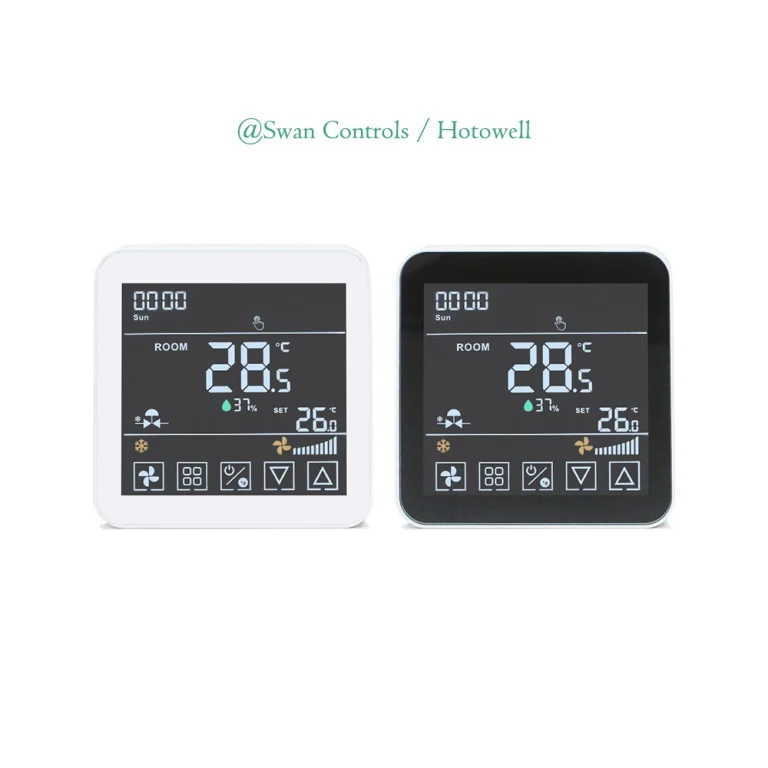
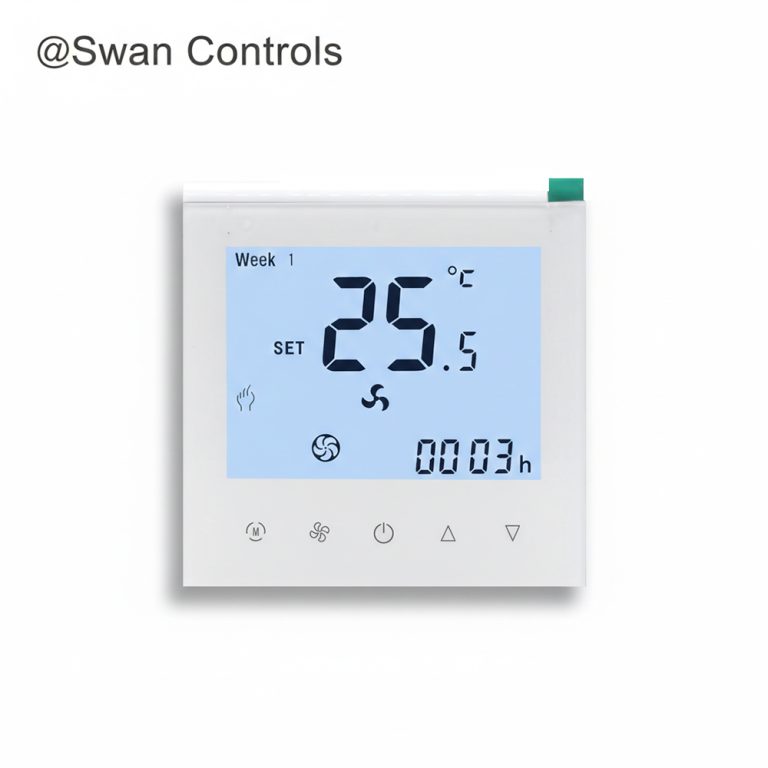
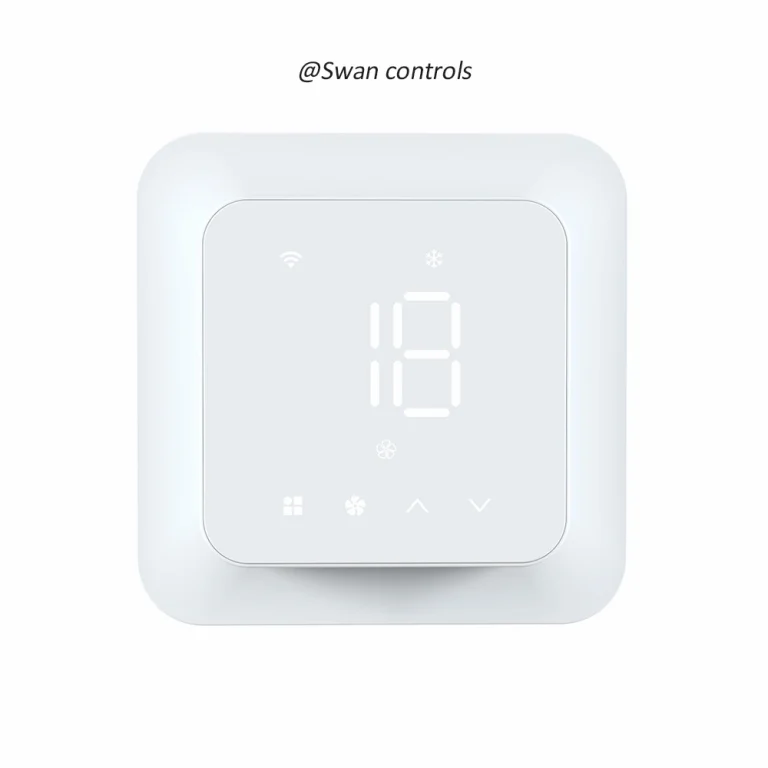
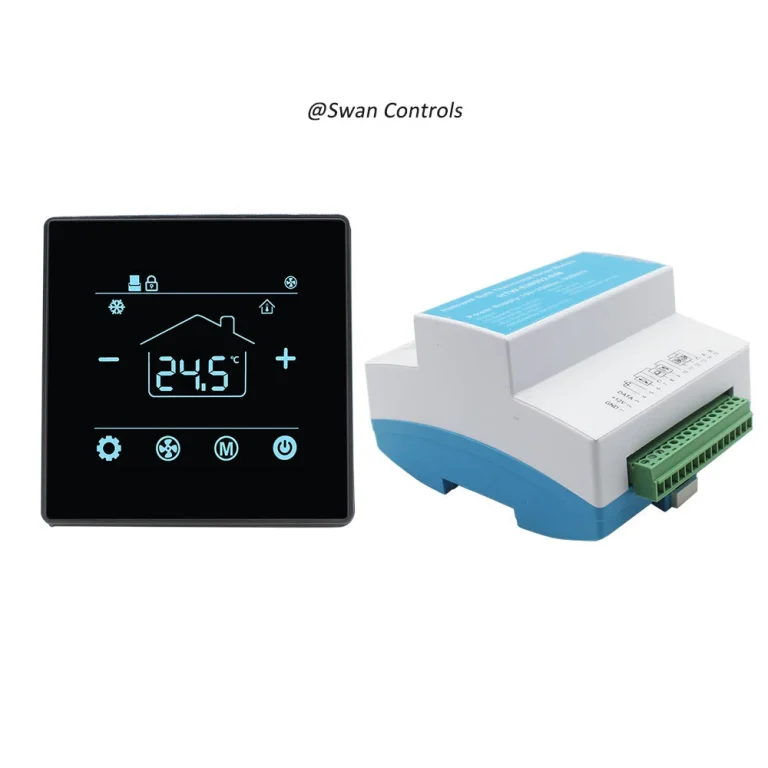
Your product range shows this difference clearly. In a simpler 2-pipe hotel or apartment style room-control project, a model such as the indoor Modbus thermostat for 2-pipe fan coil unit system or the RS485 Modbus thermostat for 2-pipe system room temperature control may be the more natural fit. When the system is genuinely 4-pipe and part of a stronger management environment, a model such as the popular Modbus thermostat for 4-pipe fan coil unit systems or the durable indoor BMS smart Modbus thermostat for 4-pipe FCU system becomes easier to justify.
If the project uses modulating logic, then the FCU 3 fan speed 0–10V modulating thermostat with Modbus may become the more relevant choice. If the project also involves more specialised control structure such as PICV-related logic, the 24VDC output PICV thermostat with Modbus keycard energy saving becomes a more useful reference.
These examples show that “hotel, office, or apartment” is not the only question. The product must also match the control logic inside that use case.
When Communication Is Truly Useful and When It Is Mostly Theoretical
This is one of the most practical questions for buyers. A Modbus thermostat adds communication value, but not every project uses that value equally after handover. In some buildings, room-level visibility and central coordination become part of daily operation. In others, the thermostat is commissioned once and then mostly left alone.
Hotels and offices often create more obvious long-term value from Modbus because the thermostat continues to exist inside a managed operational structure. Apartments may still justify it in some developments, but the benefit may be less visible if the communication layer is never used beyond installation.
This means buyers should not only ask, “Can this thermostat communicate?” They should also ask, “Who will actually use that communication after project delivery?” That question often changes the buying decision more than expected.
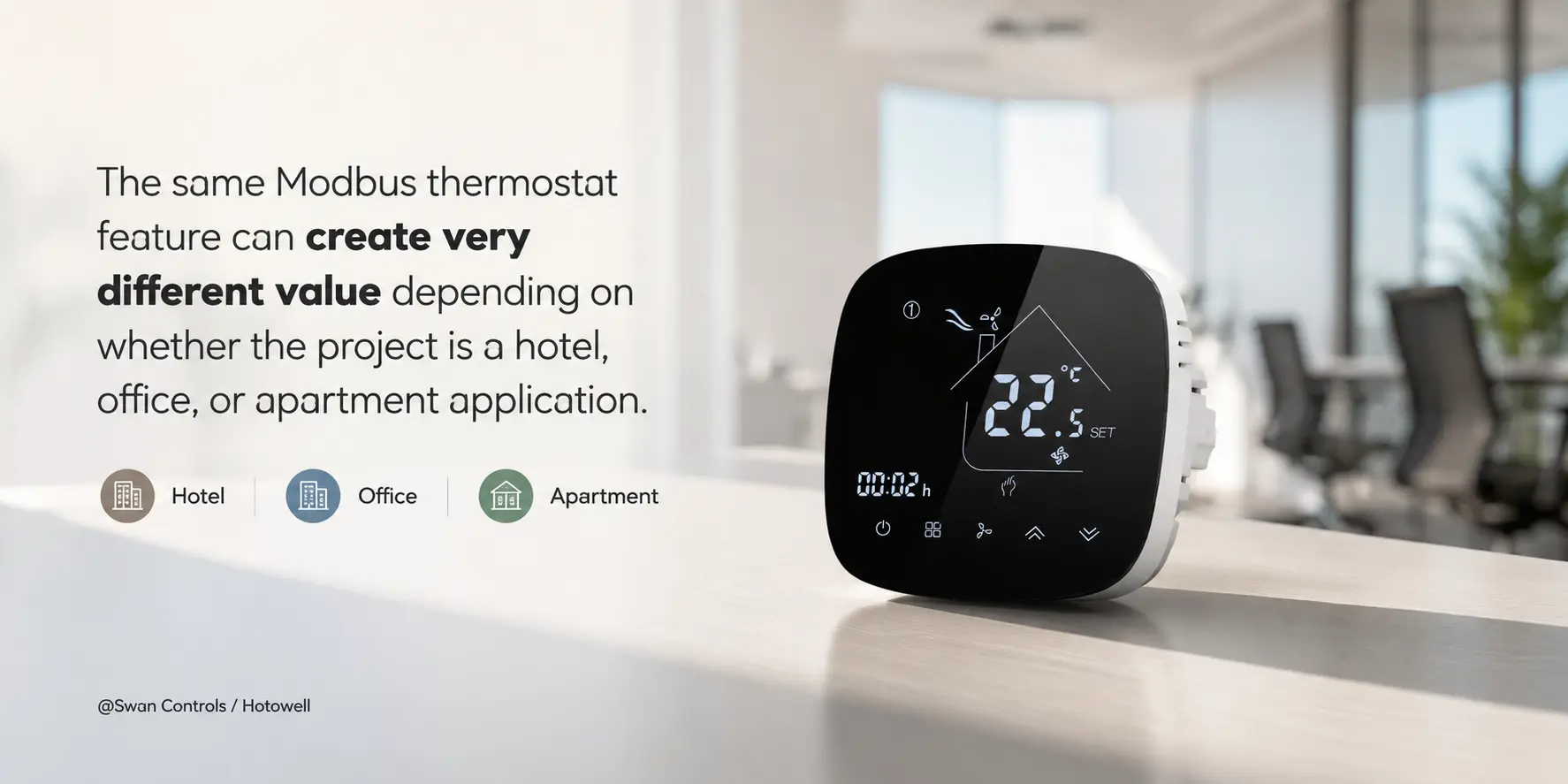
Expert Commentary: The Use Case Changes the Value of the Same Feature
One of the most common thermostat buying mistakes is assuming that a feature has the same value everywhere. It does not. The same Modbus communication feature can be highly valuable in an office BMS project, moderately useful in a hotel room-control project, and only occasionally useful in a simple apartment scenario. The same 4-pipe logic can be critical in one building and irrelevant in another. The same 0–10V output can be essential in a modulating project and pure overspecification in a standard FCU job.
This is why the best Modbus thermostat is not the one with the longest function list. It is the one whose features match the real use case. Buyers who understand this usually make calmer and more cost-effective decisions than buyers who start with a high-spec mindset and work backward.
Industry Trend: Why Modbus Still Matters Across Different Building Types
Modbus remains relevant because it still solves a real interoperability and communication need in building automation. The Modbus Organization continues to maintain application protocol, serial-line, messaging, and security specifications. That ongoing support shows why Modbus continues to matter in structured HVAC control even as other connected ecosystems grow. In projects where building-level management, room-level visibility, or long-term maintenance access matter, Modbus remains a practical answer rather than a legacy label.
But the practical lesson is still the same: the protocol may stay constant, while the use case changes the value. That is why hotels, offices, and apartments should not all be treated as if they need the same thermostat logic or the same level of communication importance.
Scientific Data and What It Means
Several technical facts help explain why Modbus thermostat value changes by project type. Modbus is defined as an application-layer protocol at OSI level 7, which shows that its core role is communication rather than local UI. The serial-line implementation guide identifies RS485 two-wire as the most common physical interface in serial Modbus systems, which explains why RS485 thermostat language is so common in HVAC. The Modbus Messaging Guide for TCP/IP shows how gateway and wider network integration extend the usefulness of the protocol beyond a single device. For buyers, the meaning is simple: Modbus is most valuable when the thermostat is part of a managed system, not when it is only a local wall control.
Real Cases and User Feedback
Case 1: Hotel project needing guest simplicity and central room logic
In one hotel-style project, the thermostat was first evaluated mainly as a guest control panel. Later, it became clear that guest simplicity was only one part of the requirement. The operator also wanted clearer room-by-room visibility and more structured room management. In that case, Modbus became more useful because the thermostat had to support the hotel team, not only the guest.
Case 2: Office project where central consistency mattered most
Another project involved an office FCU system with many rooms. The local screen was not the biggest issue. The stronger requirement was consistent room-level management and easier long-term supervision. Here, the communication value of the Modbus thermostat became more obvious than in a simple standalone space.
Case 3: Apartment project where simpler logic won
In a residential-style apartment project, the buyer first assumed a more feature-rich Modbus thermostat would always be the better choice. Later, the project review showed that the communication layer would probably not be used heavily after handover. The decision then shifted toward a simpler and more practical fit for the actual use case.
User feedback pattern: Buyers rarely regret clarifying the building use case early. They usually regret assuming that hotel, office, and apartment projects all benefit equally from the same thermostat feature set.
Frequently Asked Questions
1. Can the same Modbus thermostat be used for hotels, offices, and apartments?
Sometimes yes, but not always ideally. The same thermostat may technically work, but the most suitable choice depends on the control priorities, FCU type, and communication value in each use case.
2. Why is a Modbus thermostat often more useful in offices than in apartments?
Because offices more often need central visibility, structured room management, and easier long-term supervision across multiple spaces. Apartments may use the thermostat more like a local room thermostat unless the development also has broader integration goals.
3. What usually matters most in a hotel Modbus thermostat project?
Guest simplicity, room comfort, and operator-side room supervision usually matter most. The thermostat should support easy guest use while still fitting the hotel’s broader room-control logic.
4. Does FCU type change the thermostat choice in each use case?
Yes. A 2-pipe, 4-pipe, or 0–10V modulating FCU system changes what the thermostat actually needs to handle. The use case and the FCU control type should be judged together.
5. Is a more feature-rich Modbus thermostat always the better option?
No. The best option is the one whose communication and control features match the real building use case. Extra functions only add value when the project will actually use them.
References / Sources
- Modbus Organization, Modbus Application Protocol Specification V1.1b3
- Modbus Organization, Modbus over Serial Line Specification and Implementation Guide V1.02
- Modbus Organization, Modbus Messaging on TCP/IP Implementation Guide V1.0b
- Modbus Organization, Specifications and Implementation Guides
- Modbus Organization, Introduction to Modbus
- Schneider Electric, TH900 Series Thermostat Installation Instructions
- Schneider Electric, Thermostats and Sensors
- Wikipedia, Modbus
- Wikipedia, RS-485
- Modbus Organization, About Us