Quick Summary
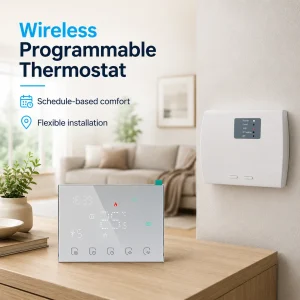
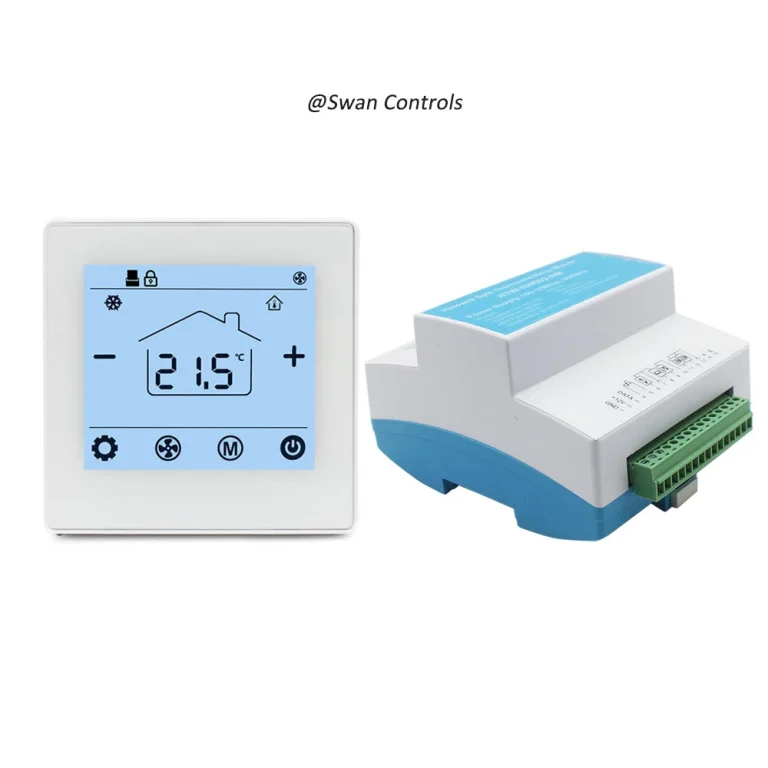
In many overseas HVAC and heating projects, a smart thermostat is not a separate system category. It is often a wifi thermostat with app control, remote setting, weekly scheduling and basic energy-saving logic. It can be useful, but it is not automatically the best choice for every project.
The right decision should start from the controlled system. A fan coil unit, boiler heating system, electric underfloor heating loop, water heating circuit, heat pump, AHU or FCU project may require different outputs, sensors, communication methods and installation logic. If the buyer starts only from the word “smart”, wrong product matching becomes more likely.
A smart thermostat is worth choosing when the project needs better end-user experience, mobile app control, flexible scheduling and remote adjustment. A normal thermostat may be better when the project needs simple local control. A Modbus thermostat, BACnet thermostat or BMS-connected thermostat is usually more suitable when the building needs centralised management, engineering data and stable system integration.
What Do Buyers Usually Mean by Smart Thermostat or WiFi Thermostat?
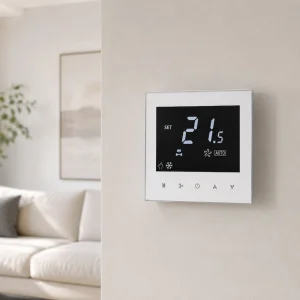
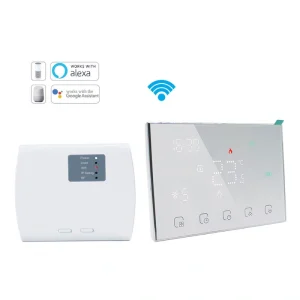
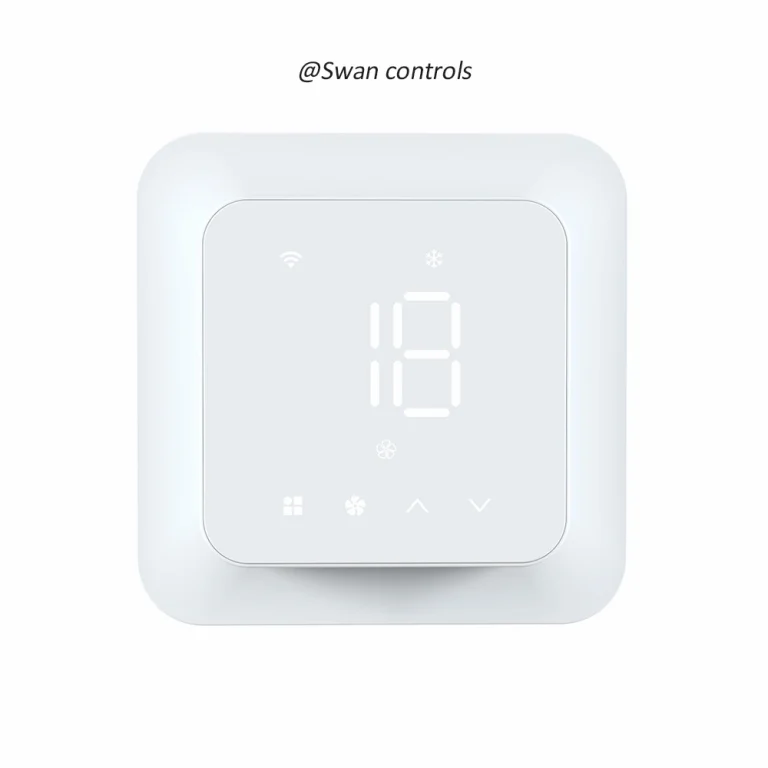
In most HVAC and heating purchasing conversations, buyers use the terms smart thermostat and wifi thermostat in a very similar way. They usually mean a thermostat that can connect to WiFi and allow control through a mobile app. The typical functions include remote temperature setting, mode change, weekly schedule, timer setting, basic energy-saving logic and sometimes voice assistant compatibility.
This meaning is practical, but it can also create confusion. A buyer may ask for a smart thermostat when the real requirement is simply app control for an apartment project. Another buyer may use the same term when they actually need a networked device for a hotel, office building or BMS project. These are very different requirements.
For residential and light commercial users, app control is often the main value. The user can adjust room temperature before arriving home, set a weekly programme or avoid unnecessary heating and cooling. ENERGY STAR describes certified smart thermostats as Wi-Fi enabled devices that adjust heating and cooling settings for improved performance, and certified models are evaluated using real field data for energy savings.
For engineering buyers, however, the question should not stop there. A wifi thermostat may improve convenience, but it does not replace correct output matching, correct voltage, proper sensor selection, stable wiring, installation compatibility and after-sales support. In B2B purchasing, “smart” should be treated as a control feature, not as the full selection standard.
Start with the HVAC System, Not the Word “Smart”
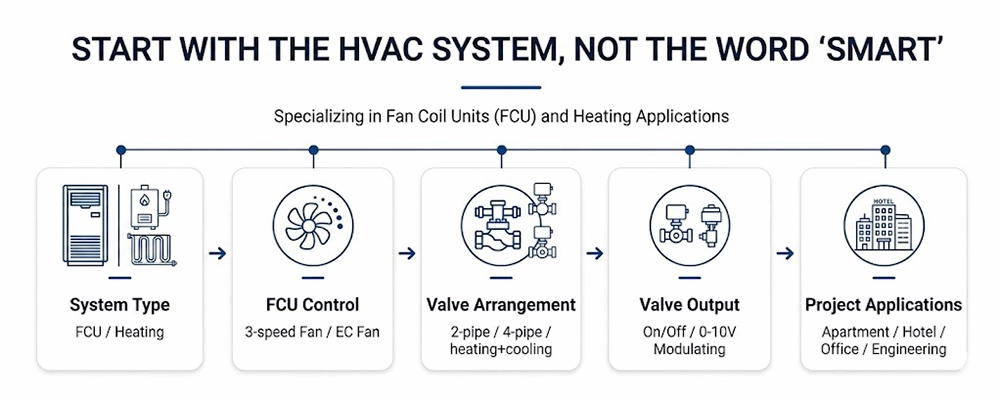
Before we discuss which WiFi thermostat to choose, it helps to remember that WiFi is just a feature — not the starting point. The first step is to confirm what the thermostat must control.
In a fan coil unit project, the thermostat may need to control a 3-speed fan, a 2-pipe valve, a 4-pipe heating and cooling valve arrangement, an EC fan, or a 0–10V modulating valve.
In a heating project, it may need to match boiler heating, electric underfloor heating, water heating or a heat pump system.
That said, HVAC systems cover many other types — such as AHUs, VRF, packaged units, and precision cooling systems. At Swan Controls (an affiliate of Hotowell), we specialise mainly in fan coil units and heating applications. So this article will focus on thermostat selection for those areas, covering our core expertise for OEM, wholesale and engineering buyers.
System Matching Comes Before App Control
| Project System | Main Control Requirement | Better Selection Direction |
|---|---|---|
| Apartment FCU | 3-speed fan, 2-pipe or 4-pipe valve control, app setting | WiFi fan coil thermostat |
| Hotel FCU | Keycard logic, stable guest operation, energy saving | Keycard hotel thermostat or BMS thermostat |
| Office Building | Central monitoring, room data, engineering control | Modbus thermostat or BACnet thermostat |
| Electric Underfloor Heating | Load capacity, floor sensor, heating protection | Heating thermostat with correct current rating |
| Boiler Heating | Dry contact, room temperature control, safe switching | Boiler thermostat or wireless boiler thermostat |
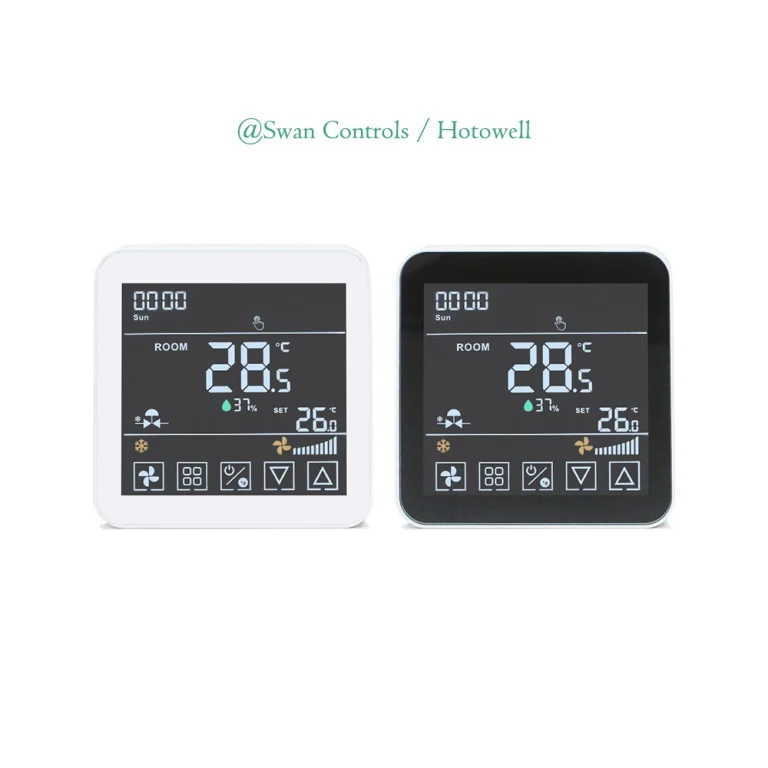
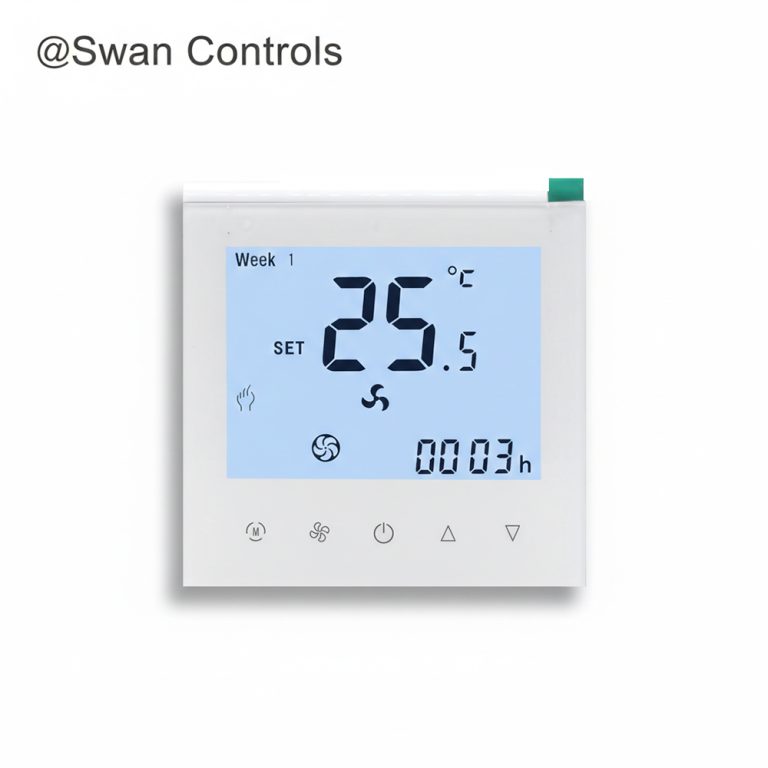
For a 3-speed fan and 2-pipe on/off valve FCU project with app control, the HTW-WF01-FC-2W fan coil thermostat is a practical match: HTW-WF01-FC-2W 2-pipe WiFi fan coil thermostat. It fits projects where the buyer wants simple room control, mobile operation and standard FCU output logic.
For a 3-speed fan and 4-pipe on/off valve FCU project, the HTW-WF11-FC-4W is more suitable: HTW-WF11-FC-4W 4-pipe WiFi fan coil thermostat.
The key reason is not only WiFi. The more important point is that the thermostat must match the 4-pipe heating and cooling structure.
For more advanced FCU projects, the buyer may need EC fan control, 0–10V modulating valve control and 24V output for valve operation. In that case, the HTW-FC09-FVMN-24WF can be considered: HTW-FC09-FVMN-24WF modulating WiFi fan coil thermostat.
The reason is not only WiFi. The output logic fits a more specific HVAC requirement.
Smart Thermostat or BMS Thermostat: Which Direction Fits the Project?
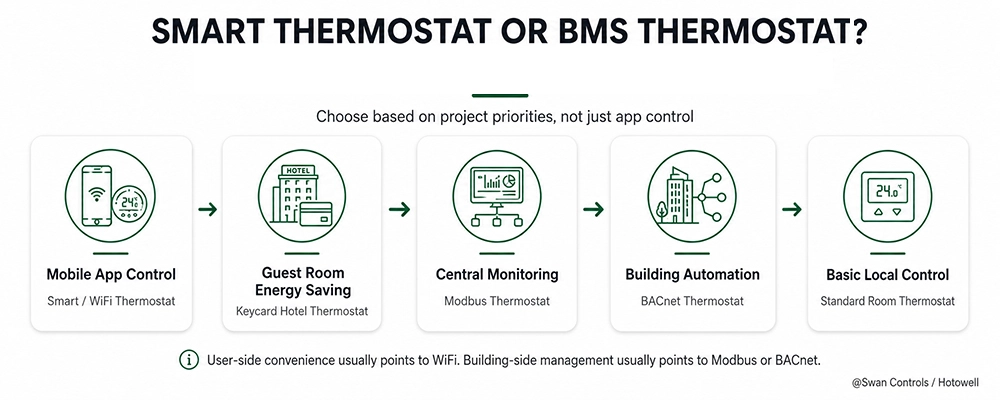
Now let’s look at how to choose. The main difference is between user‑side convenience and building‑side management.
The real decision is usually between user-side convenience and building-side management. A smart thermostat is mainly attractive when room users need app control, schedule setting and flexible local adjustment. It helps the end user interact with the room more easily.
A BMS thermostat has a different purpose. A Modbus thermostat or BACnet thermostat is normally selected when the building operator needs central monitoring, stable communication, unified settings, engineering data or integration with a building automation system. Modbus is widely used for automation communication, while BACnet is developed as a building automation and control network standard.
For hotels, office buildings, serviced apartments and managed commercial buildings, WiFi app control may not be the main requirement. The building owner may care more about room status, energy policy, central control, maintenance simplicity and integration with other systems. In that situation, a BMS-connected thermostat is often more reasonable than giving every room independent app control.
The practical rule is simple: when the room user is the main controller, a wifi thermostat can make sense. When the building manager is the main controller, Modbus or BACnet usually deserves priority.
Selection Direction for Different Project Priorities
| Project Priority | Better Choice | Reason | Typical Buyer |
|---|---|---|---|
| Mobile app control | Smart or WiFi model | Easy remote operation and schedule setting | Apartment, home, small office |
| Guest room energy saving | Keycard hotel thermostat | Matches occupancy-based hotel operation | Hotel contractor, hotel operator |
| Central monitoring | Modbus thermostat | Supports RS485 communication and engineering control | Office, school, commercial building |
| Building automation specification | BACnet thermostat | Fits BACnet-based BMS integration | Engineering company, system integrator |
| Basic local control | Standard room thermostat | Lower complexity and easier installation | Cost-sensitive project buyer |
When Is a Smart Thermostat Worth Choosing?
A connected model is worth choosing when the project benefits from remote operation and user-friendly control. This is common in apartments, private homes, small offices, small commercial spaces and decentralised HVAC or heating projects. The buyer may want tenants, office users or homeowners to control comfort from a phone without depending only on the wall device.
The second suitable case is weekly scheduling. If the room has predictable occupancy, a wifi thermostat can help reduce unnecessary operation. The U.S. Department of Energy notes that turning a thermostat back 7°–10°F for eight hours a day can save up to 10% a year on heating and cooling.
The third suitable case is distributed project management without a full BMS. Some apartment projects, rental properties and light commercial spaces need simple remote adjustment, easy user operation and a familiar app interface. In this case, a smart thermostat can provide enough control value without adding BMS cost.
The fourth suitable case is OEM and wholesale sales to consumer-facing markets. If the distributor sells to installers, small contractors or homeowners, app control can improve product appeal. The product is easier to explain: remote control, weekly schedule, comfort setting and energy-saving operation. For this type of channel, a wifi thermostat may help sales.
Suitable Project Types
Apartment and Small Office Projects
A smart thermostat is often suitable for apartments and small offices where users want direct control over comfort. The project usually does not need complicated BMS integration. The buyer cares more about simple installation, clear user operation and a product that is easy for local installers to explain.
Light Commercial and Decentralised Heating Projects
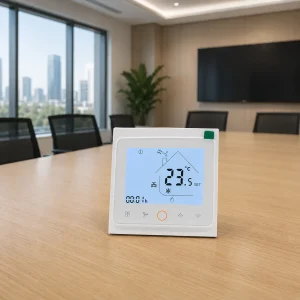
A wifi thermostat can also be useful for small shops, meeting rooms, rental spaces and decentralised heating areas. When there is no central control platform, app-based operation can provide a simple management layer. The buyer should still confirm that output type, load rating and sensor logic match the actual equipment.
When Is a Smart Thermostat Not the Best Choice?
A connected model is not the best choice when the project needs centralised building control more than individual app operation. In hotels, each guest does not need to bind a room thermostat to a personal app. The hotel operator usually needs keycard logic, occupancy-related energy saving, stable local operation and sometimes BMS communication.
For this type of project, a non-WiFi hotel thermostat may be more suitable. For example, the HTW-WF11-FC-2K is designed for 2-pipe FCU hotel applications with keycard logic:
HTW-WF11-FC-2K keycard hotel fan coil thermostat. The value is not app control. The value is hotel-room energy management and reliable guest operation.
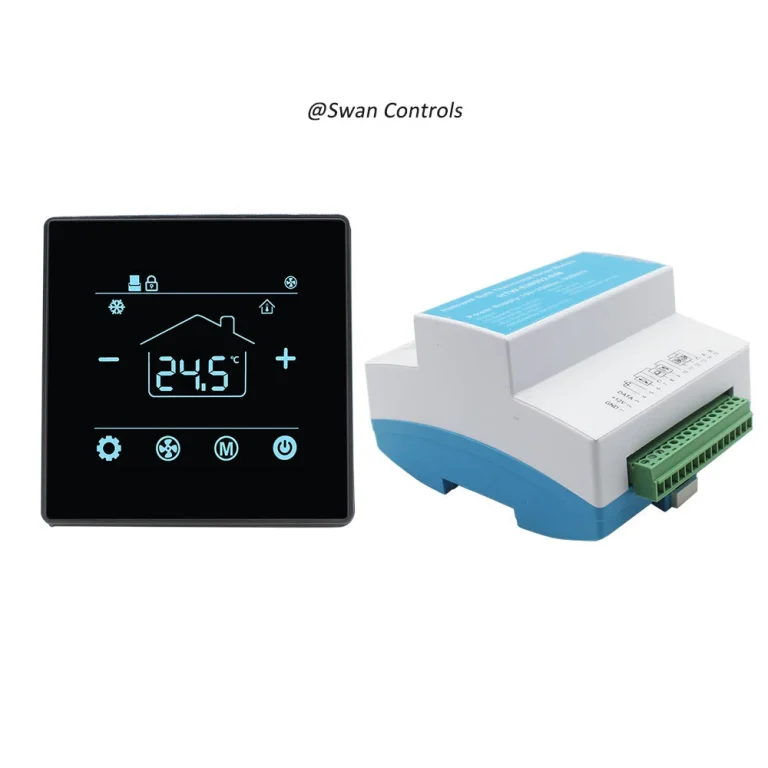
This type of connected control is also not ideal when the project must be managed by Modbus. In some office buildings, schools, commercial spaces and engineering projects, the operator needs RS485 communication, address setting, system monitoring and centralised control. In this case, our model Swan Controls HTW-WF11-FC-2EN RS485 Modbus room thermostat is better: it is more suitable when data communication and system integration matter more than app convenience.
BACnet projects have the same logic. If the building automation specification requires BACnet, WiFi app control should not be used as a substitute. For 2-pipe or 4-pipe FCU projects with external sensor needs, the HTW-WF11-FC-EB BACnet fan coil thermostat can support a more engineering-oriented control direction:
Another unsuitable case is unstable network infrastructure. If the building has weak WiFi coverage, strict IT restrictions or no plan to maintain app connectivity, user complaints may increase. A smart thermostat may look attractive in the quotation stage, but it may create extra after-sales questions if the site cannot support reliable app use.
A final unsuitable case is when the buyer has not confirmed the controlled equipment. Choosing a wifi thermostat before checking voltage, output type, valve type, fan type, pipe system and sensor position is risky. The product may look modern but fail to match the actual system.
Two Practical Project Cases
Case 1: Apartment or Small Office Project Choosing WiFi Control
A small apartment project uses fan coil units with 3-speed fans and 2-pipe on/off valve control. The buyer wants tenants to adjust room temperature by phone, set weekly schedules and control the system when away from the room. There is no central BMS requirement. In this situation, a smart thermostat is reasonable because the main value is user convenience.
For this type of project, the buyer should confirm the FCU control logic first. If the system is 2-pipe, choose a matching 2-pipe FCU thermostat. If the system is 4-pipe, choose a 4-pipe model. If the fan is EC type or the valve is modulating, choose a model that supports that output. WiFi is useful only after these control points are correct.
Case 2: Hotel or BMS-Managed Building Choosing Modbus or BACnet Instead
A hotel project has many rooms, keycard energy-saving logic and a facility team that wants stable room control. The operator does not want guests to connect thermostats to personal apps. The project may also need room status management or integration with a building control platform. In this case, a wifi thermostat may create more complexity than value.
For this project, a keycard hotel thermostat, Modbus thermostat or BACnet thermostat is more suitable. If the hotel mainly needs keycard-based room energy control, a hotel FCU thermostat is enough. If the building needs central data and control, Modbus or BACnet should be considered. The buyer should not pay for app control that the project will not use.
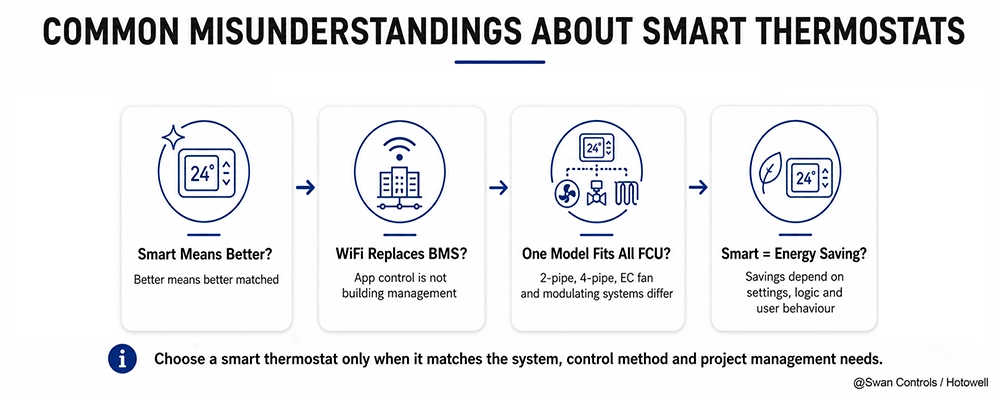
Common Misunderstandings About Smart Thermostats
The first misunderstanding is that smart means better. In real HVAC purchasing, better means better matched. A basic thermostat can be the correct choice if the project only needs simple local control. A Modbus thermostat can be the better choice if the building needs central monitoring. A BACnet thermostat can be the better choice if the building specification requires BACnet integration.
The second misunderstanding is that WiFi can replace BMS. It cannot. WiFi app control is mainly designed for app-based access. A BMS-connected thermostat is designed for building-level communication and management. They may both look digital on the wall, but their project roles are different.
The third misunderstanding is that the same model can fit all FCU systems. A 2-pipe FCU, 4-pipe FCU, EC fan FCU and modulating valve FCU may require different output logic. Buyers should confirm fan type, valve control, pipe system and voltage before choosing the model.
The fourth misunderstanding is that energy saving comes from the word smart. In practice, energy saving comes from correct scheduling, reasonable setpoints, occupancy logic, valve control, fan control and user behaviour. ENERGY STAR notes that average savings for certified models are about 8% of heating and cooling bills, but actual savings can vary by climate, comfort preference, occupancy and HVAC equipment.
The fifth misunderstanding is that app control always reduces after-sales work. It may reduce some user questions, but it can also create new questions about app pairing, WiFi signal, account management, router changes and regional platform settings. For OEM and wholesale buyers, this should be evaluated before choosing a smart thermostat product line.
Final Note / Practical Takeaway
A smart thermostat is worth choosing when the project needs app control, remote adjustment, weekly schedule and a better end-user interface. It is especially suitable for apartments, homes, small offices and light commercial spaces where users control their own rooms.
A wifi thermostat is not always the best answer for hotels, BMS-managed buildings or engineering projects that require Modbus, BACnet, keycard logic, external sensor integration or centralised control. In those projects, the better choice may be a stable fan coil thermostat with the right communication and project logic.
For overseas buyers, the safest path is to confirm the HVAC or heating system first: fan type, pipe system, valve output, voltage, sensor requirement, communication method and management style. After that, decide whether WiFi adds real value. If your project requires OEM supply, wholesale distribution or engineering model matching, please feel free to get in touch with Swan Controls to confirm the suitable thermostat direction before ordering samples.
FAQ
1- Is a smart thermostat the same as a WiFi thermostat?
In many HVAC and heating purchasing conversations, the two terms are used very closely. A smart thermostat usually means a WiFi thermostat with app control, remote setting, weekly schedule and basic energy-saving logic. However, the exact meaning should always be confirmed before ordering.
2- When should I choose a WiFi model for a fan coil unit?
Choose a WiFi model when the project needs app control and the FCU control logic is already clear. You still need to confirm whether the system is 2-pipe or 4-pipe, whether the fan is 3-speed or EC type, and whether the valve is on/off or modulating.
3- Is a smart model suitable for hotel rooms?
Not always. Many hotel rooms need keycard logic, simple guest operation, stable local control and sometimes BMS communication. A hotel keycard thermostat, Modbus thermostat or BACnet thermostat may be more suitable than app-based WiFi control.
4- When is Modbus better than WiFi?
Modbus is better when the project needs RS485 communication, central monitoring, address management and integration with an engineering control system. WiFi is better when the main need is mobile app control for individual users.
5- When is BACnet better than WiFi?
BACnet is better when the building automation specification requires BACnet communication. It is commonly considered for BMS-managed buildings where interoperability, central control and engineering data are more important than personal app control.
6- Can one thermostat model support all FCU projects?
No. Different FCU projects may need different outputs. A 2-pipe on/off valve system, 4-pipe valve system, EC fan system and 0–10V modulating valve system should be checked separately before choosing a fan coil thermostat.
7- Does app control always save energy?
No. WiFi control itself does not guarantee energy saving. Savings depend on schedules, setpoints, occupancy habits, HVAC equipment, installation and control logic. WiFi makes adjustment easier, but the project still needs correct settings.
8- What should overseas buyers confirm before ordering samples?
Buyers should confirm the system type, pipe system, fan type, valve output, voltage, sensor requirement, communication method, app requirement, installation market and OEM needs. This avoids choosing a modern-looking product that does not match the real project.
References / Sources
1- ENERGY STAR, “Smart Thermostats.”
2- ENERGY STAR, “Smart Thermostats Key Product Criteria.”
3- U.S. Department of Energy, “Programmable Thermostats.”
4- ENERGY STAR, “Smart Thermostat FAQs for EEPS.”
5- ASHRAE, “BACnet.”
6- Modbus Organization, “About Modbus.”
7- Building Science Education Solution Center, “HVAC Programmable Thermostats.”
8- ASHRAE, “BACnet Secure Connect White Paper.”