Quick Summary
When we select a WiFi model, the key question is whether remote app control creates real project value. It is useful for apartments, small offices, rental properties and user-managed HVAC or heating rooms where our customers need to adjust the temperature away from the wall device. But it is not always the better-value choice.
A local scheduling model can already handle many daily control needs. If our project only needs a local weekly schedule, an automatic time programme and stable on-site operation, paying extra for WiFi may not reduce energy use or after-sales work. It may only add app pairing, router and user training questions.
Start with System Compatibility Before Comparing WiFi and Programmable Functions
But before we start comparing WiFi and programmable functions, let’s remember one important point: system compatibility must come first. WiFi or programming is only the functional level, not the first selection step. In this article, we use fan-coil thermostat examples where needed, but the same selection logic can also guide other HVAC and heating projects.
This matters because a wifi thermostat cannot correct a wrong product platform. If we choose an app-based model for a 2-pipe FCU but the project needs 4-pipe control, the app will not solve the mismatch. If our system needs 0–10V valve control but the selected thermostat only supports on/off output, the function level is wrong, even if the product looks modern.
WiFi Thermostat vs Programmable Thermostat: What Do We Really Need?
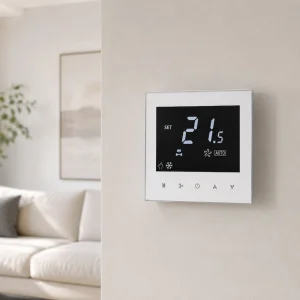
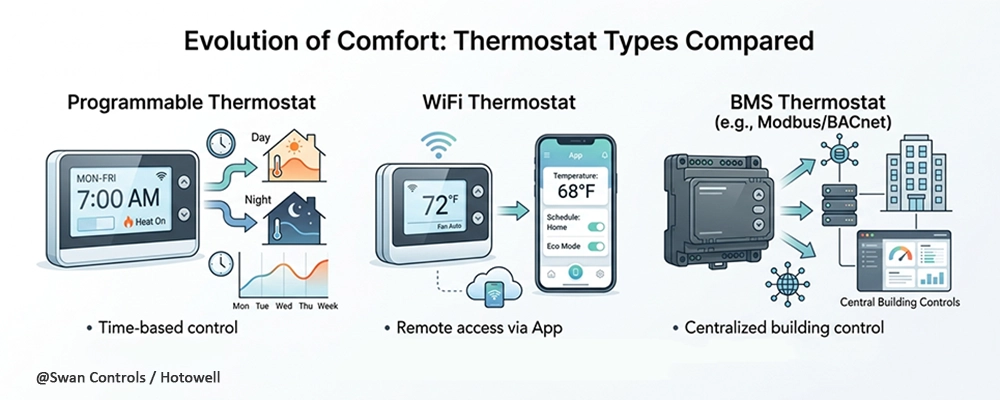
A programmable thermostat focuses on time-based automatic control. We can set daily or weekly temperature programmes directly on the device, including periods such as working hours, night setback or weekend operation. It does not require app binding or internet access. The U.S. Department of Energy notes that turning a thermostat back 7°–10°F for eight hours a day can save as much as 10% a year on heating and cooling, which shows why scheduling itself can already provide meaningful energy savings.
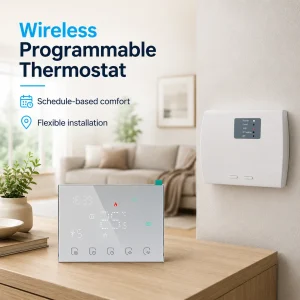
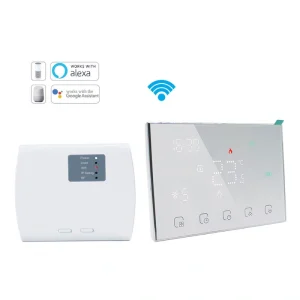
A wifi thermostat usually includes these programmable functions, but adds remote connectivity through a wireless network. We can adjust temperature, change mode, update schedules and sometimes manage rooms remotely through an app.
In simple terms, programming adds time-based automatic control. WiFi adds remote access and app interaction on top of that. A basic thermostat adds neither; it depends mainly on manual adjustment.
A BMS thermostat, such as a Modbus or BACnet thermostat, is different again because it is designed for building-side data, communication and central management rather than personal app convenience.
Function Comparison for Our Project Selection
| Comparison Point | WiFi Thermostat | Programmable Thermostat |
|---|---|---|
| Main value | Remote app control and user convenience | Local schedule and automatic time programme |
| Remote access | Yes, when network and app are available | No, normally set on the device |
| Weekly schedule | Usually included | Core function |
| Network dependence | App function depends on WiFi | No WiFi needed |
| User account or app binding | Usually required | Not required |
| Common after-sales questions | App pairing, router change, account, signal | Schedule setting and user operation |
| Best-fit projects | Apartments, small offices, rental properties, user-managed rooms | Fixed-schedule offices, schools, shops, local heating rooms |
The practical question is whether remote access is necessary. If control happens mostly on site, local scheduling may be enough. If users often adjust temperature before arriving, after leaving or across several rooms, WiFi becomes more useful.
Start from the Control Scenario
We should ask who will actually control the thermostat. A homeowner, tenant or office user may like app-based operation. A school facility manager may prefer one stable local programme. A hotel operator may not want guests to bind room devices to personal phones. A system integrator may care more about Modbus or BACnet communication than app access.
The second question is schedule stability. If the room follows a stable weekly pattern, a programmable thermostat usually provides enough control. Typical examples include classrooms, training rooms, fixed-hour offices and small shops.
The third question is whether the site can support WiFi properly. Its app value depends on network stability, account setup and user understanding. For our wholesale or OEM channels, we may also need app instructions, reset steps, pairing guidance and after-sales documents.
The fourth question is whether the project is user-managed or facility-managed. User-managed spaces often benefit from app control. Facility-managed spaces often need predictable operation, limited user access and simpler maintenance.
When Is a WiFi Thermostat Worth Choosing?
A connected model is worth choosing when the project has a real remote-control need. In an apartment, our end user may adjust the room before arriving home. In a small office, the manager may pre-cool or pre-heat the room before working hours. In a rental property, the owner may need easier control for tenants.
It is also relevant in light commercial spaces where usage patterns are less fixed, such as clinics, meeting rooms, studios and retail rooms. In these cases, app control is useful when users need to adjust settings without visiting each wall device.
The key decision point is still clear: we should only choose WiFi when we can identify who will use the app, why remote access is necessary, and how the network and account management will be handled.
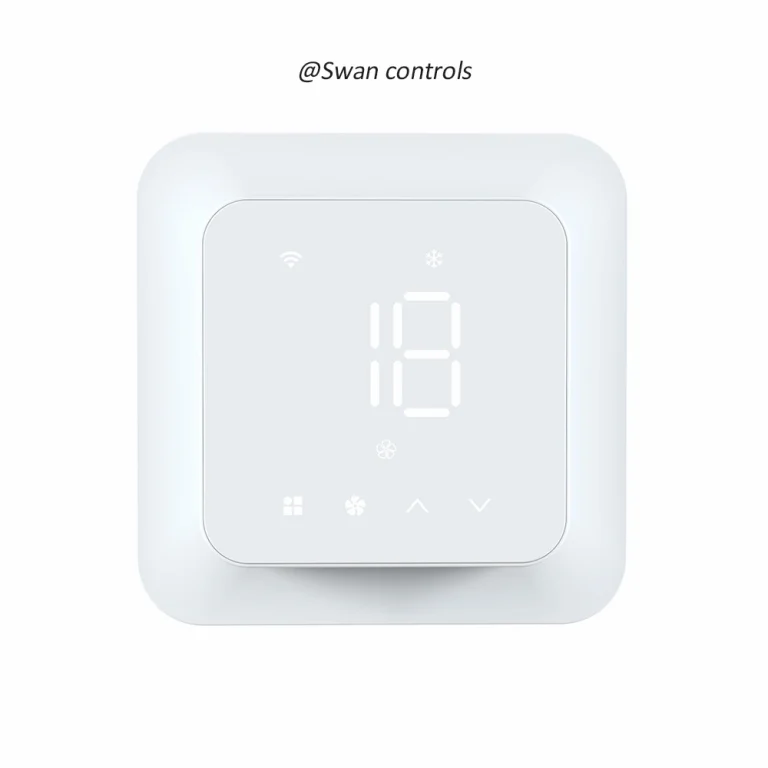
Once these conditions are met, the choice naturally moves from “whether to use WiFi” to “which WiFi configuration fits the project better”. For example, a 2-pipe FCU projects that truly need app control, HTW-WF06-FC-2W WiFi thermostat for 2-pipe fan coil systems is a more suitable direction. For 4-pipe projects, a model such as our Swan Controls HTW-WF11-FC-4W WiFi thermostat better matches the structure.
When Is a Programmable Thermostat Enough?
A local scheduling model is enough when the main requirement is a stable time programme. This is common in fixed-schedule offices, schools, training rooms, small commercial spaces and many heating projects. The user sets the working periods, night setback or weekend mode on the device, and the system follows the programme without app dependence.
This choice is strong when local management is preferred. Some facility teams do not want many users changing settings from phones, and installers often prefer fewer app-related questions.
It can also be the better value when budget matters. If the project will not use remote control, WiFi hardware and app setup bring limited benefit. We may invest in better output matching, sensor logic or clearer project documents.
Energy saving should also be understood correctly. A schedule can reduce unnecessary operation whether it is set through an app or on the wall. ENERGY STAR reports average savings of about 8% of heating and cooling bills for certified smart thermostats, but actual results vary by climate, comfort preference, occupancy and HVAC equipment.
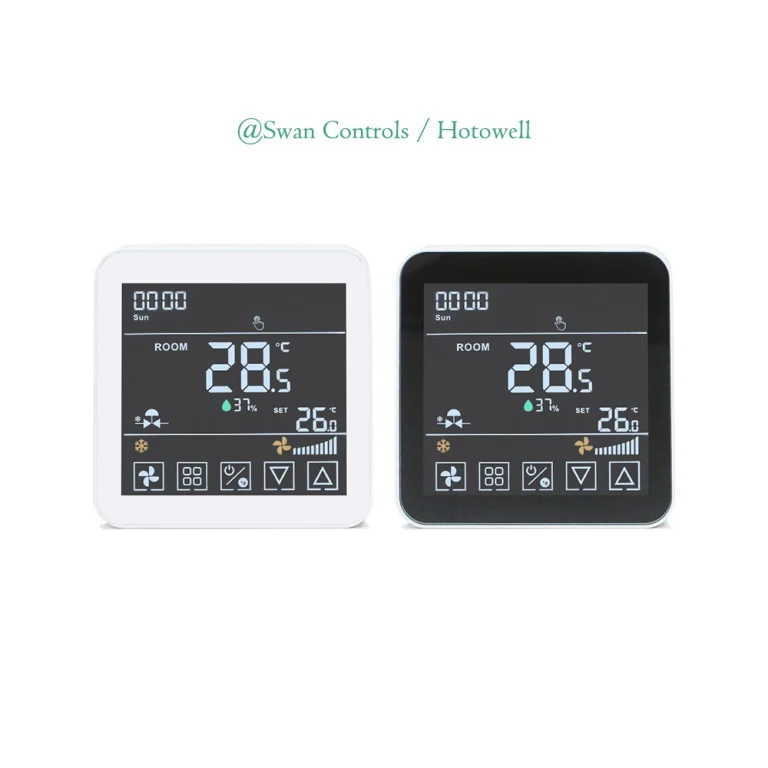
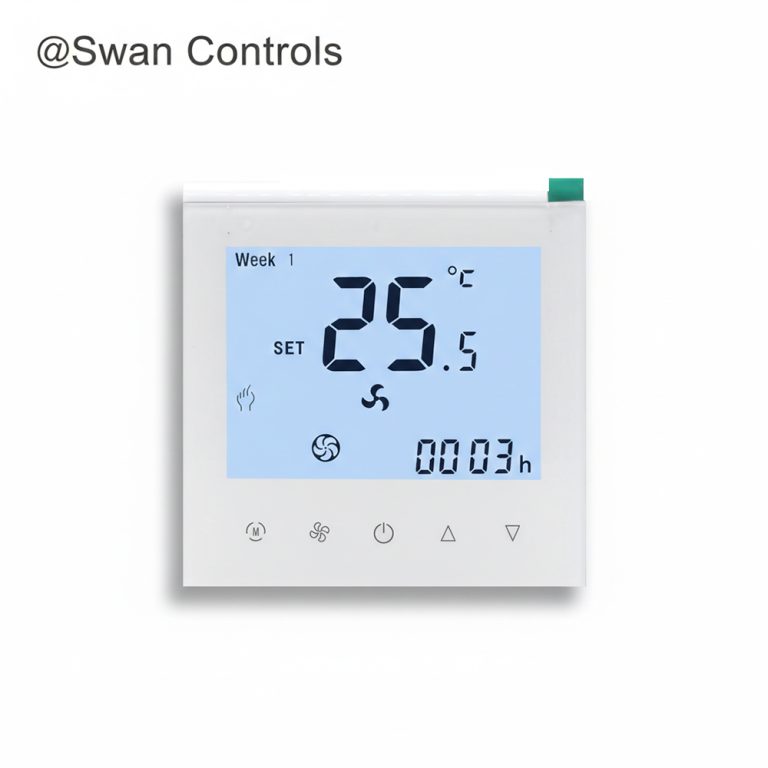
For a simple 2-pipe fan coil unit without app control, HTW-WF08-FC-2 standalone 2-pipe fan coil thermostat can be more practical. Our customer gets local room control without app setup. For another project that requires EC fan control, 0–10V modulating valve output, the HTW-FC09-FVMN-24 programmable thermostat with Modbus and 24V modulating output may fit better. In both cases, the value comes from matching the real control requirement, not from adding a feature that the site team may never use.
Where Do Basic Thermostats and BMS Thermostats Fit?
A basic thermostat is suitable when manual local control is enough. It is easy to install and usually cost-effective, but it does not provide weekly schedules or remote access.
A local scheduling model sits between basic control and app-based control. It stores the schedule on the device and often gives the best balance between control value and simplicity.
A WiFi model adds remote app access on top of scheduling. That makes it valuable in the right project, but also adds network and user-support considerations.
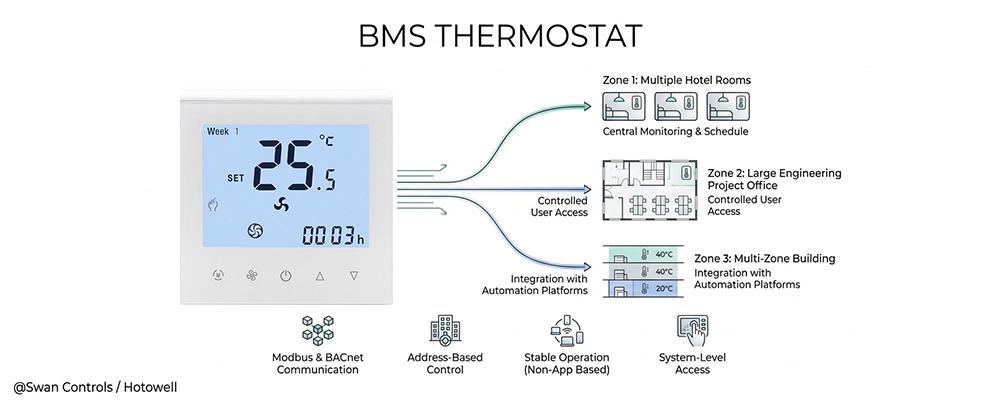
A BMS thermostat is a separate direction. Unlike a WiFi thermostat, it is usually designed for system-level management rather than personal app convenience. In many managed buildings, hotels and engineering projects, the main priority is central monitoring, stable operation and controlled user access rather than remote adjustment from a phone.
This is why Modbus and BACnet thermostats are widely used in building management environments. They support address-based communication, central scheduling and integration with automation platforms across multiple rooms or zones. In these projects, app-based WiFi control may even create unnecessary management complexity if each room operates independently.
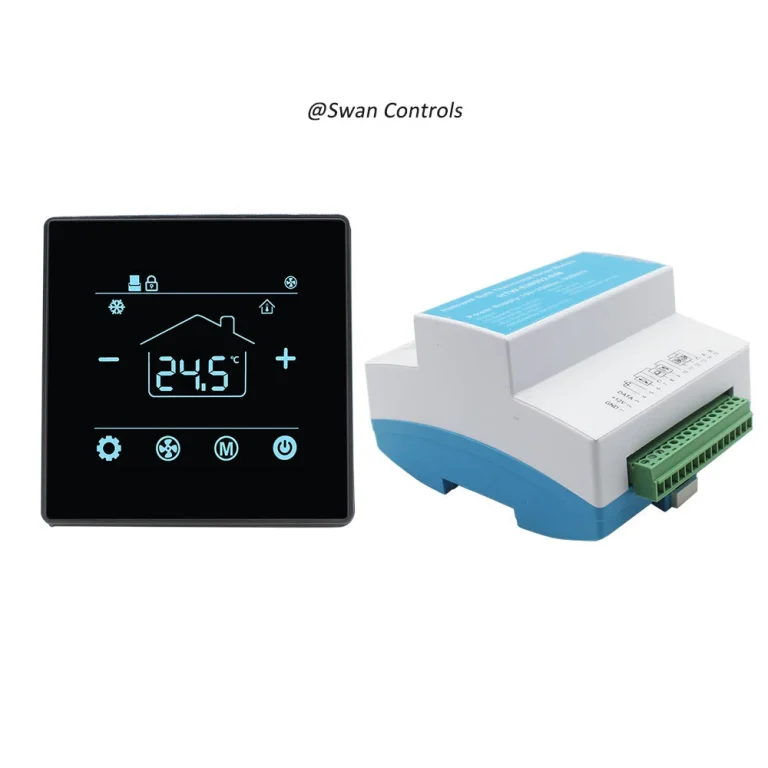
If the project needs RS485 communication, address setting and central monitoring, a model such as HTW-WF11-FC-2EN RS485 Modbus room thermostat with external sensor may be better. If the specification requires BACnet integration, HTW-WF11-FC-EB BACnet 2/4-pipe FCU thermostat with external sensor is more suitable. ASHRAE describes BACnet as a building automation and control networking protocol designed for applications including HVAC control and energy management.
Choosing by Project Need
| Project Need | Better Direction | Why It Fits |
|---|---|---|
| Manual room control only | Basic thermostat | Lowest complexity |
| Local weekly schedule | Programmable thermostat | Automatic operation without app dependence |
| Remote user control | WiFi thermostat | App setting and remote adjustment |
| Central monitoring | Modbus thermostat | RS485 communication and address-based control |
| BACnet building automation | BACnet thermostat | Fits BACnet-based BMS specification |
| Hotel guest room logic | Keycard or BMS thermostat | Better for managed room energy policy |
Practical Project Cases
Case 1: Apartment FCU Project Choosing WiFi
An apartment project uses 3-speed fan coil units and wants residents to control comfort through a phone. The owner does not need a full BMS, but the product must be easy for installers to explain. In this case, WiFi can add real value.
The buyer should still confirm the FCU type first. A 2-pipe system needs a 2-pipe FCU thermostat, while a 4-pipe system needs a 4-pipe model. The benefit of WiFi becomes meaningful only after the thermostat matches the fan and valve structure.
Case 2: School or Fixed-Schedule Office Choosing Programming
A classroom or office may follow the same pattern every weekday. The facility team wants automatic comfort control during occupied hours and setback operation after hours. Users do not need to adjust the thermostat from home.
In this case, a programmable thermostat can be the better-value choice. It provides the schedule the project needs without app binding, router questions or user account management. The project saves cost and keeps operation easier.
Case 3: Managed Building Avoiding WiFi as the Default
A managed office building or hotel may require central monitoring, restricted user control and integration with a control platform. In this situation, WiFi should not be the default answer. Modbus, BACnet or hotel keycard logic may fit the management model better.
This does not mean WiFi is wrong. It means WiFi must match the control scenario. In facility-managed projects, personal app convenience is often less important than central visibility and maintenance control.
Common Mistakes When Comparing WiFi and Programmable Thermostats
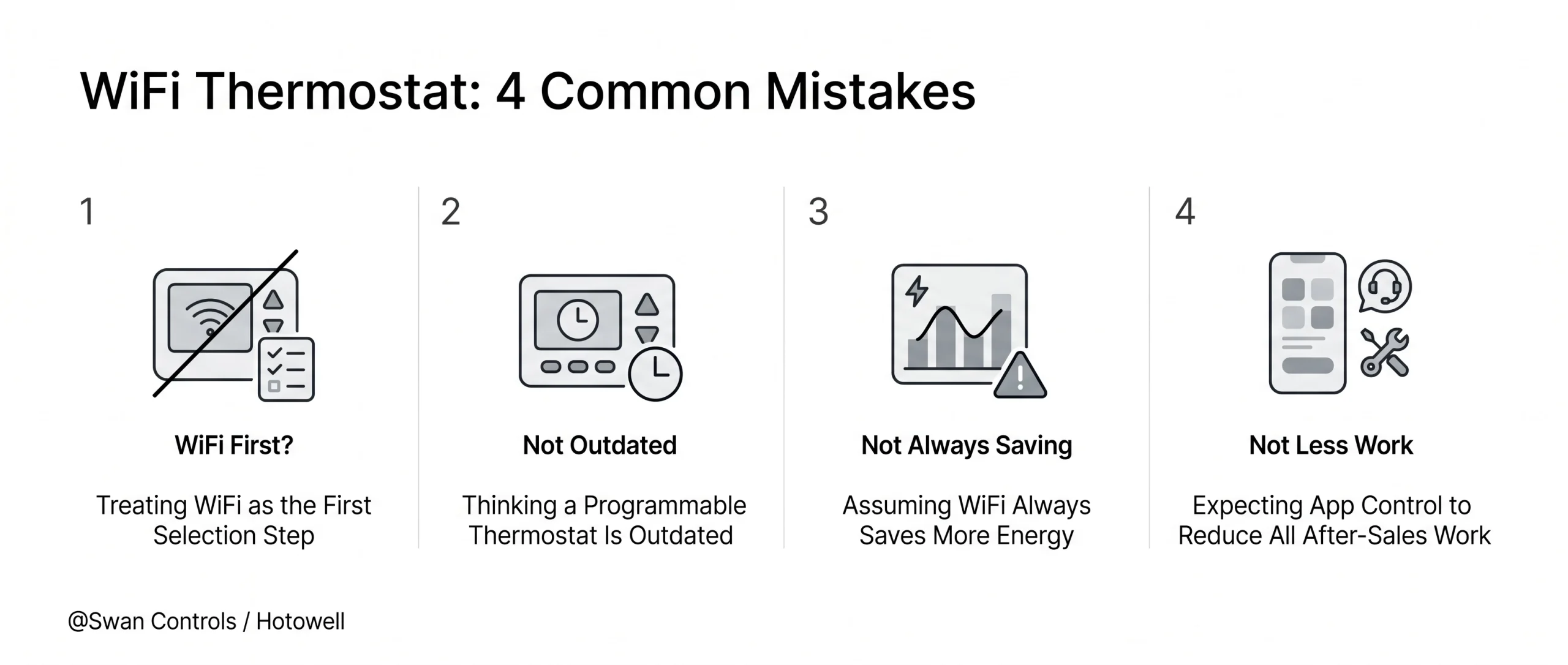
1: Treating WiFi as the First Selection Step
WiFi is not the first selection step. We should confirm output type, voltage, fan control, valve logic, sensor requirement and installation environment before discussing app control.
2: Thinking a Programmable Thermostat Is Outdated
A local scheduling model is not outdated when the project has a stable schedule. In many offices, schools and small commercial spaces, local programming gives enough automation without adding network dependence.
3: Assuming WiFi Always Saves More Energy
Energy saving depends on how the system is used. Schedules, setback settings, occupancy, setpoint discipline and equipment type all matter. WiFi may make adjustment easier, but poor settings can still waste energy.
4: Expecting App Control to Reduce All After-Sales Work
App control can improve user experience, but it can also create questions about pairing, routers, passwords, accounts and reset steps. For OEM and wholesale projects, we should prepare documents before promoting WiFi as a simple upgrade.
The practical lesson is that there is no universally “best” thermostat category. A WiFi model, programmable thermostat, basic controller or BMS-connected thermostat can all be the correct choice when they match the control logic, management method and operating habits of the project. The goal is not to add the maximum number of features. The goal is to select the level of control that the site will actually use and manage effectively.
Final Note / Practical Takeaway
A wifi thermostat is worth choosing when remote app control creates real value. It is suitable for apartments, small offices, rental properties and user-managed rooms where people need convenient adjustment away from the wall thermostat.
A programmable thermostat is often the better-value choice when the project only needs a stable weekly schedule and local automatic control. It avoids app dependence and keeps installation, training and after-sales support simpler.
For our overseas OEM, wholesale and engineering projects, the safest process is to confirm system compatibility first, then decide the function level. If the project needs remote control, choose WiFi. If it only needs local scheduling, choose programming. If it needs central building management, check Modbus, BACnet or other BMS-connected thermostat options.
FAQ
1- What is the difference between a WiFi thermostat and a programmable thermostat?
A wifi thermostat supports remote app control through a wireless network. A local scheduling model focuses on local daily or weekly schedules set on the device. Many WiFi models also include programming, but programming does not always mean WiFi.
2- Does a WiFi thermostat always include programmable scheduling?
Most WiFi models include weekly scheduling or timer functions, but buyers should still confirm the exact model and app logic.
3- When is a programmable thermostat enough?
It is enough when the room follows a stable schedule and remote app control is not needed. Typical examples include schools, fixed-schedule offices, small shops and local heating rooms.
4- When is a WiFi thermostat worth the extra cost?
It is worth the extra cost when users need remote adjustment, app-based convenience or flexible schedule changes. Apartments, rental properties and small offices are common examples.
5- Is WiFi control suitable for hotels?
Not always. Hotels often need keycard logic, restricted guest control, stable local operation or BMS integration. WiFi app control may create unnecessary complexity if the hotel operator manages each room.
6- Can local programming save energy?
Yes, if the schedule is used correctly. Setback periods and stable programmes can reduce unnecessary heating or cooling. Actual savings depend on climate, occupancy and equipment.
7- What should buyers confirm before ordering WiFi thermostats?
We should confirm system type, voltage, output logic, fan type, valve control, sensor needs, network condition, app requirement and after-sales documents.
8- Which option is better for OEM or wholesale projects?
It depends on the target channel. If the market expects app control, WiFi can improve product appeal. If our buyers need low complexity and stable local schedules, programmable models may reduce after-sales pressure.
References / Sources
Smart Thermostats | ENERGY STAR | U.S. Environmental Protection Agency / U.S. Department of Energy | ENERGY STAR Website
Programmable Thermostats | U.S. Department of Energy | U.S. Department of Energy | Energy Saver Website
Smart Thermostat FAQs for EEPS | ENERGY STAR | U.S. Environmental Protection Agency / U.S. Department of Energy | ENERGY STAR Website
BACnet, the ASHRAE Building Automation and Control Networking Protocol | ASHRAE | ASHRAE | ASHRAE Technical Resources
Standard 135-2016, BACnet | ASHRAE | ASHRAE | ASHRAE Standards and Guidelines
About Modbus | Modbus Organization | Modbus Organization | Modbus Official Website