Quick Summary
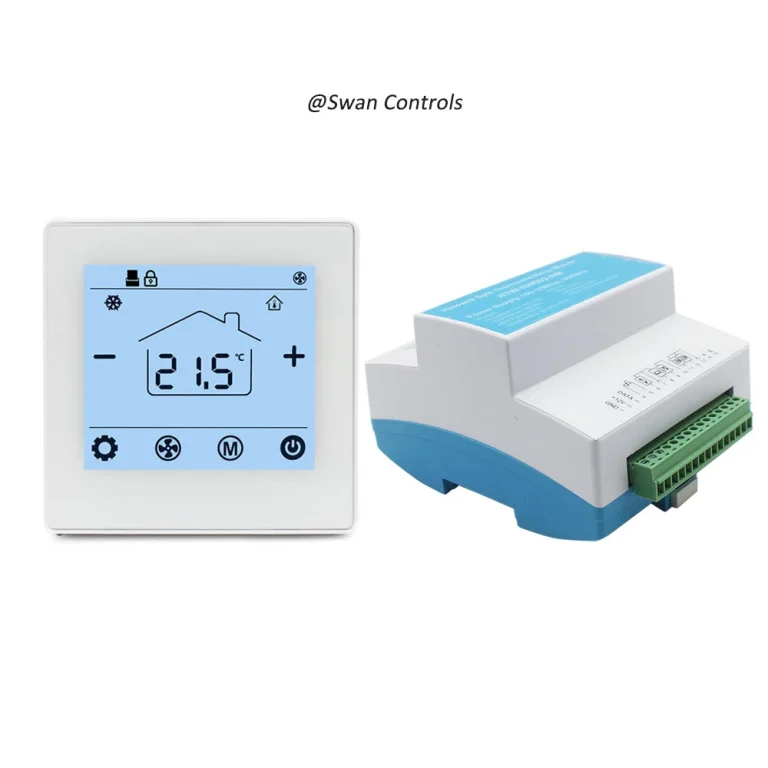
A wireless thermostat controls heating or cooling without a direct control wire between the room unit and the HVAC equipment. It usually works with a receiver, relay module, or actuator controller. A wireless room thermostat is useful when wiring is difficult, when rooms are already finished, or when flexible placement is needed. Buyers should check signal range, pairing method, power supply, receiver output, and system compatibility before choosing one.
“Can we install a thermostat without opening the wall?”
“The boiler is far from the room. Can the thermostat still control it?”
“We need room control, but the project does not have control wiring.”
These are common questions in renovation projects, apartments, villas, and light commercial HVAC systems. In many cases, the user does not want extra wiring. The building may already be finished. The control point may also be far away from the heating or cooling equipment.
A wireless thermostat is designed for this situation. It sends control signals wirelessly from the room unit to a receiver or control module. The receiver then switches the heating, cooling, valve, boiler, or fan coil output.
This article explains what a wireless thermostat is, how it works, where it is used, and what buyers should check before choosing a wireless room thermostat for residential or commercial projects. If you’re looking for a wireless thermostat please click directly.
What Is a Wireless Thermostat
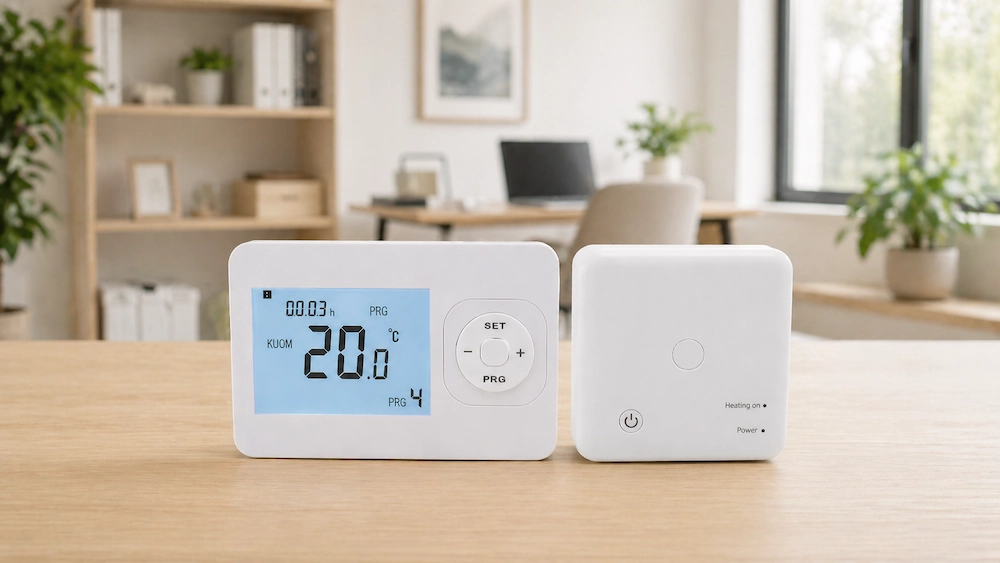
A wireless thermostat is a temperature controller that communicates without a direct signal cable between the room control unit and the HVAC equipment.
The thermostat is installed in the room. It measures indoor temperature. It compares the room temperature with the setpoint. When heating or cooling is needed, it sends a wireless signal to the receiver.
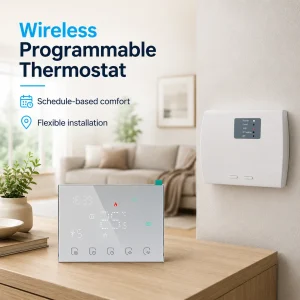
The receiver is usually installed near the controlled equipment. It may connect to a boiler, valve, electric heating system, fan coil unit, or other HVAC device.
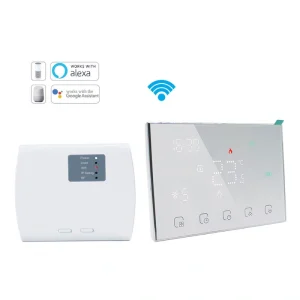
A wireless thermostat system usually includes:
- Room thermostat
- Wireless receiver
- Relay output or control output
- Power supply
- Pairing or communication setup
The main value is installation flexibility. The room unit does not need a long control cable to the equipment. This makes it useful for retrofit projects and finished buildings.
For buyers, the key point is simple. A wireless thermostat is not only a “no-wire” product. It is a control system made of a room unit and a receiver. Both parts must match the HVAC system.
How a Wireless Thermostat Works
The working logic is easy to understand.
The wireless room thermostat reads the room temperature. It checks whether the current temperature is higher or lower than the setpoint. Then it sends a signal to the receiver.
The receiver accepts the signal and controls the connected HVAC equipment. This may be an on/off output, a dry contact output, or another control method depending on the model.
Basic working steps:
- The room unit measures indoor temperature.
- The user sets the target temperature.
- The thermostat compares room temperature with the setpoint.
- The thermostat sends a wireless command to the receiver.
- The receiver switches heating or cooling output.
- The system stops when the room reaches the target range.
For example, if the room is colder than the heating setpoint, the thermostat sends a heating demand signal. The receiver closes the relay. The boiler or heating valve starts. When the room reaches the setpoint, the thermostat sends a stop signal. The receiver opens the relay.
This is similar to a wired thermostat in control logic. The main difference is the communication path. A wired thermostat sends the signal through a cable. A wireless thermostat sends it through radio frequency or another wireless method.
Wireless Thermostat vs Wired Thermostat
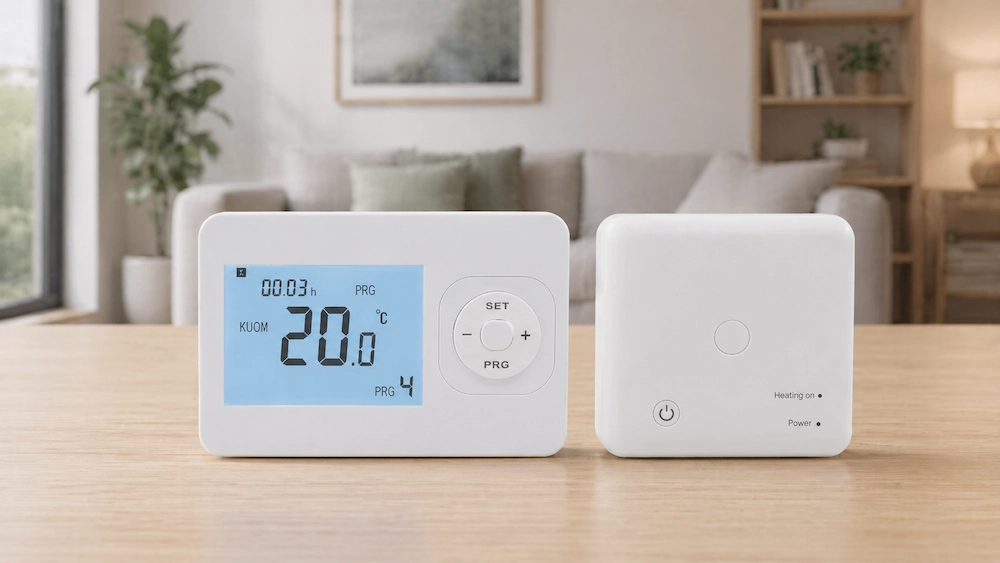
A wired thermostat uses physical cables for power and control. A wireless thermostat uses wireless communication between the room unit and receiver.
Both can control temperature. But the project choice is different.
| Item | Wireless Thermostat | Wired Thermostat |
|---|---|---|
| Installation | Easier in finished rooms | Needs control wiring |
| Room placement | More flexible | Limited by wiring point |
| Signal risk | Needs stable wireless signal | More stable through cable |
| Best use | Retrofit, villa, apartment, renovation | New build, planned wiring, fixed projects |
| Main check | Range, pairing, receiver output | Wiring, voltage, terminal definition |
A wireless thermostat is usually better when wiring is difficult or expensive. A wired thermostat is usually better when the project already has a clear wiring plan.
For overseas buyers, both types may be needed in a product line. Wireless models are easier to sell for renovation and home upgrade projects. Wired models are often preferred for new building projects.
Main Parts of a Wireless Thermostat System
A wireless thermostat is not just one device. It is usually a matched system.
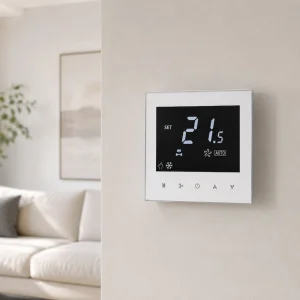
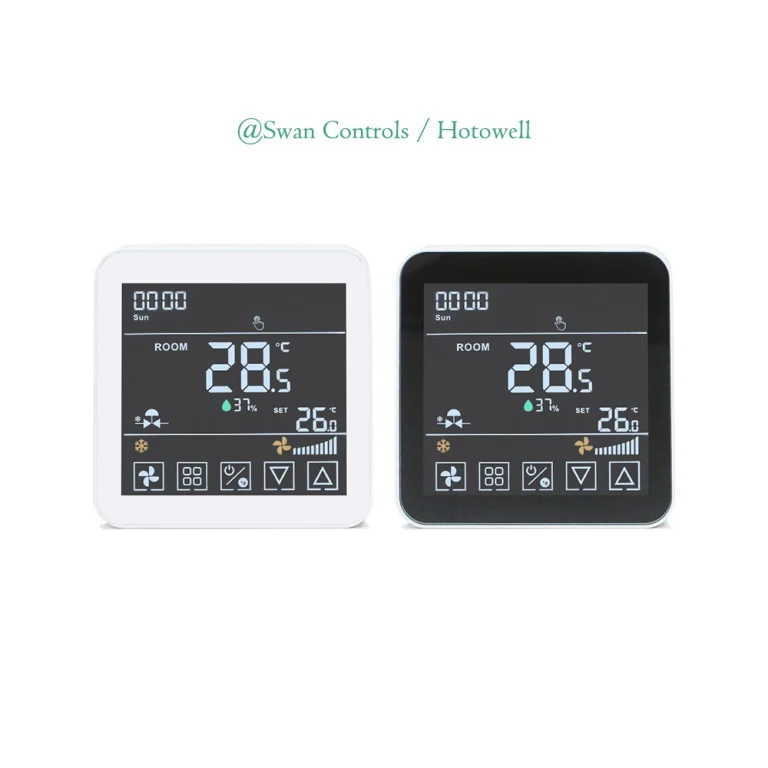
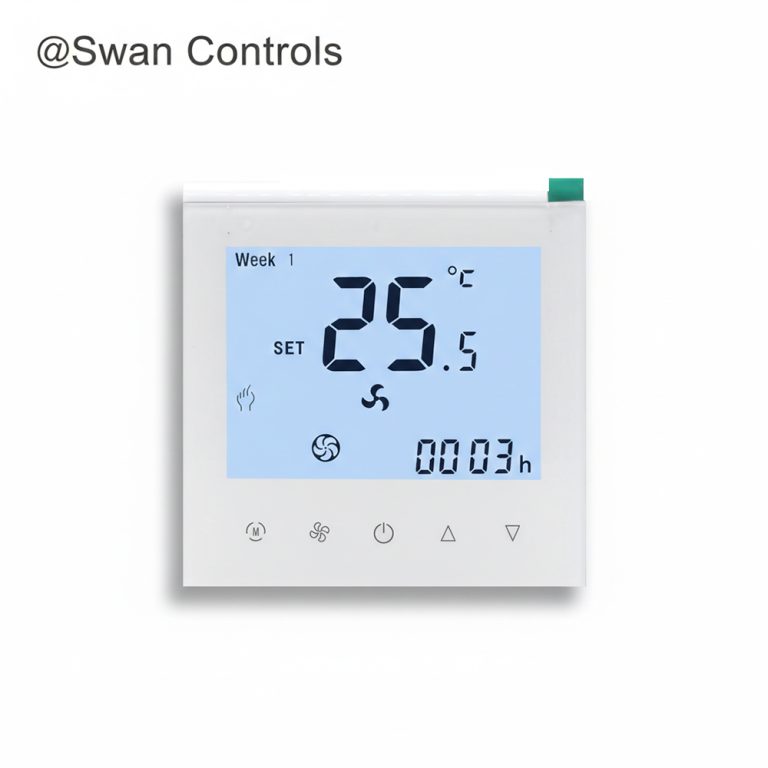
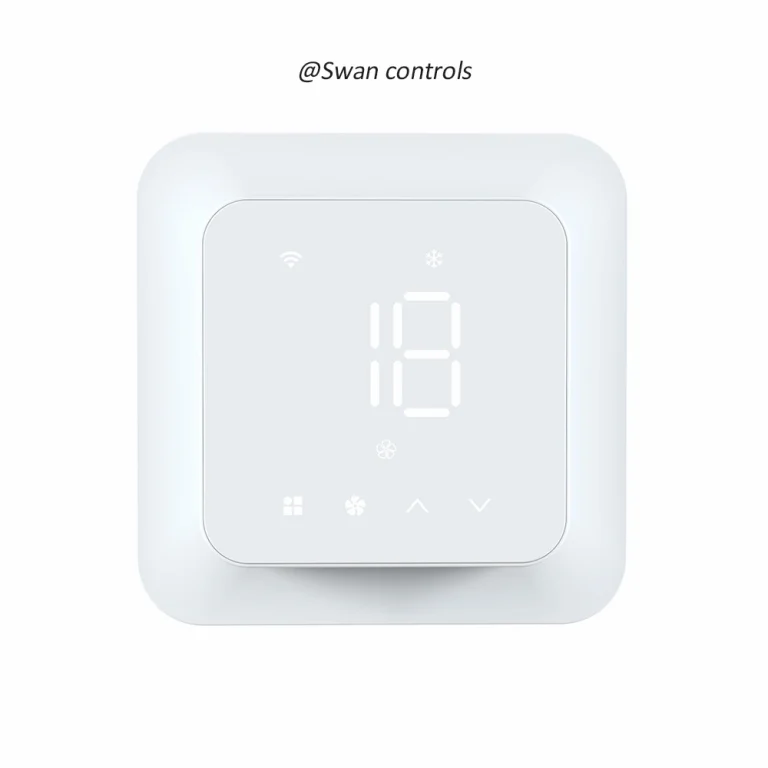
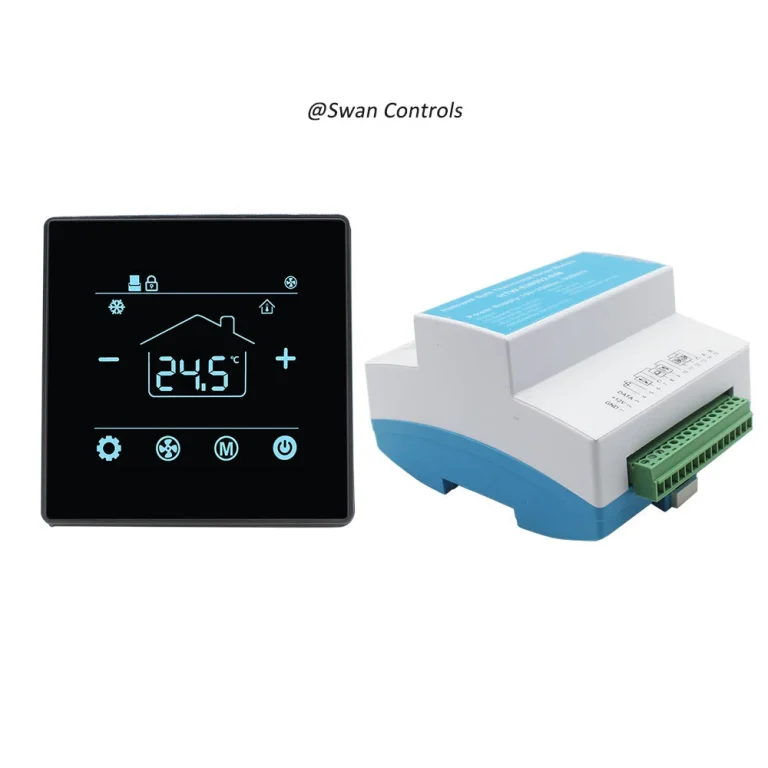
The room thermostat is the user-facing part. It has the display, buttons, sensor, setpoint, and operating mode. It may be powered by batteries, USB, or mains power depending on the design.
The receiver is the equipment-facing part. It receives the signal and controls the output. It is usually wired to the boiler, valve, heating system, or other HVAC load.
Main parts include:
- Temperature sensor
- User display
- Wireless communication module
- Receiver module
- Relay output
- Power supply circuit
- Pairing button or setup logic
The receiver is very important. If the receiver output does not match the system, the wireless thermostat cannot control the equipment correctly.
For example, a boiler project may need dry contact output. A fan coil project may need fan and valve output. A water heating project may need a relay output with suitable load rating.
This is why buyers should check both the thermostat and the receiver, not only the room display.
Common Applications of Wireless Room Thermostats
A wireless room thermostat is most useful when installation flexibility is important.
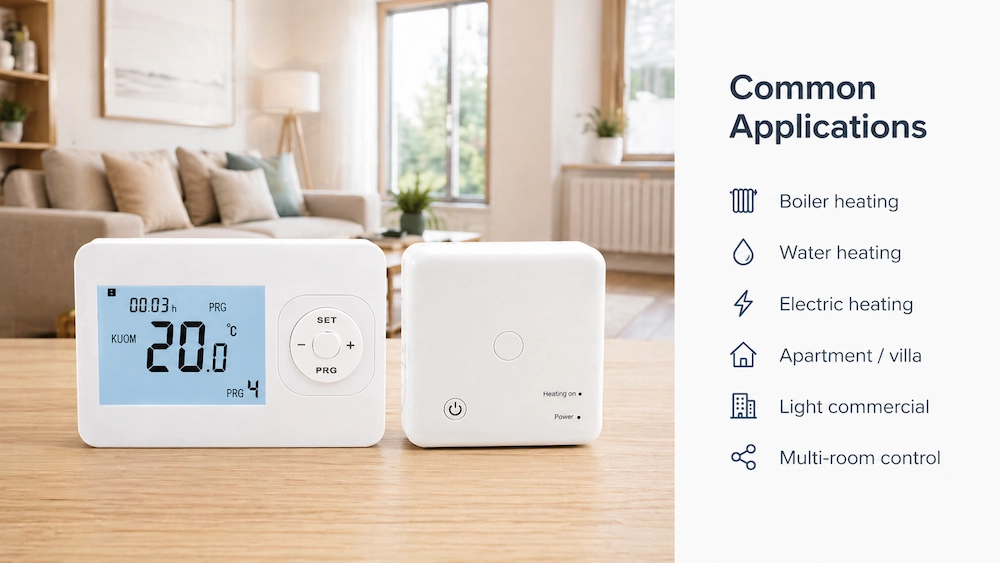
Common applications include:
- Residential boiler heating
- Water heating systems
- Electric heating systems
- Apartment renovation
- Villa heating control
- Finished homes without control wiring
- Light commercial rooms
- Multi-room heating control
In a home renovation project, running new control wires can be costly and messy. A wireless thermostat can avoid wall breaking and reduce installation time.
In a villa or multi-room project, the user may want different temperature control in different rooms. Wireless room units can provide flexible placement and easier zone control.
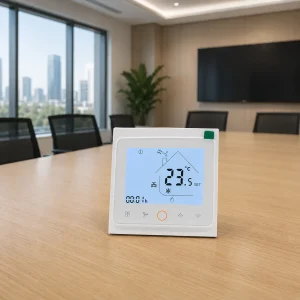
In a small office or shop, the thermostat can be placed where people actually stay, not only where wiring is available. This can improve temperature reading and comfort.
However, buyers should still check range and wall interference. Wireless does not mean unlimited distance. Building structure can affect signal quality.
Key Benefits of a Wireless Thermostat
The biggest benefit is easier installation. But that is not the only benefit.
A wireless thermostat can also improve room control by allowing better thermostat placement. A wired thermostat is often fixed near a wiring point. That point may not be the best position for temperature sensing. A wireless model can be placed in a more suitable room area.
Main benefits include:
- No long control cable needed
- Better for finished rooms
- More flexible thermostat location
- Faster retrofit installation
- Useful for multi-room control
- Less wall damage during installation
- Easier upgrade from manual control
For home users, this means less disruption. For contractors, it means faster installation. For distributors, it creates a stronger product option for retrofit and renovation markets.
For OEM buyers, wireless thermostat models can also support a higher-value product line. The product is easier to position as modern, flexible, and installation-friendly.
Possible Risks and Buyer Checks
A wireless thermostat also has risks. Buyers should not ignore them.
The most common risk is weak signal. Walls, metal cabinets, long distance, and electrical interference can affect communication. If the thermostat and receiver lose connection, control may become unstable.
Other risks include:
- Battery replacement if the room unit is battery powered
- Pairing failure during installation
- Wrong receiver output
- Signal delay
- User confusion during setup
- Different frequency requirements by market
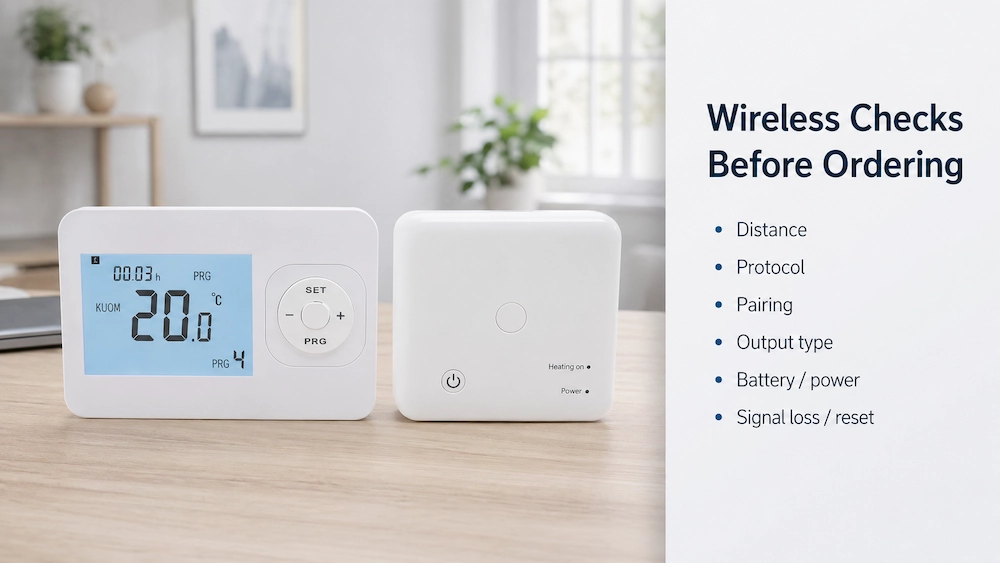
Before ordering, buyers should check:
- Wireless communication distance
- Frequency or protocol
- Pairing method
- Receiver output type
- Battery life or power supply
- Signal loss protection logic
- Manual reset or re-pairing process
For overseas buyers, frequency requirements can be important. Different markets may have different wireless regulations. Buyers should confirm local compliance needs before bulk order.
How to Choose the Right Wireless Thermostat
The right wireless thermostat should match the project, system, and user.
For home heating, simple operation is important. Users should be able to set temperature without reading a long manual. For commercial or light project use, receiver reliability and stable pairing become more important.
Key selection points include:
- Choose the correct receiver output for the HVAC system.
- Check wireless range for real building conditions.
- Confirm battery life or power method.
- Make sure pairing is simple.
- Check sensor accuracy and control deviation.
- Review relay rating and load capacity.
- Ask for a clear wiring diagram for the receiver.
- Confirm OEM options if needed.
A wireless room thermostat is often a better choice for retrofit homes, apartments, villas, and projects where the control point is far from the equipment.
A wired thermostat may still be better for large commercial buildings, new construction, or projects where long-term signal stability is the top priority.
The best choice depends on the application. Buyers should not select wireless only because it sounds modern. They should choose it when wireless control solves a real installation or comfort problem.
Related products reference:
Electric Underfloor Thermostat
Scientific Data
The data below gives practical reference values for wireless thermostat selection. Actual performance depends on wall material, distance, receiver design, power supply, HVAC load, and installation quality.
| Check Item | Typical Reference Value | Buyer Meaning |
|---|---|---|
| Indoor wireless range | 20 m to 30 m typical | Walls and floors can reduce signal strength. |
| Open-area wireless range | 50 m to 100 m possible | Best-case range is not equal to real building range. |
| Temperature accuracy | ±0.5°C to ±1.0°C | Better accuracy gives more stable comfort. |
| Comfort deviation range | ±1.0°C to ±2.0°C | Larger deviation may cause complaints. |
| Poor placement temperature error | 2°C to 3°C possible | Sunlight or airflow can affect the room unit. |
| Battery life reference | 6 to 24 months by model | Battery-powered units need maintenance planning. |
| Relay mechanical life reference | 100,000 to 1,000,000 cycles | Higher life supports long-term receiver reliability. |
| Typical room fan noise reference | 30 dB to 45 dB | Important when controlling fan coil applications. |
These values show why wireless thermostat selection needs more than a product photo. Wireless range can look strong in an open area, but real buildings are different. Concrete walls, metal doors, electrical panels, and long distance can reduce signal strength.
Temperature accuracy also matters. If the room unit is placed near sunlight, a window, or a heat source, the reading may shift by 2°C to 3°C. The system may stop too early or run too long.
Battery life is another practical factor. A battery-powered wireless thermostat is easy to install, but users must replace batteries. For rental or commercial rooms, this maintenance point should be considered before selection.
Relay life is important because the receiver handles the real switching. A stronger relay supports more stable long-term control, especially when the thermostat operates many times each day.
Practical Cases
Case 1: A home renovation project needed heating control, but the walls were already finished. Running new wires would increase cost and damage decoration. A wireless thermostat was used. The room unit was placed in the living area, and the receiver was installed near the boiler.
Case 2: A villa project needed temperature control in several rooms. Wireless room thermostats were selected to reduce wiring work. Each room could have a better thermostat position. The system became easier to adjust for different living areas.
Case 3: A small office had a wired thermostat installed near the equipment room door. The temperature reading did not reflect the working area. A wireless room thermostat allowed better placement near the occupied space. Comfort improved after relocation.
These cases show the real value of wireless control. It is not just about removing wires. It is about placing the thermostat where control makes sense.
Expert Insights
Wireless thermostat demand is growing because many projects are retrofit projects. Buyers want easier installation and lower renovation cost. Wireless control helps meet this demand.
However, industry experience also shows that wireless products must be selected carefully. Signal stability, receiver output, relay reliability, and pairing logic are just as important as the room unit design.
For overseas buyers, a good wireless thermostat supplier should provide clear receiver wiring diagrams, signal range information, pairing instructions, and application guidance. These documents reduce installation risk and after-sales questions.
For OEM buyers, wireless thermostat products can be a strong product line. But the packaging and manual must explain the room unit and receiver clearly. Otherwise, users may not understand how the system works.
Final Selection Checklist
| Check Point | Why It Matters | Recommended Action |
|---|---|---|
| Application | Different systems need different outputs. | Confirm boiler, heating, FCU, or valve control. |
| Receiver output | The receiver controls the real equipment. | Check relay, dry contact, or load output. |
| Wireless range | Walls can reduce communication distance. | Test range in real building conditions. |
| Pairing method | Difficult pairing increases installation issues. | Choose simple pairing and reset logic. |
| Power supply | Battery and mains power need different maintenance. | Confirm battery life or power wiring. |
| Sensor accuracy | Poor sensing affects comfort. | Check accuracy and placement guidance. |
| Documentation | Installers need clear guidance. | Request manual and wiring diagram before order. |
This checklist helps buyers reduce product selection risk. The best wireless thermostat is not only the one with the longest advertised range. It is the one that fits the system, building, user, and installation condition.
FAQ
1. What is a wireless thermostat?
A wireless thermostat is a thermostat that sends control signals to a receiver without a direct control wire between the room unit and HVAC equipment.
2. How does a wireless thermostat work?
It measures room temperature, compares it with the setpoint, and sends a wireless signal to the receiver to start or stop heating or cooling.
3. Is a wireless room thermostat better than a wired thermostat?
It is better when wiring is difficult, the room is already finished, or flexible placement is needed. Wired thermostats may still be better for fixed new-build projects.
4. What should buyers check before ordering a wireless thermostat?
Buyers should check wireless range, receiver output, pairing method, power supply, relay rating, sensor accuracy, wiring diagram, and system compatibility.
5. Can a wireless thermostat be used for boiler heating?
Yes, if the receiver output matches the boiler control requirement, such as dry contact output or the required relay logic.
A wireless thermostat is a practical choice when wiring is difficult, room placement needs flexibility, or retrofit installation matters. Buyers should not only check the room unit. The receiver, wireless range, pairing process, relay output, and system compatibility are equally important. A wireless room thermostat works best when it solves a real installation problem and still provides stable control.
References / Sources
- U.S. Department of Energy, Energy Saver — Thermostat Operation Guidance
- ENERGY STAR — Smart Thermostats Product Criteria and Energy Guidance
- ASHRAE — ASHRAE Handbook: Fundamentals, Thermal Comfort
- ASHRAE — Fundamentals of HVAC Control Systems
- Honeywell Home — Wireless Thermostat User and Installation Guides
- Siemens Building Technologies — Room Thermostat and HVAC Control Literature
- Schneider Electric — Room Control and Building Management System Resources
- Danfoss — Room Thermostat and Heating Control Technical Publications
- Johnson Controls — Building Automation and Room Control Application Materials
- Carrier — HVAC Control and Thermostat Application Guides
- Trane — Building Comfort Control and HVAC System Resources
- National Institute of Standards and Technology (NIST) — Building Energy and Control Performance Research