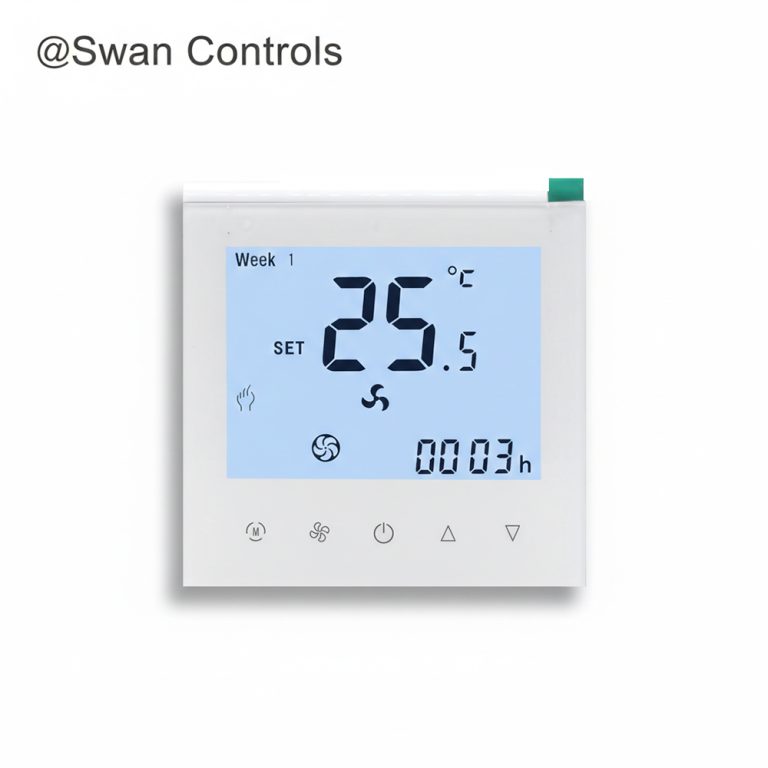
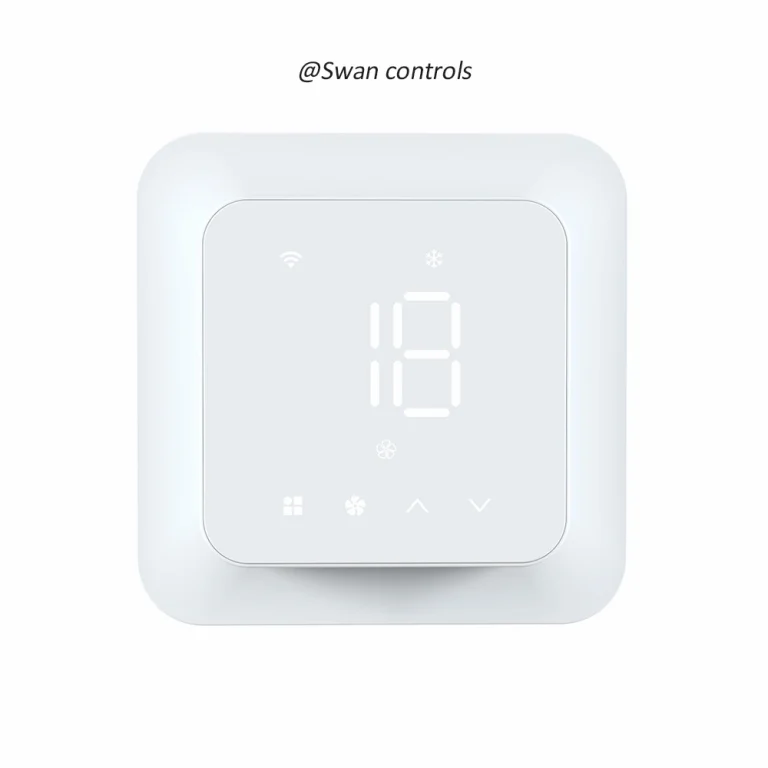
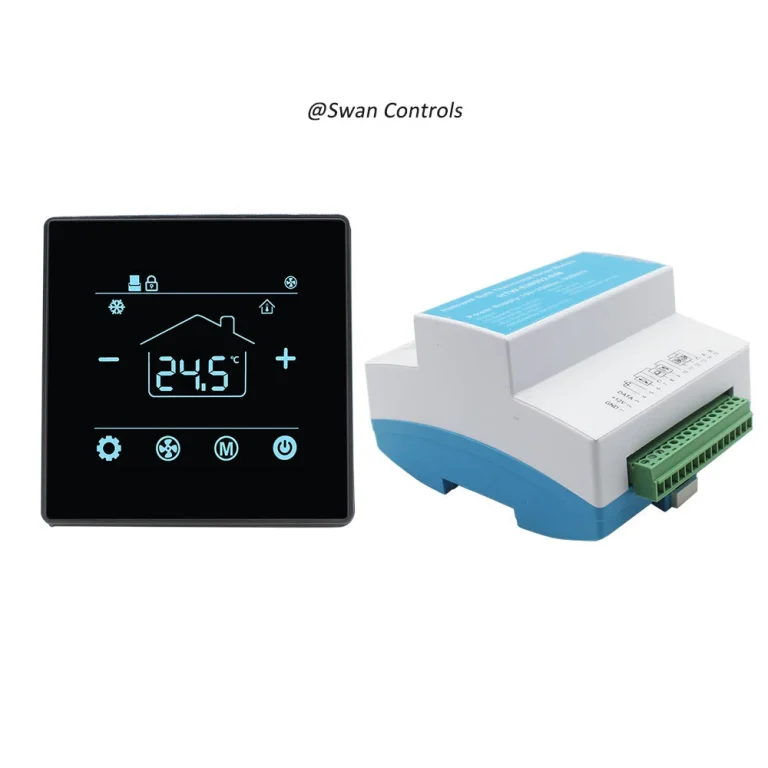
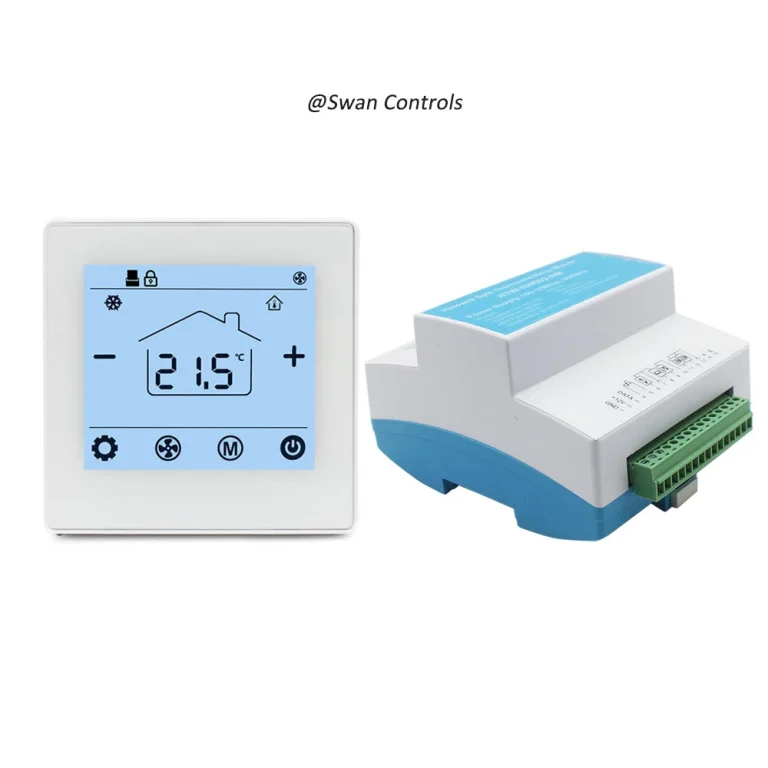
“Can you send us your thermostat specification?”
“Yes, but before that, we need to confirm the application, voltage, output, protocol, and compliance target.”
That is a much better starting point for export thermostat projects. In cross-border HVAC business, a thermostat specification is not only a product description. It is also a risk-control tool. If the specification is too general, the project may run into the wrong output type, field wiring confusion, compliance delay, market-entry problems, or repeated after-sales clarification.
In many export cases, the product itself is not the real problem. The real problem is that the thermostat was not specified clearly enough before quotation, approval, or shipment. That is why a practical export specification should define the real control requirement, not just the product name, screen style, or voltage range.
Quick Summary
For export projects, a thermostat specification should define more than model name and voltage. Buyers should confirm the HVAC application, control logic, sensor setup, output type, communication requirement, compliance target, and documentation package before order confirmation. A room thermostat that looks acceptable in a simple quotation may still be unsuitable for a hotel, boiler, water heating, or PICV project if these points are not written clearly.
Quick Summary: The 5 Specification Points That Prevent Most Export Problems
If buyers want a thermostat export project to move smoothly, five points should be written clearly from the beginning: application, voltage, output type, protocol requirement, and compliance scope. These five points reduce the most common downstream problems. When one of them is vague, the project often becomes harder to approve, harder to install, and harder to support. When all five are clear, quotation becomes more accurate and the thermostat becomes much easier to compare across suppliers.
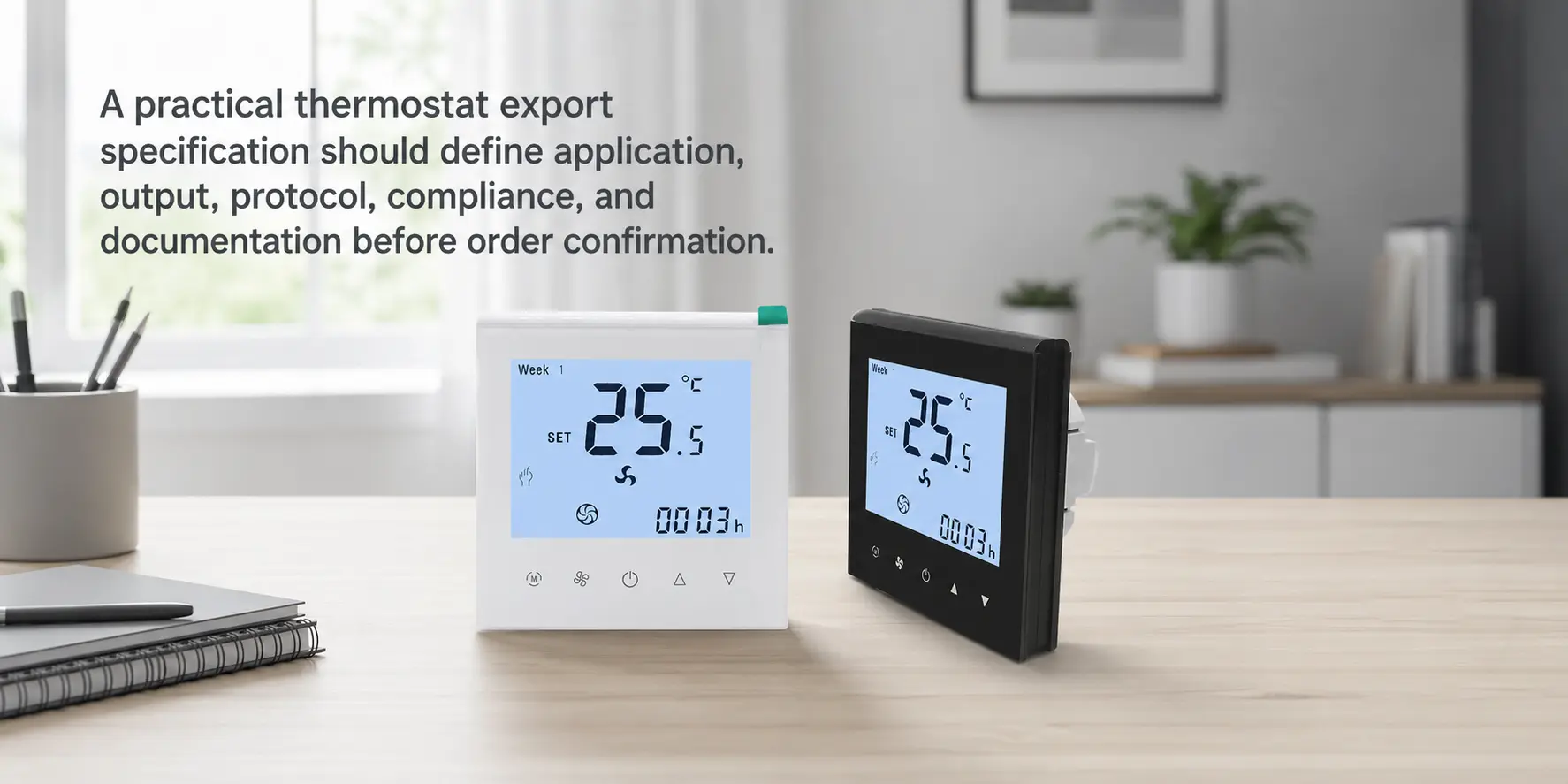
Why Export Thermostat Specifications Need More Than a Basic Datasheet
A basic datasheet may be enough for a simple local purchase, but export projects usually involve more risk. The buyer, installer, importer, distributor, and end customer may all be in different countries and may not interpret the same product wording in the same way. A specification that looks “clear enough” inside one factory or one local market may create confusion after shipment.
This is why export thermostat specifications should be written as project documents, not only as product summaries. A practical export specification should help answer the questions that matter later: what system is this thermostat for, what power supply does it need, what does it switch, what protocol does it use, what compliance path applies, and what documents will the buyer receive with it? If those answers are already clear, the project usually becomes easier at every later stage.
Start with the HVAC Application
The first item in any export thermostat specification should be the application. Without this, the rest of the specification becomes less reliable. The same thermostat category can look similar across different projects, but the control role may be completely different.
Boiler heating thermostat
If the thermostat is for boiler heating, the specification should say so clearly. The buyer should know whether the thermostat is being used for simple heating demand, a more defined power arrangement, or a project that also requires communication support. A product such as a 220V boiler thermostat with Modbus or a house thermostat for water heating and boiler heating becomes easier to evaluate once the application is stated explicitly.
Water heating thermostat
Water heating projects should also be defined clearly in the specification, especially where switching logic and target load are concerned. If the project is for water heating, that should be written before later details such as icon style or surface finish. A dedicated 3A water heating thermostat usually makes more sense in this context than a generic room thermostat described too generally.
PICV or commercial room control thermostat
Commercial room control projects often require more precise output logic, integration, or valve-related control. If the thermostat is for PICV or a similar commercial room-control role, the export specification should make that clear from the start. A 24VDC output PICV thermostat with Modbus is easier to specify correctly when the intended application is already defined.
Hotel room thermostat with keycard logic
Hotel projects need even clearer application wording because the thermostat may be part of an occupancy or keycard-linked control strategy rather than only a local temperature display. In that case, the specification should refer to guest room HVAC use, occupancy or keycard logic, and the expected room-control behaviour. A keycard HVAC thermostat should be specified as part of a hospitality control solution, not just as a wall thermostat.
If the application is not clearly specified, every later technical parameter becomes harder to interpret.
Define Voltage, Power Supply, and Wiring Category Clearly
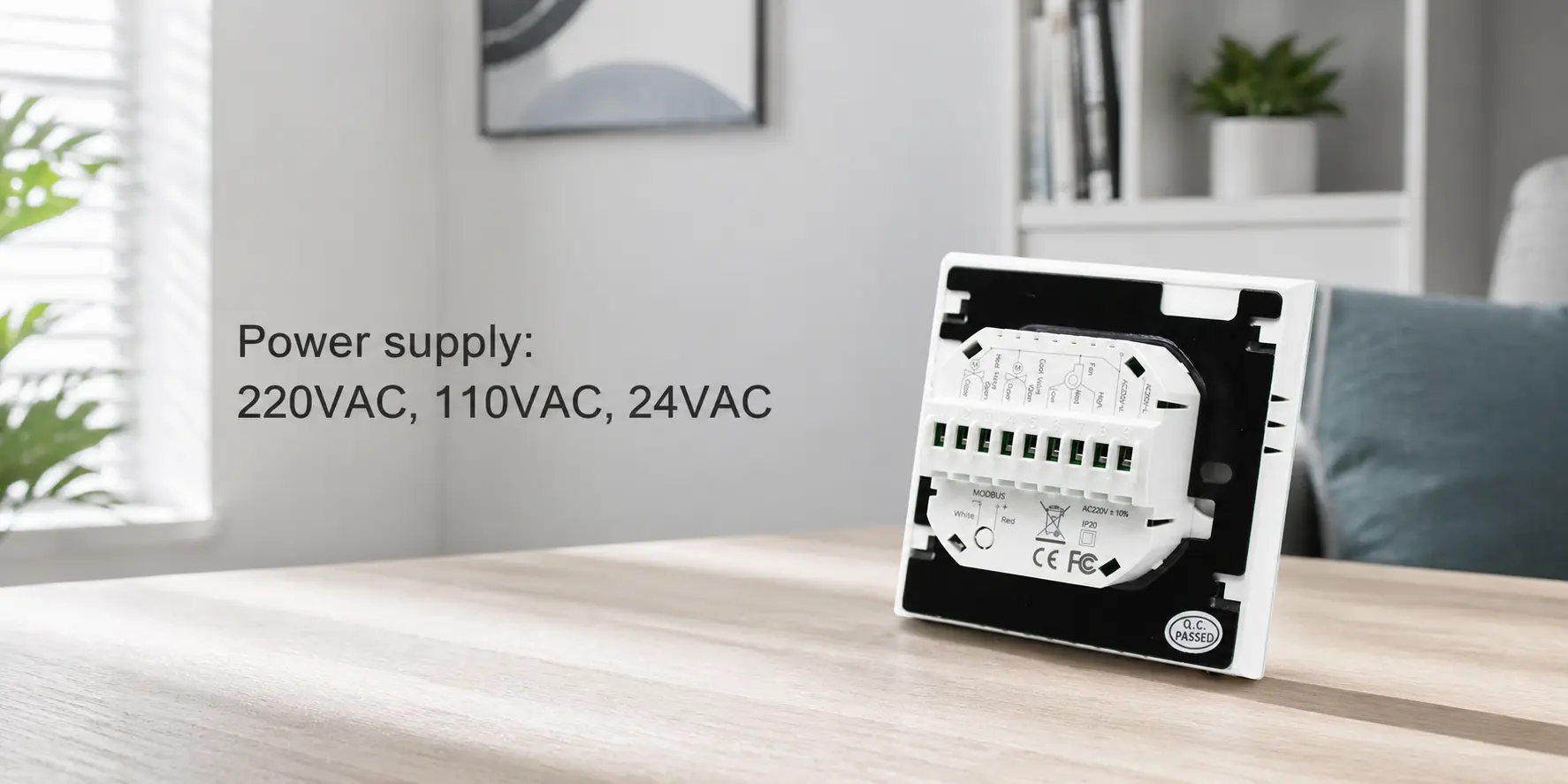
The next step is to state the electrical category correctly. Export thermostat specifications should not simply say “power supply supported” or “works with HVAC.” They should define whether the project is low-voltage or line-voltage, what the supply range is, and whether any wiring dependencies such as a common wire apply.
This point matters because not all thermostats belong to the same wiring category. Some products are intended for 24 VAC low-voltage applications. Others are not intended for line-voltage electric heating. Some also depend on a common wire for stable operation. If this is not written clearly in the specification, confusion often appears later during installation, project approval, or field troubleshooting.
| Item to Specify | Why It Matters |
|---|---|
| Power supply | Prevents field mismatch and wrong transformer assumptions |
| Low-voltage or line-voltage category | Changes product class and compatibility expectations |
| Common wire requirement | Affects installation and compatibility |
| Terminal role | Avoids wrong field wiring and wrong control assumptions |
Specify the Output Type, Not Just the Function
One of the biggest export mistakes is writing the function but not the output type. Saying that the thermostat is “for heating,” “for fan coil,” or “for hotel room use” is not enough. The specification should also define how the thermostat interacts with the controlled device.
Dry contact or simple on/off output
For many boiler and simple heating applications, dry contact or on/off logic is sufficient. If that is the expected control method, it should be stated directly in the export specification so there is no confusion between communication capability and actual switching logic.
Relay output for water heating or fan control
In some projects, the thermostat is switching a heating or fan-related load through relay logic. In these cases, the specification should describe relay-based control clearly enough to avoid misunderstanding at the equipment side.
24VDC output for PICV or valve logic
Commercial control applications often need more than a simple relay thermostat. If the target device requires a 24VDC output, this must be written explicitly in the specification. Otherwise, a visually similar thermostat may be selected and later prove unsuitable for the field device.
Communication features are not the same as load outputs
This point should be written very clearly in export documents: Modbus, WiFi, app control, or other communication features are not the same as the actual control output to the load. A thermostat may support communication and still not provide the correct output logic for the target device.

Sensor and Control Logic Should Also Be Written Into the Spec
Many export thermostat specifications mention temperature control but do not explain how the thermostat is expected to sense the relevant condition. That is a weakness. If the project depends on built-in sensing, remote room sensing, pipe sensing, changeover logic, or keycard/occupancy-related control, the specification should say so clearly.
This matters because the sensor arrangement may directly affect how the thermostat works in the room. A built-in room sensor may be enough for one project. Another project may need remote sensing because the thermostat location is not the best measuring location. In hydronic or hotel projects, the thermostat may also need changeover or occupancy-related logic, which should be specified rather than left for later discussion.
A good export specification does not list every possible sensor in the market. It identifies the sensing method that the project actually needs.
Protocol, Integration, and Ecosystem Requirements
Today, many thermostat export projects involve more than local wall control. Some need app-based residential control. Some need Modbus for building-level supervision. Some may target smart-home ecosystems where interoperability matters to the channel or to the final buyer.
This is where protocol needs should be stated as part of the specification, not treated as an optional afterthought. If the project needs Modbus, the specification should say so. If the project needs app-side control, that should be stated too. If the project wants broader smart-home interoperability, the ecosystem requirement should also be made explicit.
This point matters because interoperability is increasingly part of product value. Matter is described officially as a unifying, IP-based connectivity protocol built on proven technologies that helps manufacturers connect to and build reliable, secure IoT ecosystems while accelerating paths to market. In practical export terms, that means protocol choice can affect not only engineering, but also channel acceptance and product positioning.
Compliance and Market Requirements Must Be Confirmed Early
Compliance should not be treated as a final-stage checklist item. For export thermostat projects, it should be part of the initial specification process. If the target market is not clear, the required documentation and technical path may also remain unclear.
For example, the European Commission explains that the Low Voltage Directive covers health and safety risks for electrical equipment within defined voltage ranges, while electrical and electronic equipment in the EU may also be affected by the EMC Directive. The same official EU material on CE marking explains that CE indicates the product has been assessed to meet high safety, health, and environmental protection requirements where applicable. In practical terms, that means a thermostat export project may need to consider more than one requirement depending on the product type and target market.
EU materials on RoHS also make clear that hazardous substance restrictions form part of the wider compliance picture for electrical and electronic equipment. For buyers, the practical takeaway is straightforward: target market and compliance scope should be written into the thermostat specification process early enough to guide product selection, document preparation, and approval planning.

A Good Export Specification Also Includes Documentation
Documentation is part of the product. In export thermostat business, a shipment without clear documents often becomes a service issue later. That is why a good export specification should define not only the thermostat itself, but also the documentation package expected with it.
This package may include the datasheet, installation guide, wiring diagram, user manual, carton and label information, model code explanation, and any relevant market-entry or compliance documents required for the destination market. These materials should not be treated as extra paperwork. They are part of how the buyer understands, approves, installs, sells, and supports the thermostat.
For distributors, project buyers, and OEM/ODM customers, good documentation also reduces repetitive technical clarification. This saves time for both sides.
Expert Commentary: Export Thermostat Problems Usually Start in the Specification Stage
From a project perspective, many export thermostat problems begin before the first sample is shipped. They begin when the specification is too general. The buyer asks for a thermostat, the supplier sends a quotation, and both sides assume they are discussing the same product category. Later, it becomes clear that the project actually needed a different output type, different room logic, different protocol, or a clearer compliance path.
This is why a practical export specification is more valuable than a broad product request. It turns a general thermostat discussion into a project-defined thermostat discussion. That usually leads to faster quoting, fewer revisions, clearer approval, and fewer installation problems later.
In real export work, clear specification often matters more than the product appearance itself. We support export thermostat projects for boiler heating, water heating, hotel HVAC, and PICV applications where clear specification helps reduce mismatch and improve project efficiency. Buyers comparing options such as a boiler thermostat, a water heating thermostat, a PICV thermostat, or a hotel keycard thermostat usually benefit most when the project specification is written around the real control role first.
Scientific Data and Industry Direction
The thermostat category is becoming more structured, not less. ENERGY STAR explains that certified smart thermostats save about 8% of heating and cooling bills on average, or roughly $50 per year, and it also outlines key product criteria such as schedule setting, basic thermostat operation even without connectivity, and energy-related feedback. This is useful for export buyers because it shows that the market increasingly expects thermostats to be specified by real operating capability, not only by the word smart or by screen appearance.
The broader smart-home direction also points in the same direction. Matter’s official positioning focuses on reliable, secure interoperability and faster paths to market. That means protocol and ecosystem fit are now part of product value, especially for export projects that want stronger channel acceptance or future integration potential.
Together, these signals show why thermostat export specifications now need to define more than electrical basics. Function clarity, integration clarity, and documentation clarity are becoming part of the commercial value of the product.
Real-World Cases and User Feedback
Case 1: Boiler export project with unclear output definition
A buyer requested a thermostat for a heating project and focused first on appearance and voltage. Later, it became clear that the project expected a different output logic from what was assumed in the initial quotation. The problem was not only technical. It began because the specification did not describe the control expectation clearly enough.
Case 2: Hotel project without keycard or occupancy details in the spec
A hospitality project initially specified the thermostat too generally. After sample discussion, the buyer clarified that keycard-linked setback and room logic were needed. At that stage, the discussion shifted from “which thermostat model” to “which hotel control function,” which should have been defined much earlier.
Case 3: Commercial PICV project without 24VDC output and Modbus defined early
A commercial room-control project used generic thermostat wording in the early stage. Later, the project team confirmed that the field application actually needed 24VDC output and Modbus-related logic. The specification then had to be revised because the initial wording was too broad for the actual project need.
User feedback pattern: In many export thermostat projects, buyers do not complain that the specification was too detailed. They complain that it was not detailed enough when the real application and field conditions finally became clear.
A Practical Specification Checklist Before Order Confirmation
- Confirm the HVAC application.
- Confirm voltage and power supply.
- Confirm output type.
- Confirm sensor and control logic.
- Confirm protocol or integration requirement.
- Confirm target market and compliance scope.
- Confirm documentation package.
- Confirm model code and labelling details.
- Confirm sample and mass production consistency.
- Confirm the final control result expected in the project.
This checklist is simple, but it helps buyers turn a general thermostat request into a project-ready thermostat specification.
Frequently Asked Questions
1. What should be included in a thermostat specification for export projects?
A thermostat specification for export projects should normally include the HVAC application, voltage and power supply, output type, sensor or control logic, protocol requirement, target market or compliance scope, and the documentation package expected with the product.
2. Why is thermostat voltage and output type important in export orders?
Voltage and output type are important because they directly affect compatibility, installation, and control behaviour. If these points are not specified clearly, the thermostat may be approved, shipped, and installed, but still fail to work correctly with the target system.
3. Should a room thermostat specification include sensor and protocol details?
Yes. A room thermostat specification should include sensor and protocol details if the project depends on remote sensing, changeover logic, occupancy logic, Modbus, WiFi, app control, or other integration-related functions. These details should not be left as assumptions.
4. How do I specify a thermostat for hotel, boiler, or PICV projects?
You should start by defining the actual HVAC application, then state the voltage, output type, control logic, and protocol requirement clearly enough for the supplier and installer to understand the real project role of the thermostat.
5. What documents should a thermostat supplier provide for export projects?
A thermostat supplier should normally provide at least a datasheet, wiring diagram, installation guide, user manual, model code explanation, and where relevant, the compliance or market-entry documents needed for the target market.
For export projects, a thermostat specification should define the real control requirement, not just the product name. If application, voltage, output, protocol, compliance, and documents are clear, the project becomes easier to quote, easier to approve, and easier to install. That is the most practical way to reduce risk in thermostat export business.
References / Sources
- European Commission, Low Voltage Directive (LVD)
- European Commission, Electrical and Electronic Equipment Directives
- European Commission, Electromagnetic Compatibility (EMC) Directive
- European Commission, CE marking
- European Commission, RoHS Directive
- European Commission, FAQ key guidance document – RoHS
- Build with Matter, Smart Home Device Solution
- ENERGY STAR, Smart Thermostats FAQ
- ENERGY STAR, Smart Thermostats Key Product Criteria
- ENERGY STAR, Technical Bulletin: ENERGY STAR Certified Smart Thermostats