Quick Summary
A wifi thermostat improves control by adding remote adjustment, App schedules, device sharing and clearer user operation after the product is installed. It does not replace basic HVAC matching, and it should not change the installer’s main wiring logic when the correct model is selected.
A programmable thermostat improves control in a different way. It uses local schedules to reduce repeated manual adjustment. For apartments, small offices and light commercial rooms, the better choice depends on whether the project needs remote App control, local time programmes, or both.
Installation Comes First: What Must Be Confirmed Before Talking About WiFi
When we discuss better thermostat control, it is easy to start with the app, the screen, or the schedule menu. But in a real HVAC project, installation still starts with the system. And we should remember that the HVAC system is broad; it may mean AC, fan coils, heating, heat pumps, or many more.
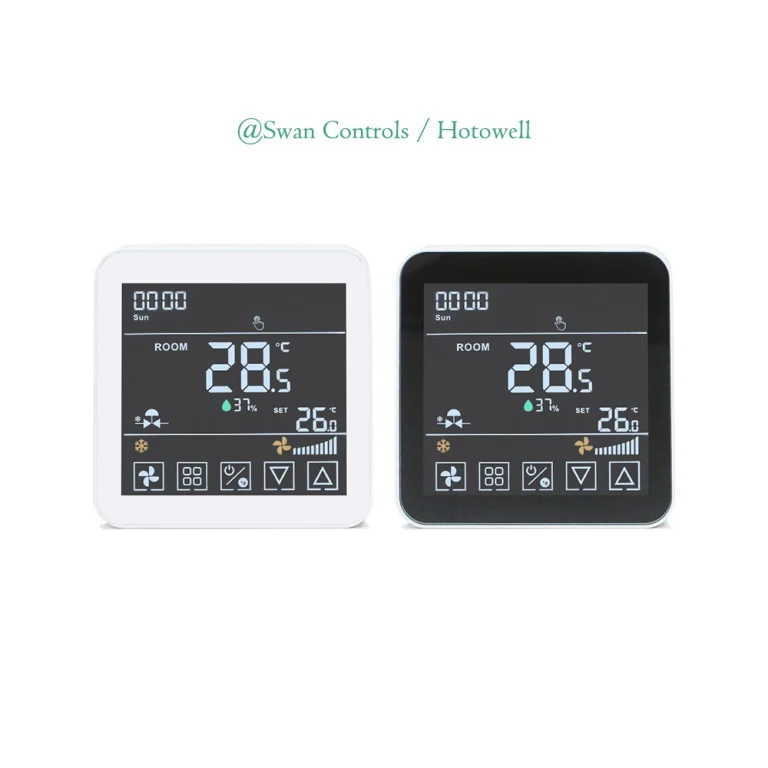
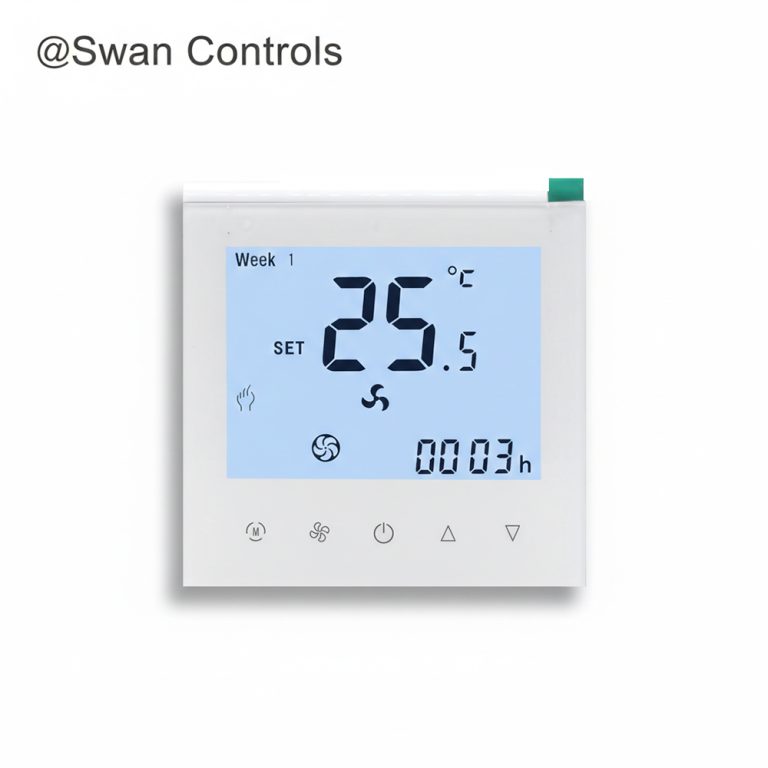
In this article, we will primarily use fan coil thermostats as examples, since we at Swan Controls—an affiliate of Hotowell—specialize more in this kind. For a fan coil system, the thermostat must match the power supply, fan type, valve output, and room control logic before any smart function becomes useful.
A wifi thermostat does not turn a 2-pipe fan coil system into a 4-pipe system. It does not make a 3-speed fan behave like an EC fan. It does not create a 0–10V valve signal if the hardware only supports on/off output. These are model and installation questions, not App questions.
To prevent these field errors, we must verify the basic electrical compatibility of the system. Specifically, four core hardware elements require verification:
-
Power Supply: Confirming whether the site requires a 110–240V AC high-voltage model or a 24V AC/DC low-voltage control thermostat to avoid product damage.
-
Fan and Valve Logic: Matching the outputs precisely to the equipment, distinguishing between 2-pipe and 4-pipe configurations, 3-speed or EC fans, and on/off versus 0–10V modulating valves.
-
Terminal Definition: Ensuring clear terminal labels and matching wiring diagrams are present so installers can complete the physical wiring with fewer questions.
-
Extra Room Requirements: Verifying if the project demands integrated auxiliary functions, such as external temperature sensors, hotel keycard inputs, or Modbus/BMS communication.
So the installation logic is clear: start with the HVAC system, then choose the control function. A wifi thermostat or programmable thermostat can improve daily use, but it cannot correct the wrong base model.
How Better Control Is Actually Added
Once the physical and electrical requirements are fully matched, the focus shifts from hardware installation to operational experience. This is where advanced features deliver their value.
Better control does not always mean more wiring. In many projects, the real improvement comes from how users set, adjust and manage the room after installation. WiFi and programmable functions are both useful, but they solve different problems.
How a WiFi Thermostat Improves Control
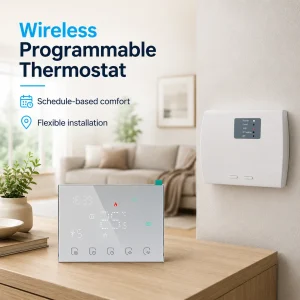
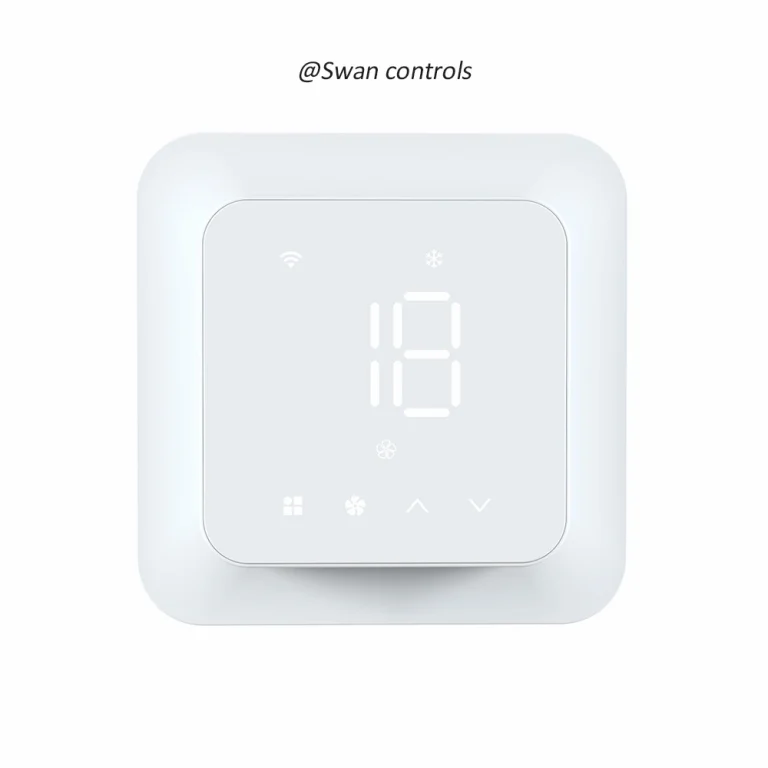
A wifi thermostat improves control mainly after installation. It gives users a more flexible way to manage room comfort without standing in front of the wall device every time.
For apartments, this may mean turning on cooling before arriving home. It may also mean checking the temperature after leaving. For small offices, a manager may adjust the room before working hours or after a schedule change. For rental rooms, App guidance can reduce repeated questions about basic operation.
Remote control is the obvious benefit, but it is not the only one.
First, it is worth remembering that a wifi thermostat already includes everything a programmable thermostat offers. We can set daily or weekly schedules directly on the device screen, just like a non-wifi model. The difference is that the App makes schedule adjustments much easier—no more pressing small buttons on the wall. We can drag time bars, copy entire weekdays, and review all periods on a phone screen.
Device sharing is also useful. In a family apartment, more than one person may need access. In a small office, one manager may share control with another staff member. This reduces dependence on one wall device or one person.
Multi-room control can also matter when the App platform supports it. It helps in apartments, clinics, classrooms, studios and small offices where several rooms need similar temperature management.
The following examples show how the same App experience maps to different system configurations:
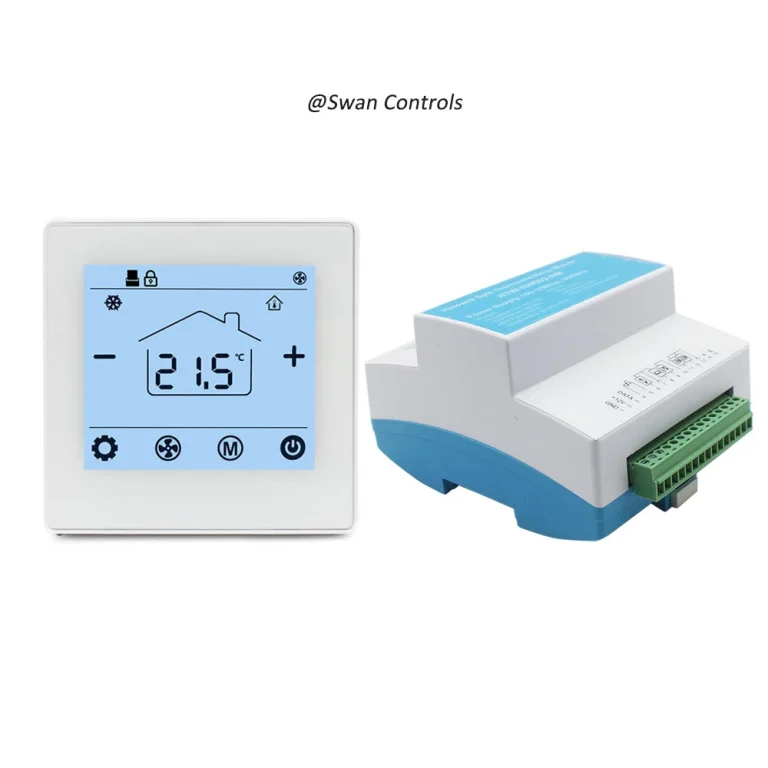
- For 2-pipe projects: Our Swam Controls thermostat HTW-WF01-FC-2W is suitable for projects requiring basic App control.
- For 4-pipe systems: The 3-speed fan 4-pipe on/off valve control with WiFi HTW-WF11-FC-4W fits this specific system logic.
- For technical projects with modulating valves: If you need WiFi, 3-speed or EC fan support, 2-pipe 0–10V modulating valve control, and 24V valve output, the our thermostat HTW-FC09-FVMN-24WF is recommended.
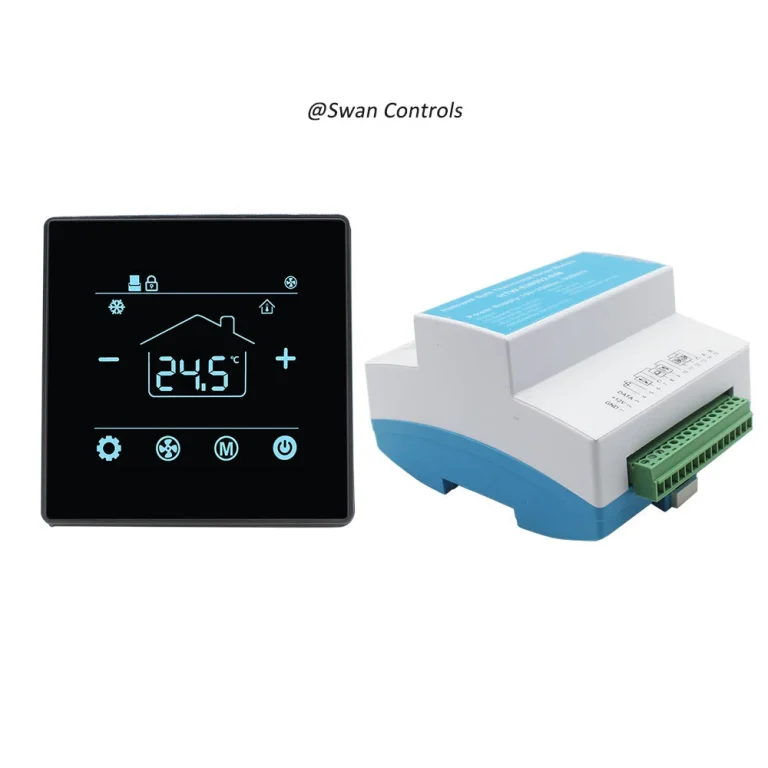
- For advanced integration: When EC fan, WiFi, Modbus, keycard, external sensor, and 2/4-pipe on/off valve control are all required, let’s consider the our advanced model Swan Controls HTW-FC08-ECNW.
The point is not to choose the longest function list. The point is to choose the model that improves control without adding unnecessary installation confusion.
How a Programmable Thermostat Improves Control
A programmable thermostat improves control through local time programmes. It does not need an App to create value. It helps the room follow a daily or weekly routine without constant manual adjustment.
This is useful when the schedule is stable. An office may need cooling from Monday to Friday during working hours. A shop may need different settings on weekends. A classroom may need heating or cooling only during fixed periods.
It is also useful when the network is weak or the user does not want App setup. The installer can set the schedule once, and the user can adjust it later from the thermostat interface.
For budget-sensitive projects, local programming can be practical. If the room only needs automatic time control, a connected model may not be necessary. A good local schedule can already solve many routine control problems.
For a 2-pipe fan coil project without App demand, standalone thermostat HTW-WF08-FC-2 can be a clean fit. It supports simple installation logic, local scheduling and stable room control.
The limitation is available. A programmable thermostat does not provide remote access unless it also has a connected function. It does not allow App sharing by itself. If users need control outside the room, WiFi becomes the better layer.
Control Improvement Comparison
| Control Need | WiFi Control | Programmable Control | Practical Decision |
|---|---|---|---|
| Remote temperature adjustment | Strong fit | Not available by itself | Choose WiFi when users need control away from the room |
| Local schedule control | Often supported, depending on model | Strong fit | Choose programmable control for stable daily routines |
| App-based schedule setting | Strong fit | Not available by itself | Choose WiFi when phone-based setting matters |
| Network-free routine control | Basic local control should remain, but App features need network | Strong fit | Choose local programming when network support is weak |
| Device sharing | Useful when supported by the App | Limited | Choose WiFi for family, office or shared-space control |
| Budget-sensitive projects | May cost more | Often simpler and more economical | Avoid WiFi if remote access is not needed |
This table shows why the choice should be based on the control problem, not on which function sounds more advanced.
Why Better Control Does Not Have to Mean Harder Installation
Some buyers worry that advanced features mean complex installation. However, a modern wifi thermostat or an advanced programmable thermostat follows the exact same basic installation routine as a traditional model. To see why, we can look at how we design these devices using the principle of hardware and software decoupling.
In any HVAC project, wiring complexity depends entirely on the equipment on site—the actual fans, valves, and power lines. If the system has a 3-speed fan, the installer must connect lines to three fan relays. If it uses a 0–10V modulating valve, the technician must handle that specific signal loop. These hard-wired steps do not change, whether we install a basic manual dial or our premium connected controllers.
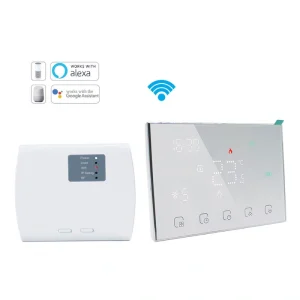
At the hardware level, we add wireless communication and advanced programming purely through chip-level integration. In our design at Swan Controls, a wifi thermostat simply includes a small wireless module and an IoT microprocessor on its main circuit board. It requires no extra signal wires or special data cables between the wall unit and the fan coil.
Similarly, a programmable thermostat uses internal software algorithms and a built-in clock to open or close those same relays automatically. It is a change in software behavior, not physical layout.
This approach creates a clear separation in time and space between physical wiring and software setup. We break the entire installation workflow into two phases:
- First is the physical installation phase, handled by the field electrician. The technician focuses only on our standard wiring diagrams: connecting the power supply, matching the high/medium/low fan terminals, and linking the valve actuators. Once secure, the installer runs a quick local test by pressing the faceplate buttons to make sure the fan runs and the valve opens. At this point, the electrical work is done.
- Second is the digital handover phase, which requires no tools and happens entirely in the software layer. Connecting the wifi thermostat to a 2.4GHz network, downloading the app, or setting up a multi-day schedule on a programmable thermostat are done on a phone or screen. Because this step involves no electrical handling, a supervisor, property manager, or end-user can easily do it later.
By separating hard wiring from digital setup, we ensure that advanced features do not create installation trouble. The real risks are simply unclear manuals or wrong model selection. When we provide clear data sheets and simple pairing guides, better control fits seamlessly onto a standard installation loop.
Technical Checks That Reduce Installation Complaints
| Check Item | Why It Matters | Risk If Ignored |
|---|---|---|
| Power supply | Confirms whether the thermostat matches site voltage | Failed installation or product damage |
| 2-pipe or 4-pipe system | Confirms heating and cooling control logic | Wrong valve operation |
| Fan type | Confirms 3-speed fan or EC fan requirement | Fan cannot run correctly |
| Valve output | Confirms on/off or 0–10V control | Valve response does not match the system |
| WiFi requirement | Confirms pairing conditions, usually 2.4GHz | Pairing failure and user complaints |
| Schedule setting | Confirms programme logic is easy to use | Wrong time periods and comfort complaints |
| Manual and handover steps | Helps installers explain operation | More after-sales questions |
This checklist keeps the discussion practical. It shows that installation complaints usually come from unclear matching or unclear guidance, not from the idea of better control itself.
Where This Matters Most in Real Projects
In apartment projects, users often care about convenience. They may want to adjust the room before coming home, share control with another family member, or check whether the temperature was changed. Here, a wifi thermostat can make the product feel easier to use. If the user only needs a stable daily routine, local programming may be enough.
In small offices, the control need is often about working hours. The room should be comfortable when people arrive, and energy should not be wasted after closing. A programmable thermostat can handle this if the schedule is stable. WiFi becomes more useful when working hours change or managers need to adjust rooms remotely.
In light commercial rooms, usage can be less predictable. Clinics, meeting rooms, studios, classrooms and small shops may have changing occupancy. If staff are always on site, local schedules can work well. If several people manage the room or the room is adjusted before use, WiFi gives more flexibility.
Hotel projects should be judged carefully. Some rooms may benefit from connected control, but hotel logic often involves keycard input, local limits, front-desk rules or BMS needs. In that case, WiFi should not be treated as the only control answer.
WiFi Thermostat vs Programmable Thermostat: Which One Should We Choose?
A wifi thermostat is usually more suitable when the project needs remote access, App schedules, device sharing or flexible room management. It is also helpful when the target market expects phone-based operation.
A programmable thermostat is usually more suitable when the project needs local schedules, simple routine control and lower dependence on network setup. It can be a strong option for stable daily use, budget-sensitive projects and sites where installers want fewer handover steps.
The choice is not about which product name sounds more advanced. It is about the real control need. If the room only needs to follow a fixed time plan, local programming may be enough. If the user needs remote adjustment and shared access, WiFi adds clear value.
If the project needs building-level management, centralized monitoring or communication with a BMS, WiFi alone is not the full answer. The buyer should check whether Modbus, BACnet or another communication method is required.
Our practical selection logic is simple: confirm the HVAC system first, confirm the installation requirement second, and then decide which control layer actually improves the project.
Common Buyer Mistakes and Consequences
The first mistake is starting with WiFi before confirming the system. A product may have App control but still fail if the project needs a different pipe system, fan output or valve signal.
The second mistake is thinking WiFi makes installation easier by itself. Installation becomes easier when the model is right, the terminals are clear, and the diagram matches the real system.
The third mistake is ignoring 2.4GHz pairing. Many smart room control products need 2.4GHz WiFi during setup. If this is not explained, users may think the product is faulty when the issue is the network.
The fourth mistake is buying too many functions for a simple room. WiFi, Modbus, keycard, external sensor and advanced valve control can all be useful, but only when the project needs them.
The fifth mistake is confusing local programming with remote control. A programmable thermostat can create automatic schedules, but it does not always provide App access. If remote control is expected, this must be checked before ordering.
The sixth mistake is not testing the full user process before delivery. A sample should be checked for wiring, output, schedule setting, App pairing, reset steps and basic user instructions.
FAQ
1. Does a wifi thermostat need special wiring?
A wifi thermostat does not always need special wiring only because it has WiFi. The wiring mainly depends on the HVAC system, power supply, fan type, valve output and control logic. The WiFi function adds App communication, but the installer still follows the terminal diagram for the selected model.
2. Can a wifi thermostat work if the WiFi network is offline?
Basic local control should remain available in a well-designed product when the WiFi network is offline. The user may lose App control, remote adjustment or cloud schedule features during the network problem, but the wall thermostat should still support normal room operation if it is wired and powered correctly.
3. Is a programmable thermostat enough for simple projects?
A programmable thermostat can be enough when the project only needs local time schedules and stable routine control. It is suitable for rooms with predictable working hours, budget-sensitive projects, or sites where App setup is not required. If remote control or device sharing is needed, WiFi should be considered.
4. What usually makes thermostat installation complicated?
Thermostat installation usually becomes complicated because of wrong model selection, unclear terminal labels, mismatched power supply, wrong fan or valve output, poor wiring diagrams, unsuitable default settings, or weak handover instructions. WiFi itself is not usually the main wiring problem.
5. Should we choose WiFi or programmable control for an HVAC project?
We should choose WiFi when the project needs remote access, App schedules, device sharing or flexible multi-room management. We should choose programmable control when the project mainly needs local schedules and simple routine operation. The final choice should always come after confirming the HVAC system and installation requirements.
References
Control Systems for Heating, Ventilating, and Air Conditioning | Roger W. Haines | Springer | Technical Book
HVAC Systems and Equipment Handbook | ASHRAE | ASHRAE | Engineering Handbook
Fundamentals of HVAC Control Systems | Steven T. Taylor | ASHRAE Learning Institute | Technical Guide
Energy Efficiency in Buildings: Thermostats and Controls | International Energy Agency | IEA | Energy Efficiency Guidance
Smart Thermostats and Energy Management in Buildings | U.S. Department of Energy | DOE | Energy Saver / Building Guidance
Wireless Networking Basics for Smart Home Devices | Wi-Fi Alliance | Wi-Fi Alliance | Technical Guidance
Building Automation and Control Systems | ISO | International Organization for Standardization | Standards Guidance
BACnet and Building Control Communication | ASHRAE | ASHRAE | Protocol Guidance
Final Note
A wifi thermostat can improve HVAC control without making installation complicated when the system match is correct, the wiring is clear, and the App setup is explained well. A programmable thermostat can also improve control when the project needs local schedules rather than remote access. For real projects, the best decision is to confirm the installation logic first, then choose the control function that actually helps the room, the installer and the end user.
@ Swan Controls / Hotowell. This article was written and published by Swan Controls, an affiliate of Hotowell, specialising in HVAC products and solution.