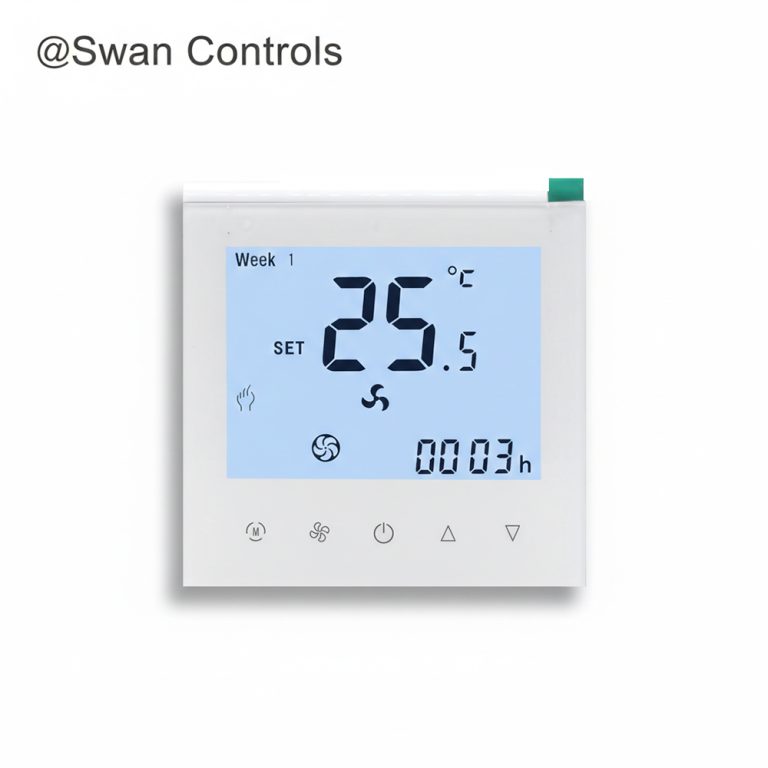
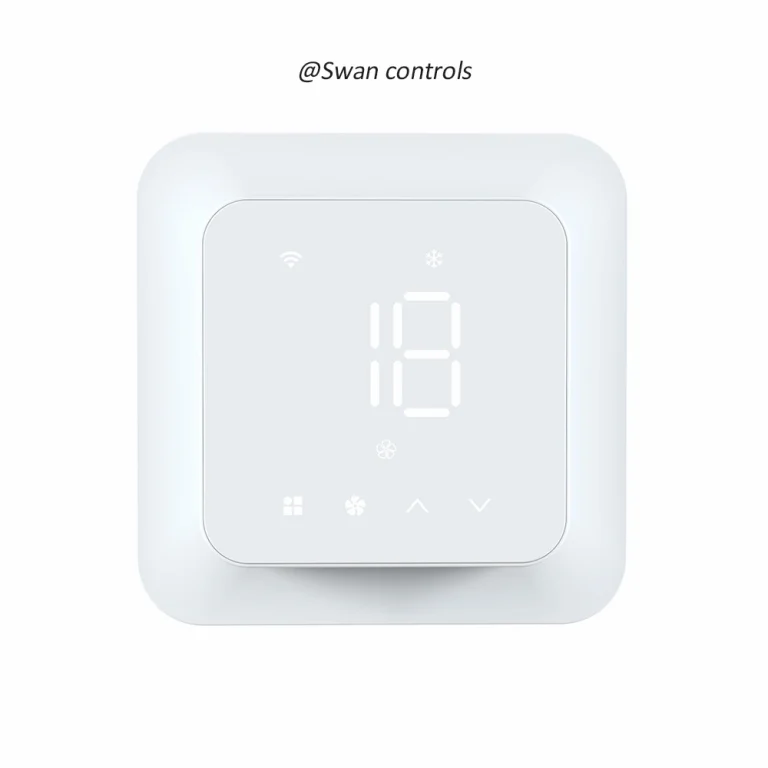
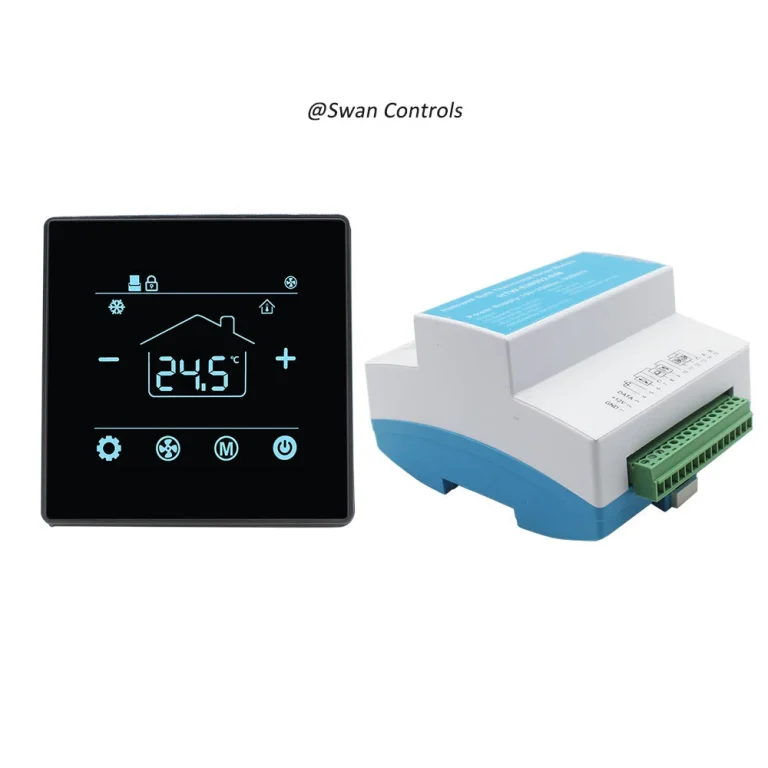
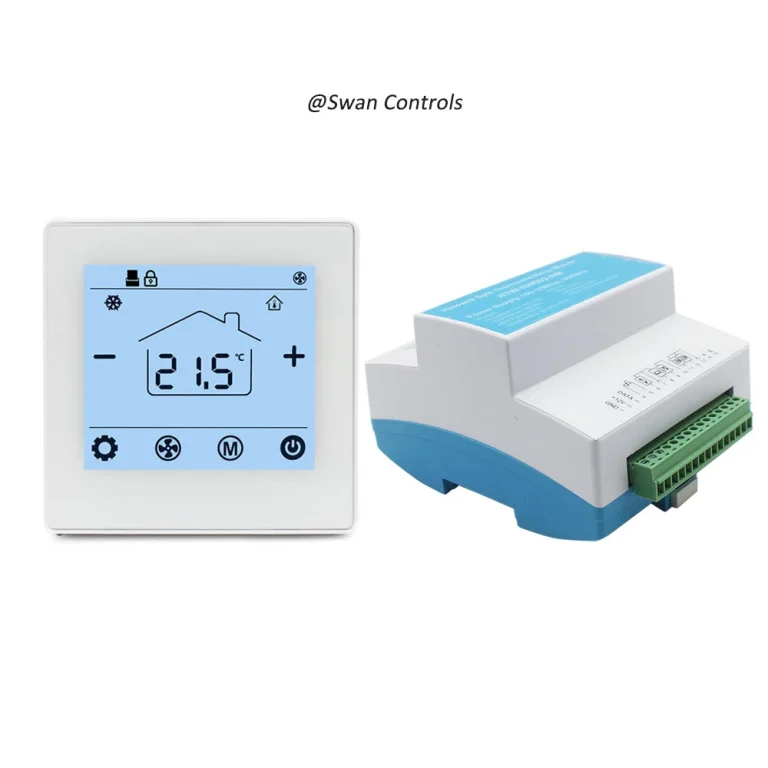
Quick Summary
Selecting a BACnet thermostat should not be based solely on the length of its function list. BACnet is a communication protocol, not the core control logic of the product. A better selection method would be to confirm the local HVAC control requirements first, then confirm the BACnet communication scope and point list. After that, decide which advanced features should be standard and which should remain optional.
The HVAC control discussed here is “fan coil system”, so the term “BACnet thermostat” is a fan coil thermostat with BACnet communication. However, the underlying principle may also be applied to other HVAC applications.
Why Overpaying Happens in BACnet Projects
Many HVAC buyers start with a clear request: the building has a BMS, so the project needs a BACnet thermostat. This is reasonable. The problem starts when BACnet is treated as the main selection standard instead of one communication feature inside a complete HVAC control product.
For fan coil unit projects, the thermostat still has to control the room equipment first. It must match the fan coil unit, valve actuator, power supply, and wall installation condition. If the local control logic is wrong, BACnet communication cannot fix it. The BMS may read the device, but the device may still fail to control the room correctly.
For example, a project may only need 3-speed fan relay control, 2-pipe on/off valve output, and basic BMS monitoring. But during selection, more options are often added: WiFi, Modbus, remote sensor, hotel keycard, EC fan output, 0–10V valve control, special firmware, private app, custom display, and special housing. These functions can be useful, but only when the site really uses them.
When an overbuilt model is selected, buyers face hidden expenses that go far beyond the initial purchase price:
Field wiring technicians get confused by excessive terminal ports that have no wires attached to them, which often leads to wiring mistakes. Local technical support teams spend hundreds of hours writing longer training manuals for features that the building will never activate. If a property manager accidentally changes an unneeded configuration setting deep within a complex parameter menu, it can disrupt the room temperature, causing immediate occupant complaints. An overbuilt product can be harder to sell, harder to install, and harder to support.
Furthermore, many system integrators charge extra programming fees for every single data point they have to map into the central automation dashboard. If you buy a device with forty communication objects but only use five of them, you are forced to spend valuable time cleaning up your automation software view. This is why simplicity in building automation directly equates to project safety.
Start With the Fan Coil System Mechanical Specifications
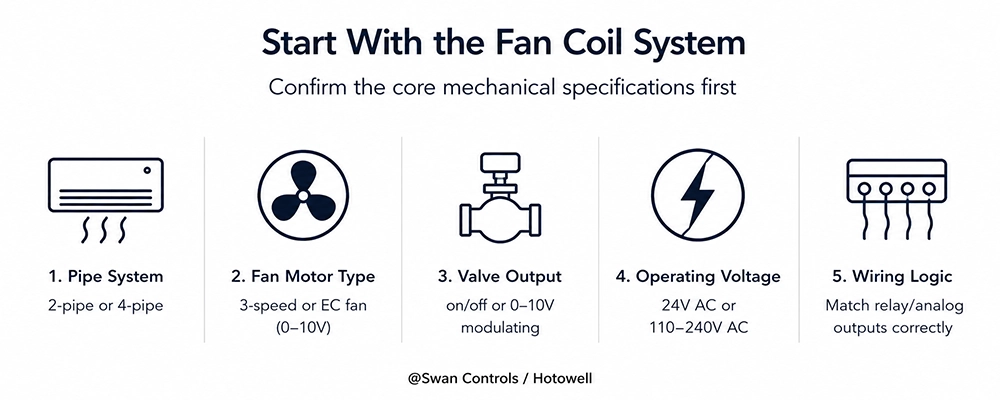
Before discussing protocols, baud rates, or network architecture, we should confirm what the fan coil thermostat must control locally. A BACnet thermostat is still a fan coil thermostat first. It must match the correct fan type, valve type, pipe system, voltage, and wiring logic. BACnet is only a data layer. It cannot correct a wrong hardware match.
The first question is whether the system is 2-pipe or 4-pipe. A 2-pipe system usually uses one water loop for heating or cooling, depending on seasonal water switching. A 4-pipe system has separate heating and cooling water loops, so the thermostat needs different control logic and separate valve outputs. If you send a 2-pipe model to a 4-pipe field location, the room will either lack heating or cooling completely because the internal microprocessor lacks the secondary relay terminal to control the independent hot water valve actuator.
The second question is the fan motor type. Many traditional fan coil units use a 3-speed fan controlled by High, Medium, and Low relays. Modern energy-saving projects may use EC fan motors that need a 0–10V analog signal. These two systems are not interchangeable. Attempting to run an EC fan motor using a standard three-speed relay setup will yield zero performance, while connecting a three-speed motor to a modulating voltage wire can cause electrical shorts and permanent equipment damage.
The third question is the valve actuator output. Some systems use simple on/off valves. Other projects need 0–10V modulating valve output to adjust water flow according to room load. If the site needs modulating control, a simple on/off model will not solve the comfort requirement, even if it communicates with BMS. The valve will either remain permanently open or tightly shut, completely destroying the energy-saving goals of the property owner.
The fourth question is operating voltage. Some projects use 24V AC control circuits. Many international FCU projects use 110–240V AC. Selecting the wrong voltage can damage the device or stop installation before communication testing begins. Connecting line voltage to a low-voltage board will instantly destroy the internal electrical components, melting the relays and rendering the sample unusable.
This is why we do not suggest asking only, “Do you have a BACnet thermostat?” A better first question is, “What fan coil mechanical system does this project use?” Once the local HVAC control parameters are clear, the communication layer becomes easier to confirm.
Confirm the BACnet Requirement Before Adding Options
After the local control parameters are clear, the next step is the Building Management System requirement. A BACnet thermostat is useful when the building needs centralized monitoring, device status, remote setpoint adjustment, scheduling, or energy management through BACnet communication.
The project buyer should confirm what the BMS team really needs to read, write, or monitor. Some projects only need basic points, such as room temperature, set temperature, working mode, fan speed, and valve status. Other projects may need alarm status, occupancy status, parameter settings, remote lock, or running hours.
It is also important to confirm technical details. Many room-side devices use BACnet MS/TP over RS485. The automation team may need device address settings, baud rate options, wiring method, termination guidance, and a clear BACnet point list. If these details are not confirmed early, field commissioning may be delayed.
A BMS-compatible thermostat should not be selected by protocol name alone. The point list matters. The wiring diagram matters. The installation manual matters. The local parameter menu matters. For OEM and wholesale buyers, these documents reduce repeated technical questions from installers. When local electricians cannot find a straightforward diagram showing how to ground the RS485 communication wire, network noise will interrupt data transmissions across the entire floor.
Separate Must-Have Functions From Optional Features
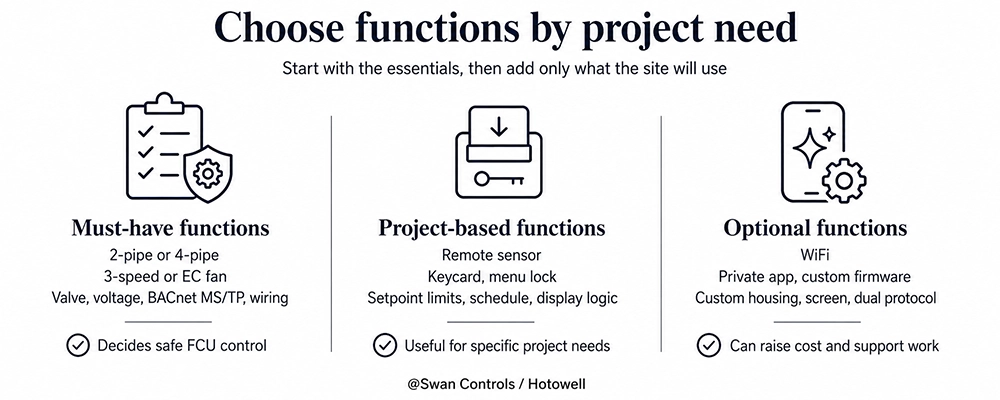
The safest way to avoid overpaying is to divide all functions into three groups. The first group is must-have functions. Without them, the fan coil thermostat cannot fit the project. The second group is project-based functions. They are valuable only when the site has a clear use case. The third group is optional functions. They may support marketing or special markets, but they should not be added by default.
| Function group | What to check | Why it matters |
|---|---|---|
| Must-have functions | 2-pipe or 4-pipe system, 3-speed fan or EC fan, on/off or 0–10V valve control, operating voltage, BACnet MS/TP hardware, clear terminal wiring diagrams. | These specifications decide whether the device can safely control the FCU and connect to the network. |
| Project-based functions | Remote sensor, hotel keycard, parameter lock, temperature limits, 7-day schedule, customized screen logic. | These are valuable when the project has a clear operational need, such as hotels, schools, or public buildings. |
| Optional functions | WiFi, private app branding, custom firmware, custom housing colours, dual-protocol communication options. | These can improve market positioning, but they may also increase unit cost and support work. |
This table keeps the discussion practical. A hotel may need keycard input and parameter lock. An office may care more about stable BMS points. An apartment may need simple user operation. Each project has a different reason to choose a room thermostat. Reviewing this structured division before finalizing a technical proposal guarantees that the commercial contract remains perfectly aligned with field realities.
Do Not Automatically Combine WiFi and BACnet Features
One common overpayment mistake is to request WiFi and BACnet on the same device without checking who will use each interface. WiFi usually serves the user side. It helps occupants with app control and remote adjustment. BACnet serves the building side. It helps the BMS read and manage room-side HVAC data.
In many offices, hospitals, and public buildings, the BMS is the main system for control, scheduling, and monitoring. In this case, room WiFi may not be necessary. Adding WiFi can increase cost, create app setup questions, raise IT approval issues, and add training work for installers. Imagine a five-hundred-room commercial office project where every single thermostat requires its own local wireless network connection. The IT department will face massive cybersecurity challenges trying to protect so many wireless IP addresses, whereas a standard wired network handles everything seamlessly.
This does not mean WiFi is wrong. Some serviced apartments, executive suites, or premium rooms may need both app access and building-level monitoring. But this should be a verified project requirement, not an automatic choice.
If the project only needs local control and app operation, a WiFi model may be enough. Our HTW-WF01-FC-2W supports 3-speed fan, 2-pipe on/off valve control, and stable WiFi for fan coil projects. If the project needs both user-side app operation and Modbus, our HTW-WF11-FC-4ENS1W supports 3-speed fan, 2/4-pipe on/off valve control, WiFi, Modbus, and remote sensor use.

Match the Product Level to the Project Type
Different building types need different levels of control. A hotel room, office, serviced apartment, and retail space may all use an HVAC thermostat, but they do not need the same feature package.
For hotels, the focus is energy saving and simple guest operation. Useful functions may include keycard input, temperature limits, parameter lock, and power recovery. The engineering team may also need BMS monitoring. But not every hotel room needs WiFi. In many hotel projects, reliable local control plus wired building integration is more practical. Hotel guests rarely want to download a separate mobile application just to adjust the temperature for a two-night stay; they prefer responsive mechanical buttons on the wall.
For office buildings, the focus is central monitoring, stable communication, and low maintenance. The BMS team usually wants to read room temperature, mode, fan speed, and operating status. A clean BACnet point list is often more valuable than unused app features. Corporate tenants do not need access to advanced settings, so locking the interface locally ensures the building operates at maximum efficiency.
For apartments, the choice depends on the sales and management model. If the apartment is centrally managed, BACnet integration may help. If units are sold to private owners, a WiFi thermostat may be more attractive. If only local comfort control is required, a simple standalone fan coil thermostat may be enough.
Use Existing Platforms Before Asking for Special Customisation
To avoid long development time, high engineering cost, and higher MOQ, we suggest matching your project requirements against tested product platforms before requesting special firmware or new hardware. OEM customization is useful, but many project needs can be covered by a standard or semi-standard platform.
| Project need | More suitable engineering direction | Example standard model |
|---|---|---|
| Basic local FCU control with 3-speed fan and 2-pipe on/off valve. No network integration needed. | Standalone programmable or non-programmable local control. | HTW-WF11-FC-2 |
| 2-pipe fan coil control with end-user app operation. | WiFi control platform for user-side convenience. | HTW-WF01-FC-2W |
| 2-pipe or 4-pipe fan coil control with WiFi and Modbus. | Cloud app access plus RS485 Modbus automation. | HTW-WF11-FC-4ENS1W |
| EC fan project requiring 0–10V signal, WiFi, Modbus, keycard, and remote sensor. | High-spec EC fan control platform. | HTW-FC08-ECNW |
| RS485 Modbus control without WiFi. External sensor needed. | Pure Modbus room control for commercial automation. | HTW-WF11-FC-2EN |
| 2-pipe or 4-pipe commercial fan coil project requiring BACnet MS/TP integration. | Native BACnet communication for BMS integration. | HTW-WF11-FC-EB |
This comparison helps both the factory sales team and the buyer speak clearly. Instead of asking for “the best model,” both sides can discuss the actual HVAC system. One buyer may only need a standalone fan coil thermostat. Another buyer may require a native BACnet thermostat because the BMS integrator has a clear point list. A third buyer may find that Modbus or WiFi is the better match. By selecting a pre-tested platform, you also gain access to complete wiring schematics, localized parameter guides, and certified hardware configurations right away, eliminating weeks of preliminary research and engineering overhead.

Conclusion: From Selection Logic to a Safer Sample Order
Let’s make a simple conclusion. Winning building project tenders does not mean you have to accept high product prices. Once your technical team builds a clear selection rule based on local mechanical needs instead of broad protocol marketing, the next right step is never a rushed price fight or quick bulk buying. Instead, the safest way forward is to write down your structural needs into a short engineering note before ordering factory samples. This direct project note must clearly check your fan coil setup, valve actuator details, fan speeds, local line voltage, wall back-box dimensions, system integration needs, and exact OEM data tracking expectations.
Taking the time to write this first plan changes your sample testing from a guessing game into a very clear technical check phase. Instead of blindly checking dozens of confusing software settings that your central building system might never use, your field team can test the exact hardware relays and BACnet communication points needed for your building. This step connects hardware matching and digital setup perfectly.
In the end, balancing low costs and high-performance climate control comes down to alignment. A wholesale distributor needs a flexible, standard room thermostat platform that lowers local stock costs and works perfectly across many commercial jobs. A mechanical contractor needs an easy terminal wiring layout that quickly shortens field setup deadlines and lowers labor costs. A brand owner focuses on private label support, lasting laser-printed logos, and clear user manuals to protect their market share.
These different business models prove that adding every optional chip into one device is an outdated buying method. By keeping your hardware matching right, keeping your protocol needs aligned with the real setup scope, and keeping advanced features tied strictly to real field use, we at Swan Controls help you get the most competitive, project-fit solution that avoids unneeded product costs completely.
Frequently Asked Questions
What is the best way to choose a BACnet thermostat?
The best way is to start with the local fan coil system, not only the protocol name. Confirm the pipe configuration, fan motor type, valve signal, voltage, wiring diagram, and wall box condition first. After the hardware matches the site, confirm the BACnet point list and BMS requirement.
Should we choose WiFi and BACnet features together?
Not always. WiFi is mainly for user-side app control, while BACnet is for BMS integration and facility management. If the project does not need app control, adding WiFi may increase cost, IT approval work, and after-sales support without clear value.
Can one single thermostat model fit all fan coil projects?
No. A fan coil thermostat must match the field equipment. A 2-pipe system, 4-pipe system, 3-speed fan, and EC fan system may all need different control logic and wiring. A wrong hardware match can cause control failure or unsafe installation.
When are optional functions worth adding to a project?
Optional functions are worth adding only when they solve a real site problem. Keycard input suits hotels. Remote sensors help when the thermostat is installed in a poor temperature location. WiFi suits serviced apartments. Custom housing suits brand projects with enough volume.
What parameters should we test before placing a bulk order?
Test the local HVAC control first, including fan relays, valve outputs, and voltage. Then test BACnet point reading, point writing, device address, baud rate, and BMS mapping. Finally, check the manual, wiring diagram, label, and default parameter menu.
Choosing a commercial BACnet thermostat should be treated as a cost-control decision, not a feature-collection exercise. The ideal product should match the fan coil unit, support the real BMS needs, and avoid functions the site will not use. For OEM partners, wholesalers, and contractors, early technical confirmation helps reduce sample mistakes, installation delays, and unnecessary product cost.
References / Sources
ASHRAE — BACnet, the ASHRAE Building Automation and Control Networking Protocol. https://www.ashrae.org/technical-resources/bookstore/bacnet
BACnet International — Building Automation and Control Network introduction and compliance standards. https://bacnetinternational.org
BACnet Committee — About the BACnet Standard and ongoing protocol maintenance. https://bacnet.org/about-bacnet-standard
ASHRAE — Guideline 36: High-Performance Sequences of Operation for HVAC Systems. https://www.ashrae.org/professional-development/all-instructor-led-training/catalog-of-instructor-led-training/guideline-36-best-in-class-hvac-control-sequences
© This technical article is researched and written by Swan Controls, an established affiliate of Hotowell. The content is intended for HVAC project buyers, OEM partners, regional distributors, and mechanical installation contractors.