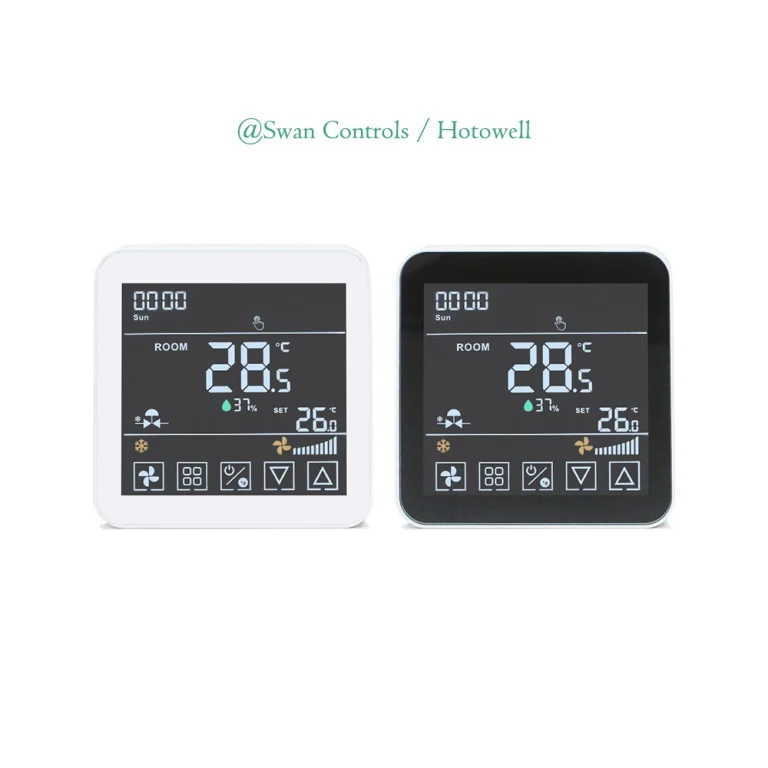
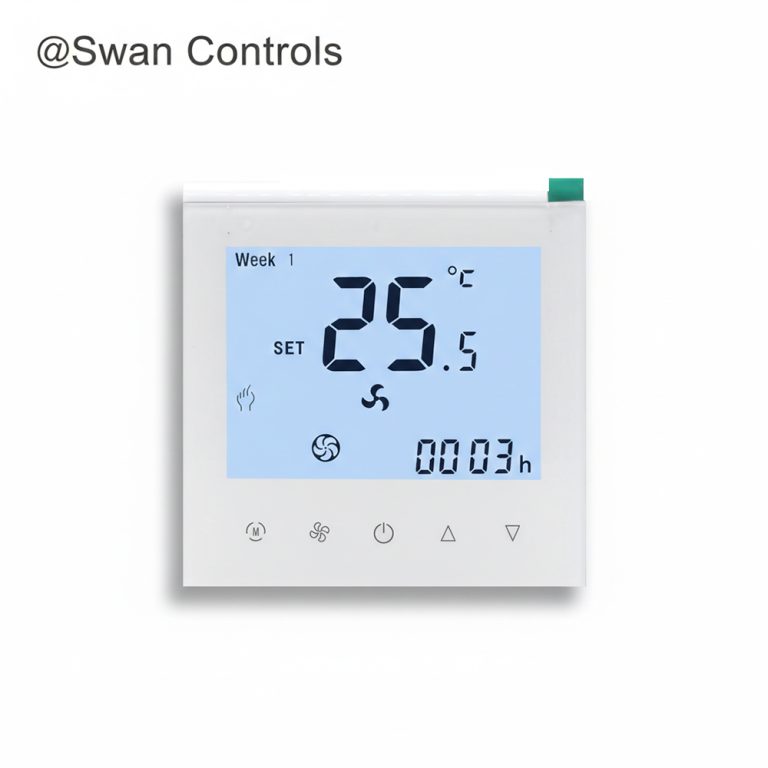
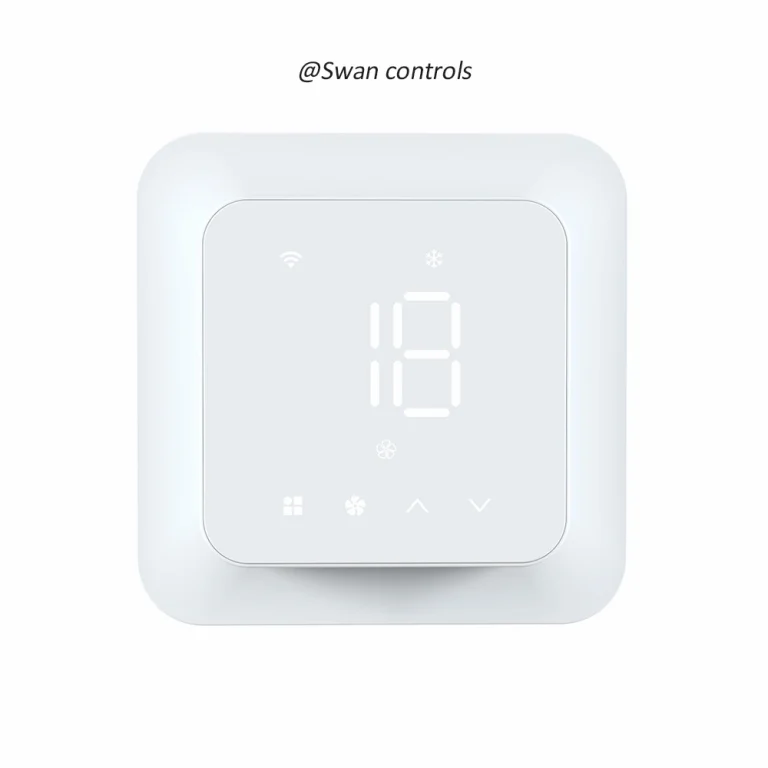
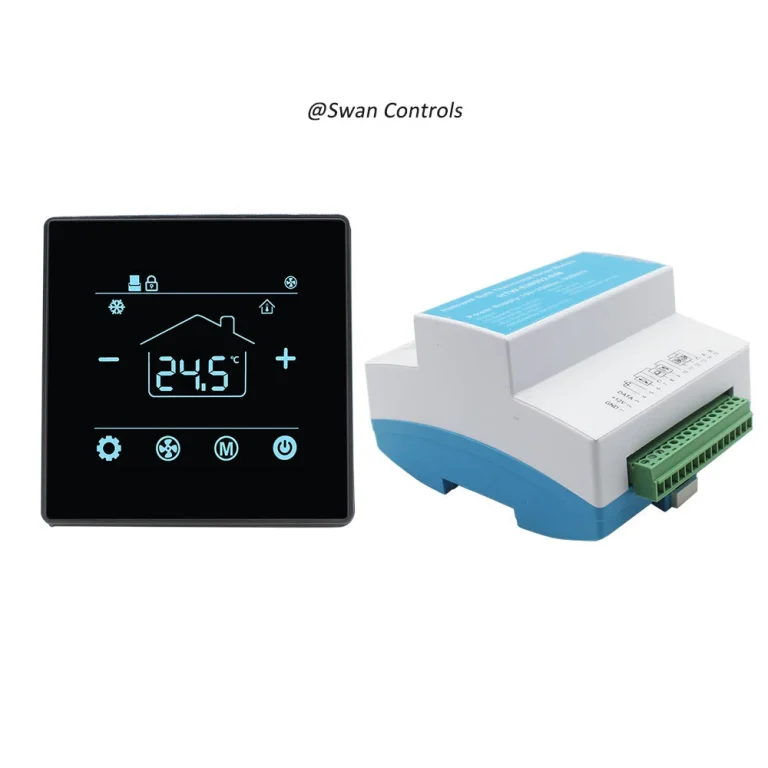
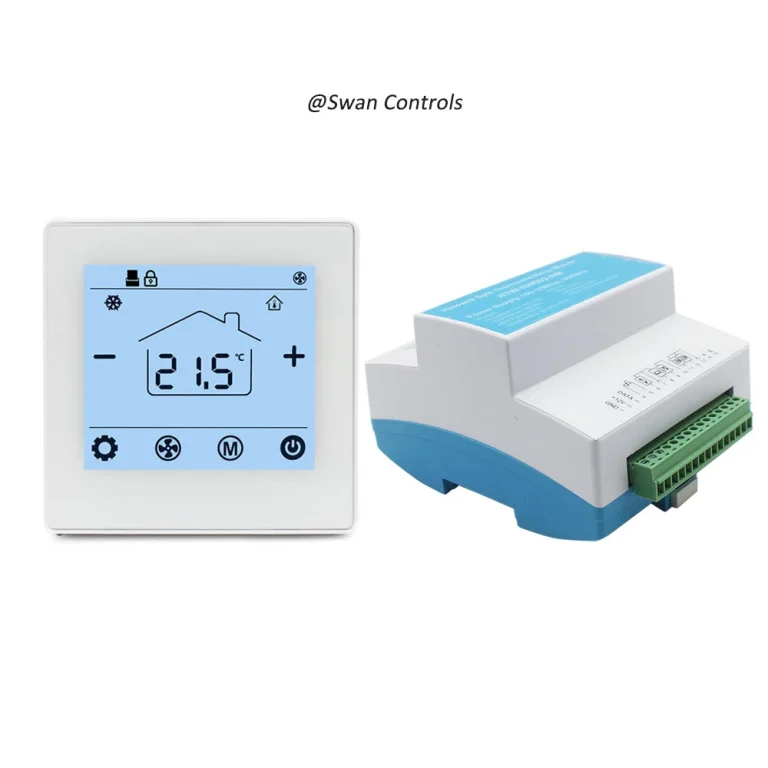
Quick Summary
Choosing the right digital thermostat is not mainly about screen design, Wi-Fi, or price. The first step is to confirm the HVAC system type, power supply, control output, communication need, and installation environment. A thermostat that works well in an apartment may not work in a hotel FCU project.
For commercial buildings, the main questions are usually about FCU control, BACnet, Modbus, RS485, BMS connection, key card input, and long-term maintenance. For residential projects, buyers usually care more about simple operation, heating load, boiler control, electric heating safety, and app control.
“We are working on hotel rooms, apartments, and some office projects. Can we use one digital thermostat for all of them?”
The simple answer is: not always.
Commercial and residential projects often require very different control functions. Hotels, offices, and serviced apartments usually focus on integration. They may need BMS or PMS connectivity, key card energy-saving control, central monitoring, and reliable communication through Modbus or BACnet. Residential projects, on the other hand, usually focus on simplicity. Homeowners and installers often prefer a room thermostat featuring Wi-Fi, app control, easy scheduling, and straightforward installation.
A hotel room with a fan coil unit may need 3-speed fan control, valve output, key card logic, and Modbus or BACnet communication. An office with EC fans may need 0–10V fan control and RS485 connection. A residential boiler system may only need heating control and app operation. An electric heating project may require a 16A relay and accurate floor sensor support.
So the better question is not “Which digital thermostat looks modern?” The better question is “Which room thermostat matches the system and the control logic?”
Start from the HVAC System, Not the Appearance
Many wrong purchases happen because buyers start from the front panel. They compare screen size, touch buttons, colour, or app control. These details matter, but they are not the first decision point.
The first decision point is the system.
For a fan coil unit, the thermostat may need to control fan speed and valve output. For a 2-pipe FCU system, the logic is simpler. For a 4-pipe FCU system, the thermostat may need separate heating and cooling valve outputs. For EC fan systems, the thermostat may need a 0–10V signal instead of only relay fan speed control.
For a boiler heating system, the control logic is different. The thermostat may send a dry contact or heating output signal. It does not need to control a fan coil fan. For electric heating, the main concern is relay load, floor sensor input, overheat protection, and safe wiring.
This is why a digital thermostat should be selected by application first.
| Project System | Main Control Need | What to Check First | Better Product Direction |
|---|---|---|---|
| Hotel FCU | Fan + valve + energy saving | 2-pipe/4-pipe, key card, BMS | Modbus or BACnet FCU thermostat |
| Office FCU | Stable room control | Fan type, valve type, power supply | FCU room thermostat |
| EC fan project | 0–10V fan control | EC fan signal, RS485, Wi-Fi need | EC fan thermostat |
| Boiler heating | Heating output | Boiler interface, voltage, app need | Wi-Fi boiler thermostat |
| Electric heating | High load heating control | Relay load, sensor, wiring safety | 16A electric heating thermostat |
The U.S. Department of Energy notes that heating and cooling are major home energy expenses, so correct control and operation are important for both comfort and energy use. It also states that setting back a thermostat by 7°–10°F for 8 hours a day can save up to 10% per year on heating and cooling.
Commercial Projects Need Stronger System Integration
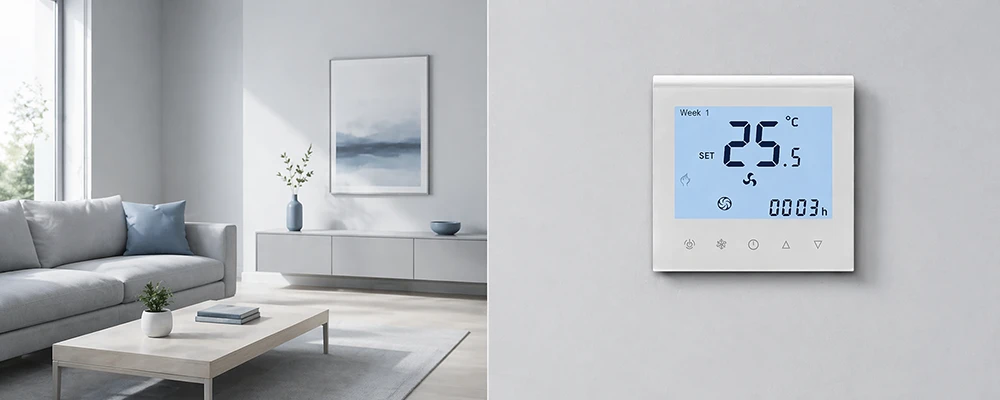
Commercial projects usually have more control points. A hotel, office building, serviced apartment, school, hospital, or shopping centre may have hundreds of rooms. In these projects, one thermostat problem can become a large maintenance issue.
For this reason, commercial buyers should check these points first:
- Does the thermostat support the right FCU type?
- Does it control 2-pipe or 4-pipe systems?
- Does it match the valve voltage and output type?
- Does it need BACnet, Modbus, or only local control?
- Does the BMS need to read room temperature, setpoint, mode, fan speed, and occupancy status?
- Does the project need key card input for hotel energy saving?
- Does the supplier support OEM, custom label, and project documentation?
For BMS projects, BACnet is often used because it was designed for building automation and control systems, including HVAC, energy management, lighting, access control, and other building systems.
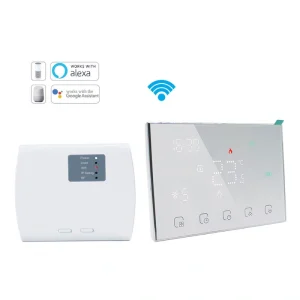
In this type of project, a BACnet thermostat with external sensor support HTW-WF01-FC-EB(← please click it directly) can be a better match.
For hotel rooms, Modbus can also be a practical choice. It is commonly used in automation and intelligent device communication. The Modbus Organization describes Modbus as a protocol suite used across distributed automation systems and supported by users and suppliers of automation devices.
A Modbus hotel thermostat with door card function HTW-WF11-FC-2KN (← please click it directly) is useful when the hotel wants room-level control, simple setup, and energy-saving logic.
When EC Fan Control Is Needed
Not all fan coil systems use traditional 3-speed fans. Many modern projects now use EC fans. In these applications, the room thermostat usually needs to provide a 0-10V control signal instead of simply switching low, medium, and high fan relays.
This is an important point for overseas buyers. A standard relay-output model may not control an EC fan properly. If the fan requires a 0-10V signal, a dedicated EC fan controller should be selected.
If your project requires a room thermostat for EC fan control, Wi-Fi, RS485 Modbus, and convenient local operation, the Swan Controls HTW-FC08-ECNW smart EC fan thermostat (← please click here) is an excellent option.
Residential Projects Need Simpler Operation and Correct Load Matching
Residential buyers often ask for Wi-Fi, app control, weekly scheduling, and easy operation. These are useful features, but the thermostat still needs to match the heating system.
For boiler heating, the buyer should check whether the thermostat output is suitable for the boiler interface. A Wi-Fi boiler thermostat is a better fit than a fan coil thermostat because the control logic is heating-focused. The HTW-WF02RP-3ANV Wi-Fi boiler thermostat (← please click it directly) can be used in the residential heating part of the article.
For electric heating, the relay load is more important. A 16A electric heating thermostat is normally used for electric floor heating or similar electric heating loads. The HTW-HT03P-16A3 Wi-Fi electric heating thermostat (← please click it directly) is relevant here and should be placed in the electric heating section, not in the commercial FCU section.
ENERGY STAR defines smart thermostats as Wi-Fi enabled devices that adjust heating and cooling temperature settings for better performance. It also notes that certified smart thermostats are based on actual field data and are independently certified to deliver energy savings.
Commercial vs Residential Selection Table
| Selection Point | Commercial Project | Residential Project |
|---|---|---|
| Main concern | Integration, reliability, maintenance | Comfort, simple control, app use |
| Common system | FCU, AHU zone, BMS-connected HVAC | Boiler heating, electric heating, small HVAC |
| Communication | BACnet, Modbus, RS485 | Wi-Fi, Tuya app, local control |
| Important input | Key card, external sensor, BMS data | Room sensor, floor sensor, app schedule |
| Common risk | Wrong protocol or valve output | Wrong load or heating system type |
| Buyer type | Contractor, distributor, OEM buyer | Installer, wholesaler, residential project buyer |
| Better supplier support | Custom protocol, OEM label, project wiring file | Clear model selection, safe wiring, simple setup |
This table should appear early in the article because it helps readers scan quickly. It also helps search engines and AI answer engines understand the difference between project types.
Key Technical Checks Before Ordering
A digital thermostat should not be ordered before the following details are confirmed.
(1) Power Supply
Check whether the thermostat needs 24VAC, 95–240VAC, 220VAC, or another power input.
(2) Control Output
Check whether the thermostat provides relay output, dry contact, 0–10V output, valve output, or fan output. The output must match the equipment.
(3) System Type
Confirm whether the project is FCU, boiler heating, electric heating, heat pump, EC fan, or another system.
(4) Pipe Type
For FCU projects, confirm 2-pipe or 4-pipe. This affects heating and cooling control.
(5) Fan Type
Check whether the fan is 3-speed AC fan or EC fan. The control signal is different.
(6) Communication Protocol
Confirm whether the project needs BACnet, Modbus RTU, RS485, Wi-Fi, or no communication.
(7) Sensor Requirement
Some projects need external room sensors or floor sensors. Others only need built-in sensing.
(8) Installation Environment
Hotel, office, apartment, villa, school, and public building projects may require different display logic, locking function, or user interface.
(9) OEM and Custom Needs
A thermostat manufacturer should be able to discuss logo, label, packaging, colour, firmware, protocol mapping, and project documentation when the order quantity supports it.
Common Mistakes Buyers Should Avoid
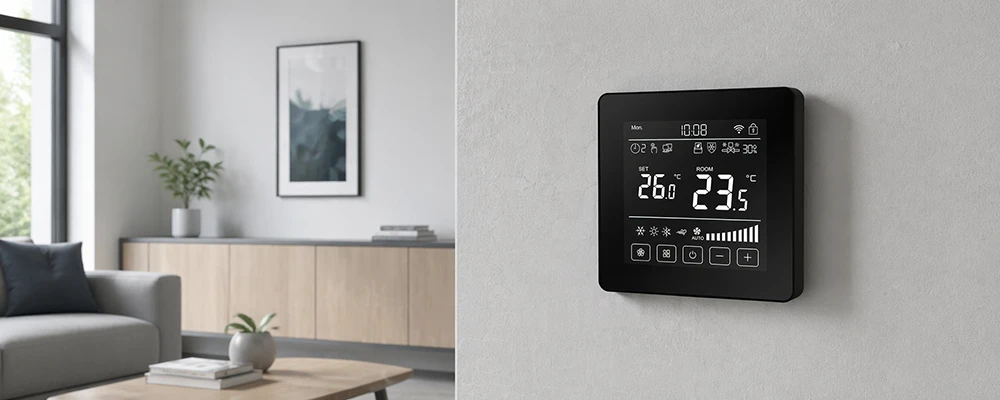
The first mistake is choosing by appearance only. A modern screen does not mean the thermostat can control the correct HVAC system.
The second mistake is treating all Wi-Fi thermostats as the same. Wi-Fi is only a communication feature. It does not confirm whether the device can control FCU, boiler heating, or electric heating.
The third mistake is ignoring voltage. This is especially risky for hotel and commercial projects. Different markets and systems may require different power supplies.
The fourth mistake is choosing Modbus or BACnet without checking the register list or object list. For BMS projects, the integration team needs readable and writable data points.
The fifth mistake is using a heating thermostat for an FCU project. A heating model may not control fan speed or valve logic.
The sixth mistake is not checking relay load for electric heating. If the load is higher than the thermostat rating, the project may need a contactor or another control method.
The seventh mistake is buying from a supplier without technical support. For OEM, wholesale, and project orders, the buyer should choose a thermostat manufacturer that can support wiring checks, model selection, and custom options.
Scientific Data and Engineering Reference Points
Scientific and engineering data cannot select a model alone, but it helps buyers judge whether the thermostat is suitable for the project.
ASHRAE Standard 55 is designed to define indoor thermal conditions that are acceptable for most occupants. It considers air temperature, radiant temperature, humidity, air speed, clothing, and activity level. This means thermostat selection is only one part of comfort control, but it is a very important part.
The International Energy Agency reports that space cooling energy consumption has more than tripled since 1990. This makes HVAC control more important in offices, hotels, apartments, and other buildings with growing cooling demand.
| Data Point | Typical Reference Range or Value | Buyer Meaning |
|---|---|---|
| Room temperature control accuracy | Often ±0.5°C to ±1°C, depending on sensor and design | Helps improve comfort stability |
| Setpoint adjustment step | Commonly 0.5°C or 1°C | Affects user comfort and control precision |
| Electric heating load | Often up to 16A for electric heating thermostat models | Must match floor heating or load design |
| FCU fan control | 3-speed relay or 0–10V EC fan signal | Must match fan type |
| RS485 communication | Common in Modbus RTU systems | Useful for BMS or central monitoring |
| Energy setback impact | DOE states up to 10% annual heating/cooling savings with 7°–10°F setback for 8 hours/day | Useful for hotel and residential scheduling |
| Smart thermostat savings | ENERGY STAR technical material reports about 8% or $50 average annual home savings | Useful for residential value explanation |
For commercial buyers, the most useful data is not only energy saving. It is also wiring accuracy, signal compatibility, relay life, communication reliability, and easy maintenance.
Practical Case 1: Hotel FCU with Door Card Function
A hotel project uses fan coil units in guest rooms. The buyer wants simple room operation, but the building owner also wants energy saving when the guest leaves the room.
In this case, a Modbus hotel thermostat with door card function is often more suitable than a standard residential Wi-Fi model. The thermostat can support room-level operation, while the door card input can help reduce unnecessary heating or cooling when the room is unoccupied.
The key checks are 2-pipe or 4-pipe FCU, fan speed type, valve voltage, Modbus register need, and door card logic.
Recommended product: HTW-WF11-FC-2KN Modbus hotel thermostat with door card function (← please click it directly) .
Practical Case 2: Office Project with EC Fan
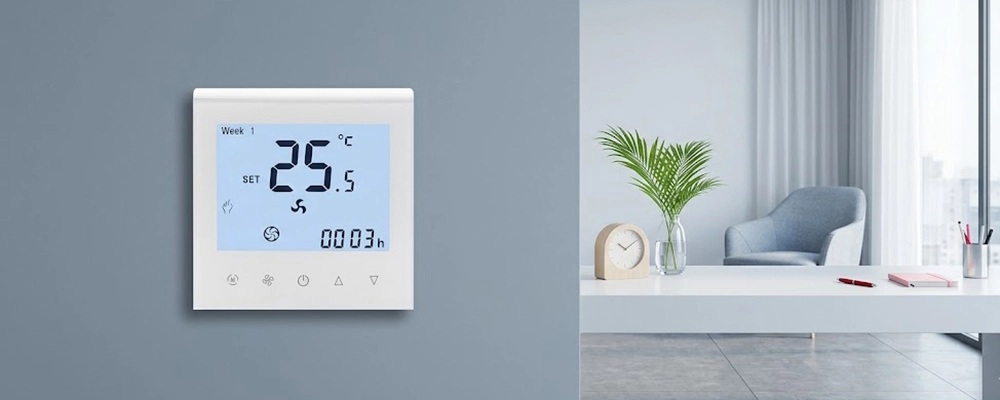
An office project uses EC fan coil units. The buyer wants better fan control, lower noise, and possible central management.
In this case, a standard 3-speed relay thermostat may not be the right choice. The thermostat should support EC fan control, usually through a 0–10V signal. If the project also needs Wi-Fi and RS485 Modbus, the HTW-FC08-ECNW is a better fit.
The key checks are EC fan signal type, valve output, RS485 wiring, power supply, and whether the system needs local control, app control, or BMS reading.
Recommended product: HTW-FC08-ECNW smart EC fan thermostat(← please click it directly) .
Practical Case 3: Residential Heating Project
A residential project may use boiler heating or electric floor heating. These two applications are not the same.
For boiler heating, the buyer should choose a thermostat made for boiler or water heating control. App control can be useful because the user can adjust heating before arriving home.
For electric heating, the buyer should focus on relay load and floor sensor support. A 16A Wi-Fi electric heating thermostat is more suitable when the heating load matches the device rating.
The key checks are heating type, load, sensor, wiring, voltage, and whether Tuya or another app platform is required.
Recommended products: (please click it directly →) HTW-WF02RP-3ANV for boiler heating and HTW-HT03P-16A3 for 16A electric heating.
How to Choose a Supplier, Manufacturer, or OEM Partner
For a single home project, a buyer may only compare features and price. For a commercial or wholesale project, the supplier choice is more important.
A good thermostat manufacturer should help confirm:
- Correct model for the HVAC system
- Wiring diagram before order
- Voltage and output details
- Communication protocol support
- Sensor and installation requirements
- OEM logo and label options
- Custom function possibility
- MOQ and lead time
- Sample testing process
- Technical documents for installers
For OEM buyers, the most important point is not only the unit price. It is whether the factory can support stable production, clear communication, and repeatable quality.
For distributors, the best product is not always the most advanced one. It is the product that matches the local market, installer skill level, project budget, and after-sales expectation.
FAQ
What is the difference between a digital thermostat and a digital room thermostat?
A digital thermostat is a general term for a thermostat with electronic sensing, display, and control logic. A digital room thermostat is usually used to control the temperature in one room or zone. In HVAC projects, the second term is often used for wall-mounted room control in hotels, apartments, offices, and homes.
Which thermostat is best for hotel FCU projects?
For hotel FCU projects, buyers should usually choose an FCU thermostat that supports fan speed control, valve output, key card input, and Modbus or BACnet if BMS integration is required. The best choice depends on 2-pipe or 4-pipe design, voltage, valve type, and the hotel’s energy-saving logic.
Do I need Modbus or BACnet for a commercial thermostat?
You need Modbus or BACnet when the thermostat must connect with a BMS or central control system. BACnet is often used in building automation projects, while Modbus is common in many HVAC and industrial control systems. For simple local room control, communication may not be necessary.
Can one thermostat be used for both commercial and residential projects?
One thermostat can only be used across both project types if the system, voltage, output, and control logic are the same. In many cases, commercial FCU projects and residential heating projects need different models. A hotel FCU thermostat is usually not the right choice for electric floor heating.
How do I choose a thermostat supplier for OEM or wholesale orders?
Choose a supplier that can confirm the system match, wiring, voltage, output, protocol, documentation, and custom options before production. For OEM or wholesale orders, the supplier should also support logo, label, packaging, stable lead time, and sample testing.
Final Note / Practical Takeaway
The right answer to “How to choose the right digital thermostat?” is simple: start from the HVAC system, not from the screen.
For commercial projects, focus on FCU control, BMS integration, BACnet, Modbus, key card function, and long-term maintenance. For residential projects, focus on heating type, load rating, app control, sensor support, and easy operation.
A digital room thermostat should match the project before it looks attractive. If the system type, voltage, output, and communication are correct, the project is much easier to install, manage, and maintain. If these points are wrong, even a good-looking thermostat can cause wiring problems, comfort complaints, and extra service cost.
References / Sources
- U.S. Department of Energy, “Programmable Thermostats.” https://www.energy.gov/energysaver/programmable-thermostats
- U.S. Department of Energy, “Heating and Cooling.” https://www.energy.gov/energysaver/heating-and-cooling
- ENERGY STAR, “Smart Thermostats.” https://www.energystar.gov/products/smart_thermostats
- ENERGY STAR, “Smart Thermostats: ENERGY STAR Home Upgrade.” https://www.energystar.gov/products/energy_star_home_upgrade/smart_thermostats
- ENERGY STAR, “Technical Bulletin: ENERGY STAR Certified Smart Thermostats.” https://www.energystar.gov/sites/default/files/asset/document/Technical_Bulletin_ENERGY_STAR_Smart_Thermostats_508.pdf
- ASHRAE, “BACnet™, the ASHRAE Building Automation and Control Networking Protocol.” https://www.ashrae.org/technical-resources/bookstore/bacnet
- ASHRAE, “Standard 55: Thermal Environmental Conditions for Human Occupancy.” https://www.ashrae.org/technical-resources/bookstore/standard-55-thermal-environmental-conditions-for-human-occupancy
- ANSI Blog, “ANSI/ASHRAE 55-2023: Thermal Environmental Conditions for Human Occupancy.” https://blog.ansi.org/ansi/ansi-ashrae-55-2023-thermal-environmental-conditions/
- International Energy Agency, “Space Cooling.” https://www.iea.org/energy-system/buildings/space-cooling
- International Energy Agency, “Energy Efficiency 2023.” https://www.iea.org/reports/energy-efficiency-2023
- Modbus Organization, “Modbus Organization.” https://www.modbus.org/
- CIBSE, “Guide H: Building Control Systems.” https://www.cibse.org/knowledge-research/knowledge-portal/guide-h-building-control-systems-2009/