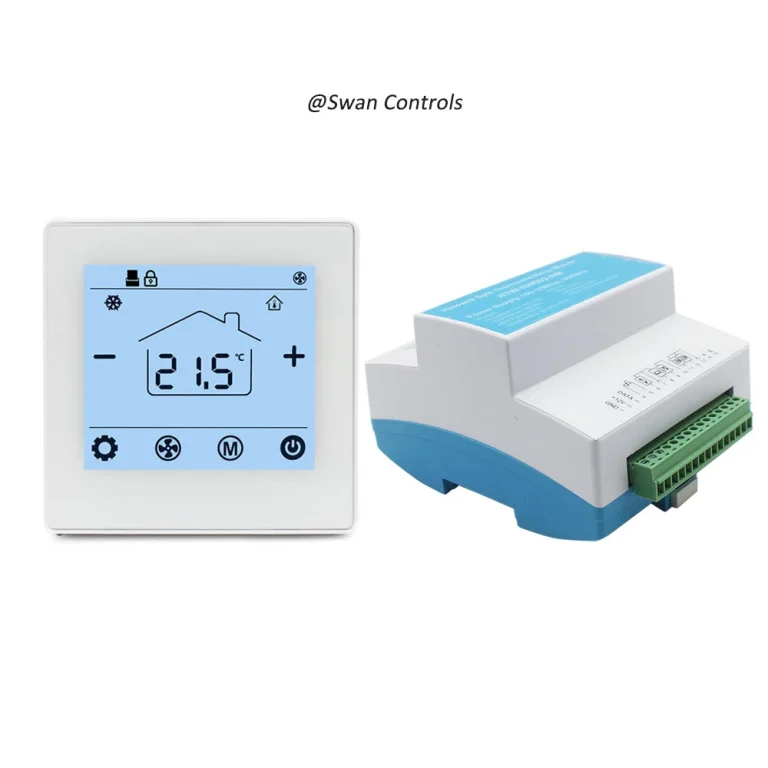
Quick Summary
Choosing the right HVAC thermostat should start with the system type, not with appearance, Wi-Fi function, or price. For FCU projects, heating projects, boiler control, 24V AC systems, and OEM orders, we should first confirm what the thermostat needs to control, then check voltage, output, wiring, communication, sensor logic, and supply stability.
Many products can look like a wall thermostat, but the internal control logic may be completely different. A fan coil thermostat, electric underfloor heating thermostat, boiler thermostat, and 24V heat pump thermostat should not be selected in the same way.
Why “HVAC Thermostat” Is Easy to Misunderstand
Many overseas buyers search for an HVAC thermostat when they are not yet sure which product category they need. This is understandable because the term sounds broad and practical. However, in real projects, it may refer to very different products.
For one project, it may mean a fan coil controller for hotel rooms. For another, it may mean a heating controller for electric underfloor heating. A boiler installer may use the same phrase when looking for a dry-contact room controller. A North American contractor may use it when asking for a 24V thermostat for a conventional AC or heat pump system.
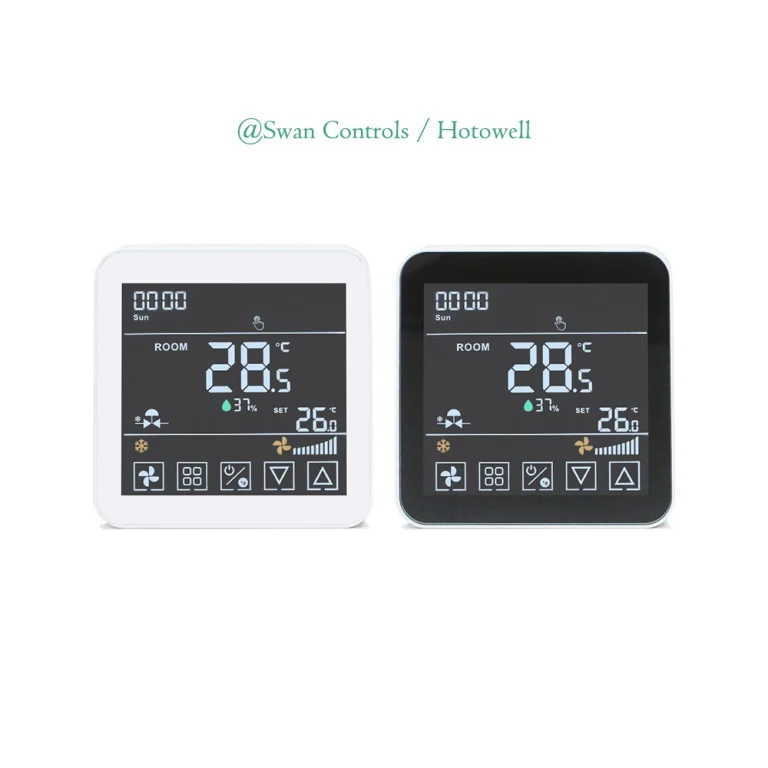
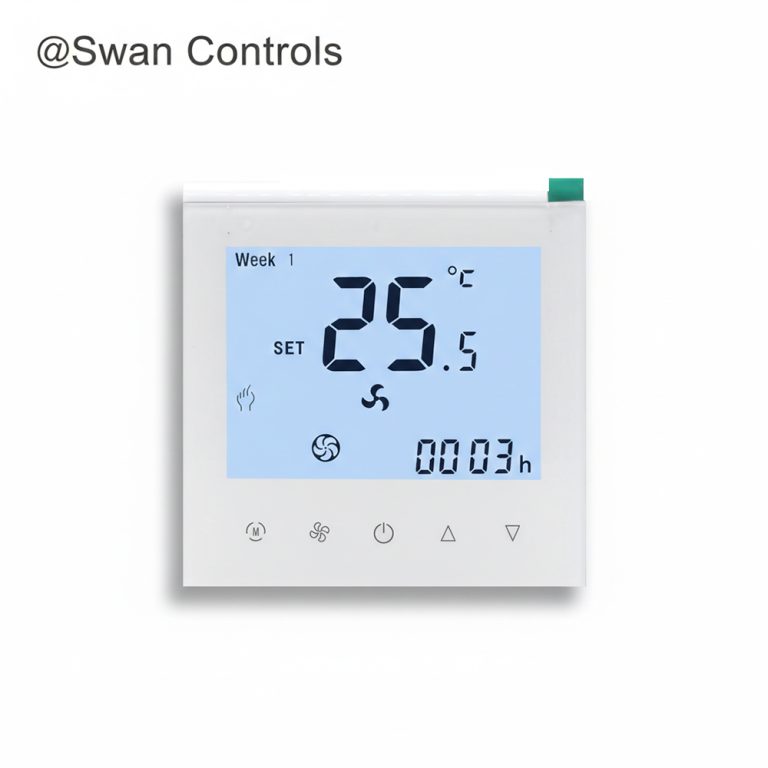
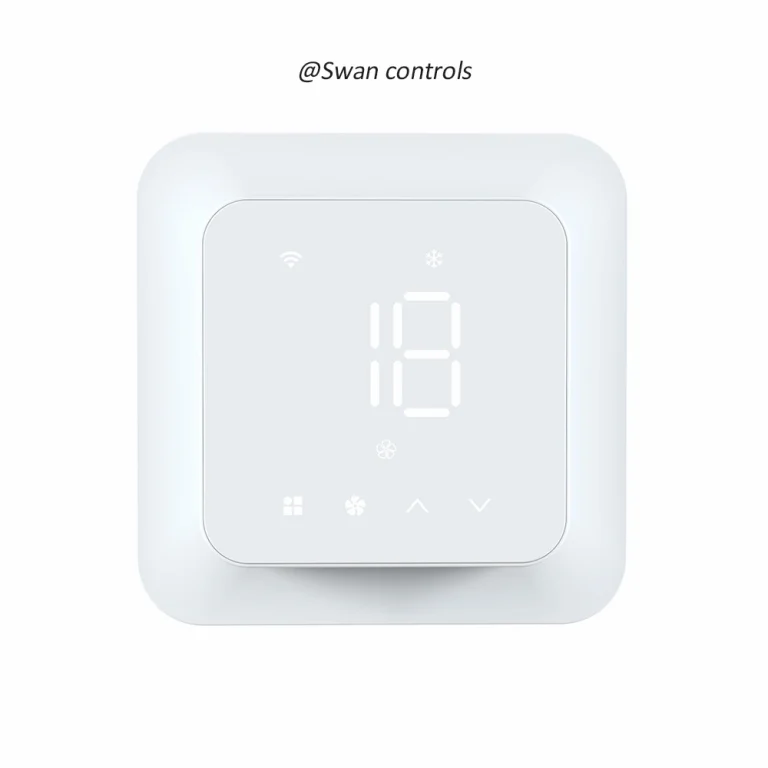
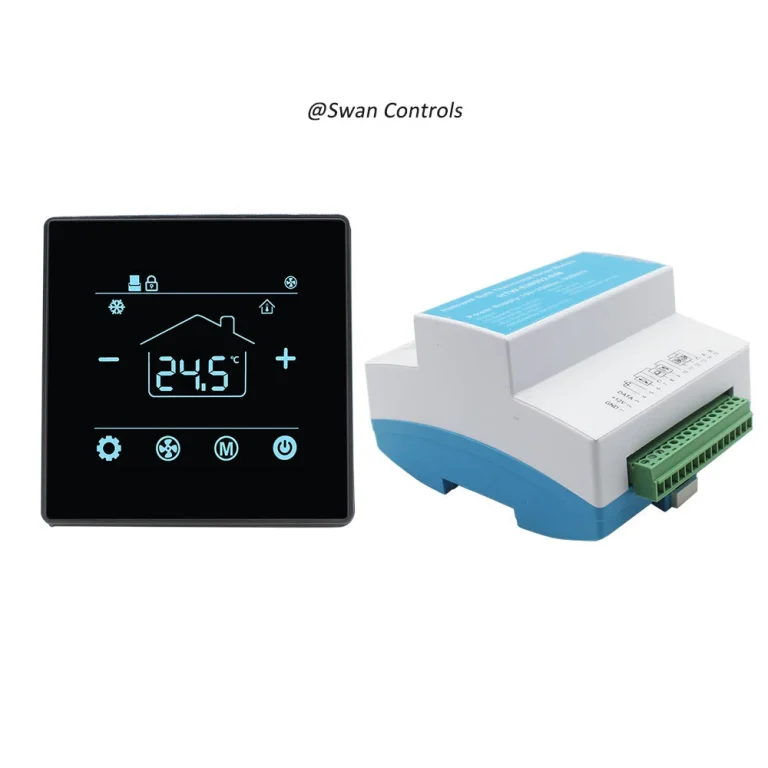
The front design can also create confusion. Many thermostats have a screen, buttons, temperature display, and wall-mounted installation. From the outside, they may all look like a wall thermostat. But behind the front panel, the voltage, output, relay logic, communication, and wiring terminals may be completely different.
A 220V fan coil thermostat cannot be selected in the same way as a 16A electric heating thermostat. A dry-contact boiler thermostat cannot be replaced by a live-output heating model. A 24V heat pump controller cannot be chosen only because it has Wi-Fi.
This is why the first question should not be “Which model looks better?” or “Which one is cheaper?” The first question should be: what HVAC system does this thermostat need to control?
First Principle: Choose by System First, Then Check Function Details
The safest selection path is simple: confirm the system first, then confirm the function details.
The system type decides the product direction. The function details decide the final model. If this order is reversed, we may compare the wrong products and create installation problems later.
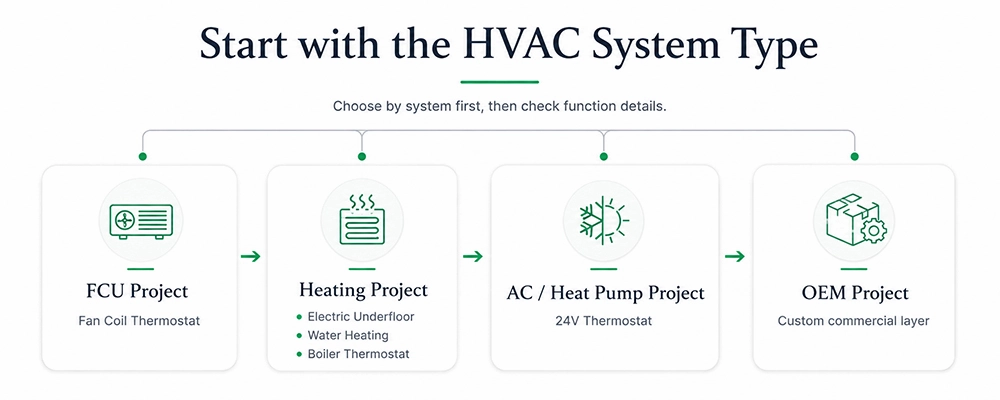
For FCU projects, we should check pipe type, fan type, valve output, voltage, and communication. For heating projects, we should separate electric underfloor heating, water heating, and boiler control. For AC or heat pump projects, especially in North America, we should confirm whether a 24V control model is required.
For OEM orders, the logic is the same. OEM work should not start from logo printing only. It should start from a stable product platform that already matches the system. Then we can discuss logo, packaging, model code, default settings, manuals, and possible software adjustments.
This logic helps avoid a common sourcing mistake: treating all thermostats as the same product with different prices. Two products may look similar, but one may control a 3-speed fan and valve, while another may switch a boiler through a non-voltage relay.
Start with the HVAC System Type
HVAC systems include many product directions, and no supplier should be assumed to cover every category in the same way. Our Swan Controls, an affiliate of Hotowell, focuses mainly on room control products for fan coil units, heating systems, boiler control, and selected 24V HVAC applications.
So when we are asked to recommend an HVAC thermostat, we usually start by confirming the system type first.
| Project Type | Main Thermostat Direction | What to Check First |
|---|---|---|
| FCU project | Fan coil thermostat | 2-pipe / 4-pipe, 3-speed fan or EC fan, valve output, voltage, BMS communication |
| Heating project | Electric underfloor, water heating, or boiler thermostat | Load current, dry contact, valve output, sensor type, installation method |
| AC / heat pump project | 24V control thermostat | R/C/Y/W/G/O/B terminals, heating and cooling stages, heat pump logic, wiring diagram |
| OEM project | Existing product platform + custom commercial layer | Logo, packaging, label, default settings, documents, MOQ, repeat-order consistency |
This table is only the first filter. After the system direction is clear, we should move to the function details inside each product category.
Fan Coil Thermostat: What Buyers Should Confirm
A fan coil thermostat is commonly used in hotels, offices, apartments, schools, hospitals, and commercial buildings. It controls room temperature by managing fan speed, valve operation, and sometimes communication with a central system.
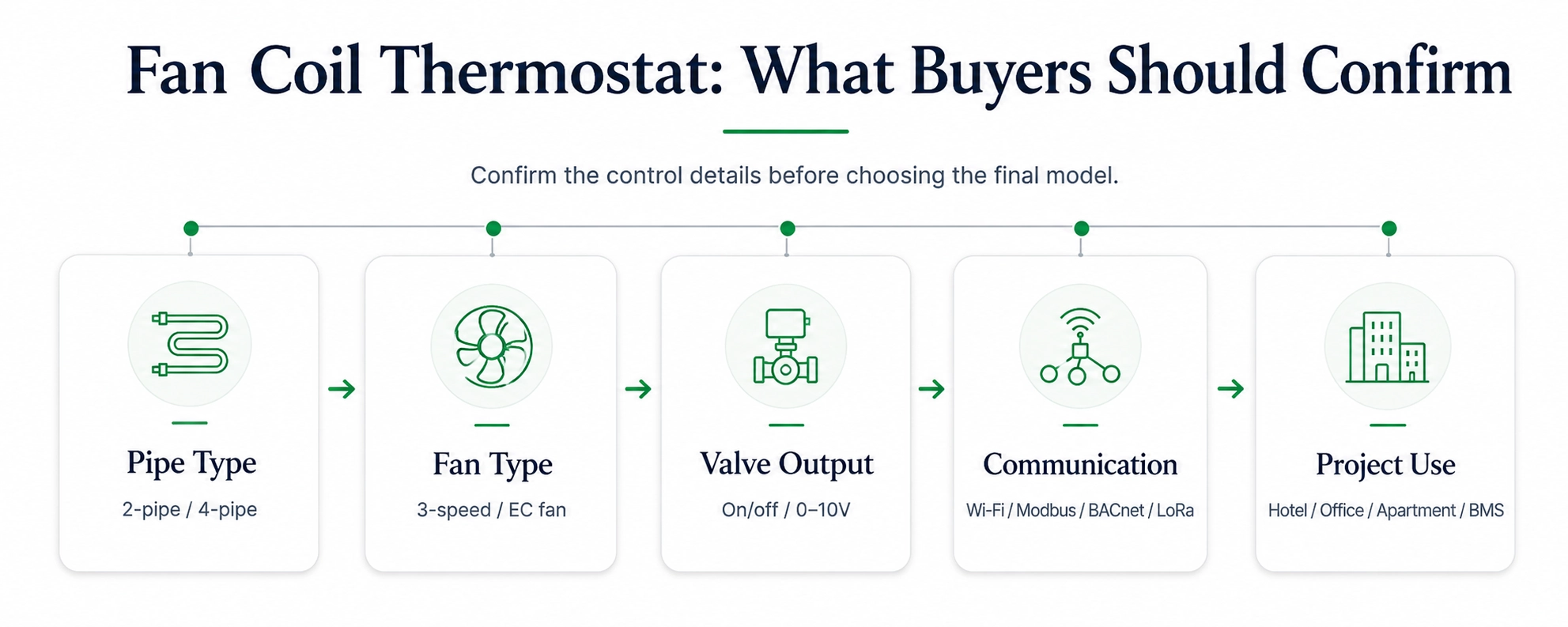
For this product category, selection should be made step by step.
Pipe Type: 2-Pipe or 4-Pipe
The first detail is whether the project uses a 2-pipe or 4-pipe FCU system.
A 2-pipe system usually uses the same coil for cooling or heating, depending on the central water supply. A 4-pipe system has separate hot water and chilled water circuits, so it can support heating and cooling more flexibly.
If the pipe type is wrong, the thermostat logic may not match the actual system. This can lead to incorrect heating/cooling operation, confusing installer feedback, and repeated troubleshooting.
Fan Type: 3-Speed Fan or EC Fan
The second detail is fan control.
Many FCU projects still use 3-speed fan control: low, medium, and high. Some newer projects use EC fans, where 0–10V control allows more flexible fan speed adjustment. These two control methods are different.
If the fan type is not clear yet, we would like to recommend our model Swan Controls HTW-FC09-FVMN-24, which supports 3-speed fan, EC fan, 2-pipe control, 0–10V modulating valve control, 24V output, and Modbus communication. It is useful for projects where the control requirement is more technical than a standard on/off FCU thermostat.
Valve Output: On/Off or Modulating Control
The third detail is valve control.
Some FCU systems only need simple on/off valve output. Other projects need 0–10V modulating valve control. In some commercial projects, valve logic may also be linked with BMS control or system energy performance.
We should not only ask whether the thermostat can control a valve. We should ask what signal the valve requires.
Communication: Standalone, Wi-Fi, Modbus, BACnet, or LoRa
The fourth detail is communication.
A standalone thermostat may be enough for simple room control. Wi-Fi may be suitable for residential or light commercial projects. Modbus and BACnet are often more important for commercial buildings where thermostats are connected to a BMS.
For BACnet FCU projects, especially where external sensor support is needed, we can consider our model Swan Controls HTW-WF11-FC-EB. It is suitable for 2-pipe or 4-pipe fan coil applications and supports BACnet communication with external sensor options.
For hotel or apartment projects where keycard control and wireless communication are important, our model Swan Controls HTW-WF08-2KE-LoRa can be considered. It supports 2-pipe on/off control, keycard input, external sensor, and LoRa communication.
For simpler 4-pipe FCU projects that need Wi-Fi app control, our model Swan Controls HTW-WF11-FC-4W is more suitable when the project needs Tuya app control together with 4-pipe fan coil operation.
Project Function: Hotel, Office, Apartment, or BMS Use
A hotel project may care more about keycard input, energy-saving setback, simple user interface, and central management. An office project may care more about BMS communication and stable operation. An apartment project may care about Wi-Fi, appearance, and easy installation.
So the right fan coil thermostat should not be selected only by appearance. It should match the project’s pipe type, fan type, valve output, communication method, and maintenance plan.
Heating Thermostat: Separate Electric Heating, Water Heating, and Boiler Control
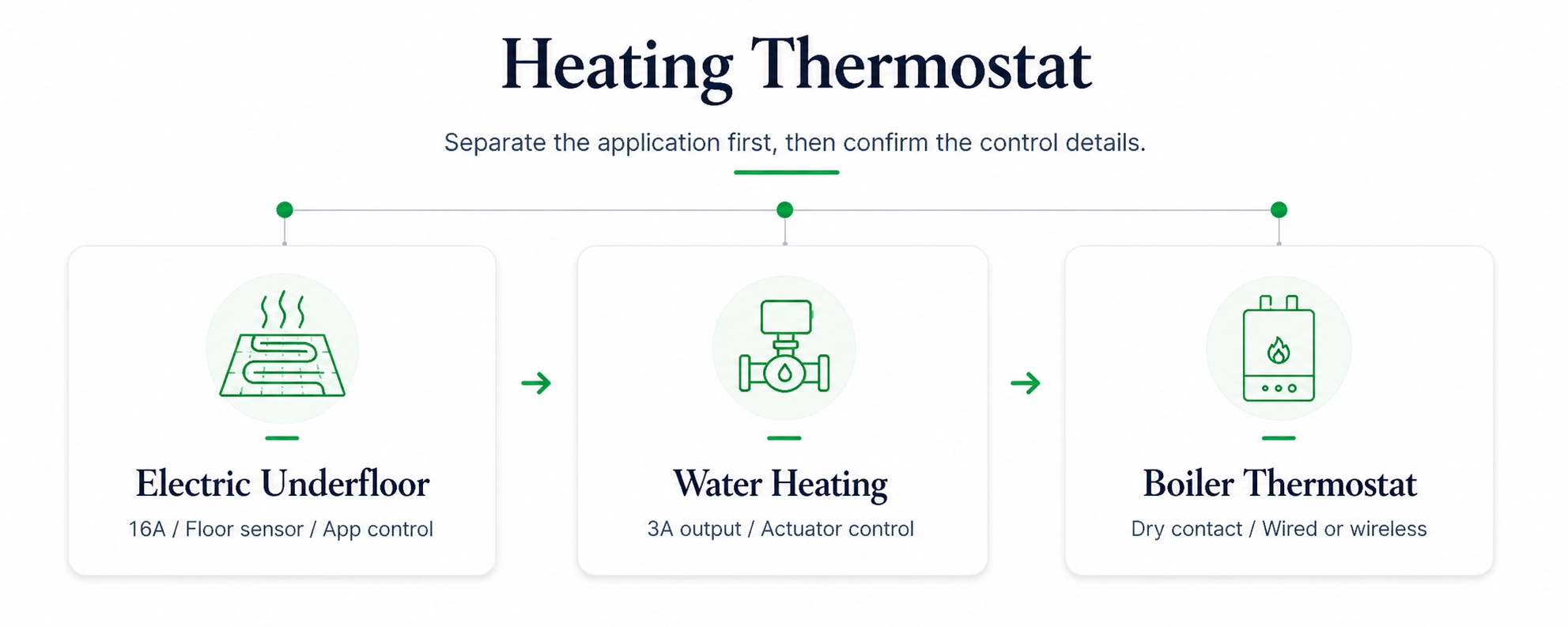
Heating projects are easy to misunderstand because many customers simply ask for a heating thermostat. In practice, heating control may mean electric underfloor heating, water heating, or boiler switching.
These three applications should not be mixed.
Electric Underfloor Heating
Electric underfloor heating thermostats usually control heating cables, heating mats, or electric floor heating loads. The most important detail is load current.
Many electric heating projects require 16A control capacity, depending on the heating area and installed power. We should confirm voltage, maximum current, floor sensor support, overheat protection, and wall box size.
An external floor sensor is often important because it helps protect the floor surface and reduce overheating risk. This is especially useful for wooden flooring, tile heating, and comfort heating applications.
Design style also matters. Some markets prefer touch keys and modern displays. Others prefer simple interfaces that homeowners can understand quickly. However, design should come after electrical compatibility.
For Wi-Fi electric floor heating projects, we can consider our model Swan Controls HTW-HT09-16A3, which is suitable when 16A electric heating control and app operation are required.
Water Heating
Water heating thermostats usually control a valve or actuator, not a heavy electric heating load. This means we should focus on output terminals, actuator logic, voltage, and whether normally open or normally closed control is required.
Some water heating systems use 3A relay output for actuator control. This is very different from a 16A electric floor heating thermostat. If we choose the wrong type, the product may be oversized, incorrectly wired, or unsuitable for the actuator.
For smart water heating applications, our model Swan Controls HTW-WF02RP-3ANV can be considered when Wi-Fi control and water heating system compatibility are required.
Boiler Thermostat
A boiler thermostat usually works differently from direct heating control. In many boiler systems, the thermostat sends a dry-contact or non-voltage signal to start or stop the boiler.
This is one of the most common selection errors. Some customers see “heating thermostat” and assume it can work with a boiler. But if the boiler requires dry contact and the selected thermostat outputs live voltage, the wiring may be wrong and unsafe.
For boiler control, we should confirm whether the output is dry contact, whether a receiver is needed, whether the system should be wired or wireless, and whether Wi-Fi control is required.
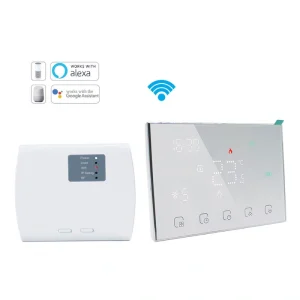
For wireless boiler control with Wi-Fi function, our model Swan Controls HTW-WT13P-WF is suitable for projects that need a wireless thermostat and receiver solution for heating control.

24V AC or Heat Pump Thermostat: When This Is the Right Direction
In North America and some other markets, projects may need a 24V HVAC thermostat for a conventional system or heat pump system. This category should not be mixed with 220V fan coil or heating thermostats.
A 24V control product usually works with terminals such as R, C, Y, W, G, O, and B. These terminals are linked to cooling, heating, fan, reversing valve, and common wire logic. For heat pump systems, we also need to confirm the number of heating and cooling stages.
This type of thermostat is often used for packaged AC units, conventional heating and cooling systems, or heat pump systems. We should provide the wiring diagram before confirming the model.
For multi-stage 24V applications, our model Swan Controls HTW-MT8600 can support up to 3H2C control for conventional systems or heat pump systems. It is more suitable when the project requires 24V smart control rather than a 220V room controller.
The main risk is assuming that all room thermostats are electrically similar. A product that works well for a hotel FCU may not be suitable for a 24V AC system. A 24V model may also be unsuitable for direct 220V heating control.
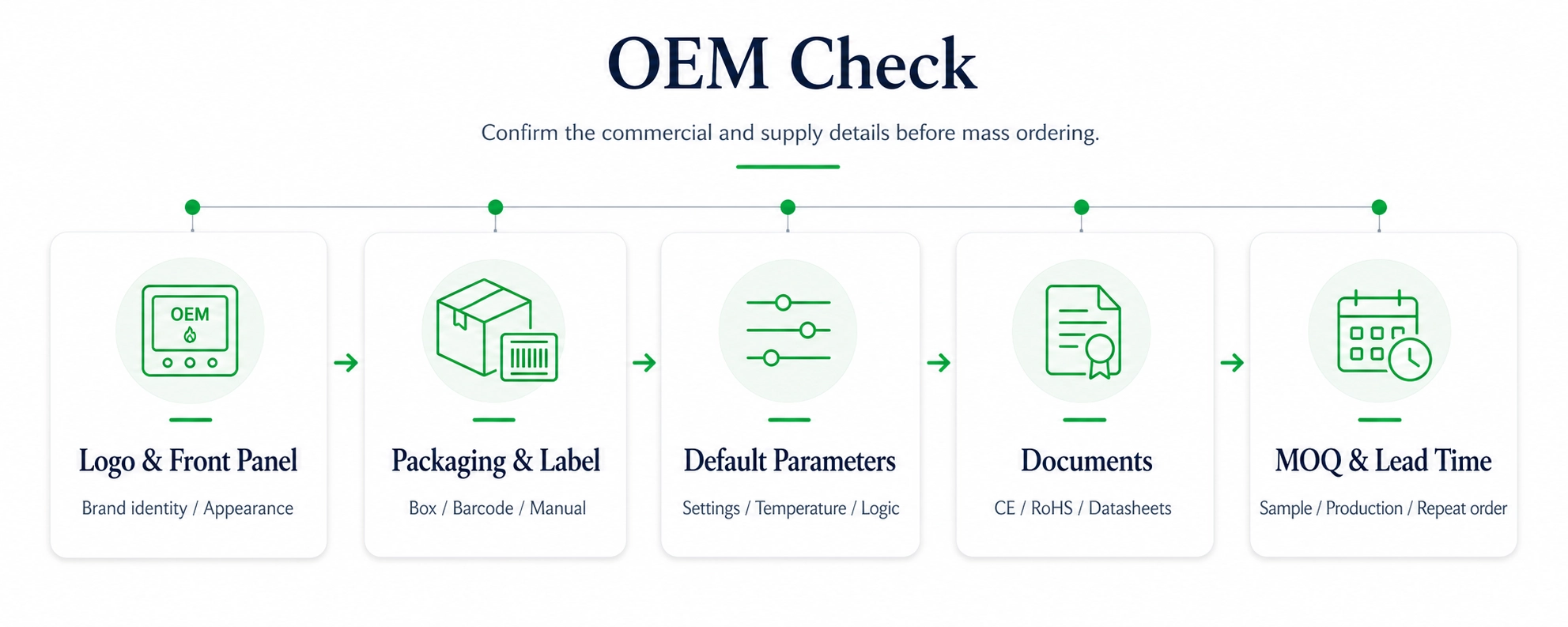
OEM Check
For OEM projects, thermostat selection should not stop at the function list. A product may work technically, but still be unsuitable for long-term brand development if the supplier cannot support stable customisation and repeat supply.
| OEM Check Point | What to Confirm | Why It Matters |
|---|---|---|
| Logo and front panel | Logo position, printing method, panel colour, button style, display layout | Helps build a consistent product image in the target market |
| Packaging and label | Box design, model label, barcode, manual language, installation notes | Reduces warehouse mistakes, installer confusion, and after-sales questions |
| Default parameters | Temperature range, fan logic, sensor setting, display unit, protection setting | Makes the product closer to local usage habits and project requirements |
| Firmware or function adjustment | Which functions can be changed, which require engineering evaluation, and which are not recommended | Avoids unrealistic custom requests and reduces development risk before mass production |
| Certification documents | CE, RoHS, test reports, product photos, datasheets, and wiring documents where applicable | Supports customs clearance, tender submission, distributor approval, and project documentation |
| MOQ and lead time | Sample quantity, pilot order quantity, packaging MOQ, production lead time, repeat order timing | Helps plan stock, launch schedules, and market testing more safely |
We at Swan Controls, an affiliate of Hotowell, support OEM thermostat projects based on existing product platforms. This is usually safer than developing everything from zero. We can start from a proven model and then customise the commercial layer, including logo, label, packaging, manual, default settings, and selected function details.
Practical Case 1: Hotel FCU Project
A hotel project needs thermostats for guest rooms. The project uses fan coil units and needs stable room control, simple operation, and possible energy-saving logic.
The correct direction is not simply “smart thermostat.” We should first confirm whether the FCU is 2-pipe or 4-pipe, whether the fan is 3-speed or EC type, and whether the valve is on/off or modulating.
If the hotel also wants room status control, keycard input or BMS communication may be important. In this case, the best choice is usually a fan coil thermostat with the correct fan and valve output. If centralized management is required, Modbus, BACnet, or another communication method should be confirmed before sample testing.
Practical Case 2: Residential Electric Floor Heating
A residential project may need a modern wall thermostat for electric floor heating. The first thing to check is not only the design. We must confirm voltage, load current, sensor type, and floor protection logic.
If the heating cable load is high, the thermostat must support suitable current. For many electric underfloor heating projects, a 16A model is required. A floor sensor is also recommended because it helps protect the floor and improve comfort.
Wi-Fi may be useful for end users, especially when they want remote control or scheduling. But app control cannot solve a wrong load selection. If the electrical side is not suitable, the product may create safety risks or after-sales complaints.
FAQ
1- What is the difference between a fan coil thermostat and a heating thermostat?
A fan coil thermostat usually controls fan speed and valve operation for an FCU system, while a heating thermostat may control electric underfloor heating, a water heating actuator, or a boiler signal. We should not choose only by appearance. The correct model depends on the controlled equipment, voltage, output type, and wiring requirement.
2- Can one thermostat work for FCU, boiler, and electric floor heating?
Usually no. These systems have different control logic. An FCU thermostat may control fans and valves, a boiler thermostat may need dry-contact output, and an electric floor heating thermostat may need 16A load capacity and a floor sensor. Some models support flexible functions, but we should confirm the wiring diagram before ordering.
3- When should we choose a 24V thermostat?
A 24V thermostat is usually used when the HVAC system is designed around low-voltage control terminals such as R, C, Y, W, G, O, and B. This is common in many North American conventional AC and heat pump systems. It should not be mixed with 220V fan coil or electric heating thermostats unless the system design clearly supports it.
4- What should we confirm before ordering OEM thermostats?
For OEM projects, we should confirm the product platform first, then discuss logo, label, packaging, user manual, default parameters, firmware options, certification documents, MOQ, lead time, and repeat-order consistency. A low price is not enough if the model cannot remain stable for future orders or if the supplier cannot support project documentation.
5- What information should we provide before asking for a thermostat recommendation?
We should provide the system type, voltage, wiring diagram, controlled equipment, output requirement, communication requirement, installation market, expected quantity, and whether OEM packaging or logo service is needed. With this information, the supplier can check the right thermostat direction more accurately before sample testing or bulk ordering.
Final Note
A suitable HVAC thermostat is not one fixed product. It depends first on the system type, then on voltage, output, wiring, fan or valve control, communication, sensor needs, and OEM requirements.
For FCU projects, focus on fan type, pipe type, valve logic, and BMS communication. For heating projects, separate electric underfloor heating, water heating, and boiler dry-contact control. For 24V AC or heat pump projects, check terminals and system stages carefully. For OEM orders, do not only ask for the lowest quotation; confirm model stability, documents, packaging, custom options, and repeat-order consistency.
The most common mistake is choosing by appearance, Wi-Fi function, or price before confirming what the thermostat actually needs to control. A thermostat that looks modern may still be wrong for the system. A product with many functions may still create installation problems if the output logic does not match.
If you are choosing a thermostat for a commercial, residential, or OEM project, please feel free to share your system type, voltage, wiring diagram, target market, and expected quantity. We can help you check the suitable direction before ordering.
References
1- ASHRAE Terminology | ASHRAE | HVAC&R terminology and technical definitions
2- ANSI/ASHRAE Standard 135, BACnet | ASHRAE | Data communication protocol for building automation and control networks
3- BACnet Resource Files | ASHRAE | BACnet standard resource materials for building automation communication
4- Modbus Application Protocol Specification V1.1b3 | Modbus Organization | Function codes used within Modbus transactions
5- IEC 60364 Low-Voltage Electrical Installations | International Electrotechnical Commission | Electrical installation safety and design principles
6- IEC 60730 Automatic Electrical Controls | International Electrotechnical Commission | Safety requirements for automatic electrical controls
7- ISO 16484 Building Automation and Control Systems | International Organization for Standardization | Building automation system design and integration reference
8- EN ISO 52120-1 Energy Performance of Buildings | ISO / CEN | Impact of building automation, controls, and management on energy performance
9- Energy Saver: Heat Pump Systems | U.S. Department of Energy | Heat pump operation and energy efficiency guidance
10- RoHS Directive 2011/65/EU | European Union | Restriction of hazardous substances in electrical and electronic equipment
Copyright © Swan Controls / Hotowell. All rights reserved. This article is written and published by Swan Controls, an affiliate of Hotowell, for HVAC thermostat buyers, distributors, contractors, and OEM project partners.