Quick Summary
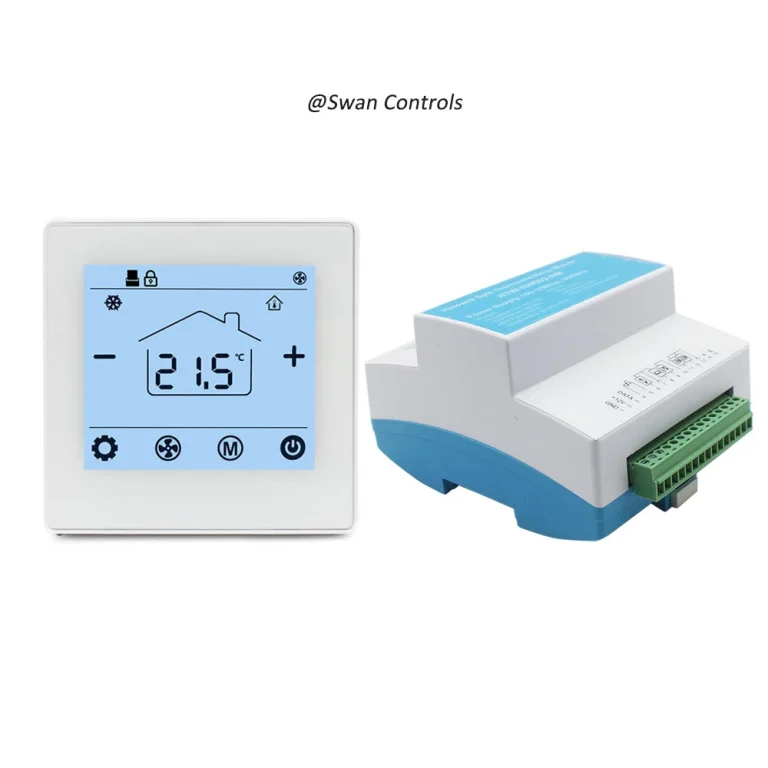
Overseas buyers should not order a programmable thermostat by price only. The real checks include system type, voltage, wiring, relay rating, schedule logic, sensor accuracy, packaging, manuals, OEM options, and after-sales support. A 7 day programmable thermostat is a better choice when users need different schedules for each day. For importers, distributors, and project buyers, sample testing before bulk order is the safest step.
“Can this programmable thermostat fit our local voltage?”
“Will installers understand the wiring diagram?”
“Can we sell this as a 7 day programmable thermostat under our own brand?”
These are real questions for overseas buyers. A thermostat may look simple in a catalogue. But for importers, wholesalers, contractors, and OEM buyers, the buying risk is not only about the unit price.
A wrong programmable thermostat can create many problems after delivery. The voltage may not match. The wiring terminals may confuse installers. The schedule setting may be too difficult for users. The packaging may not fit local sales channels. The manual may not be clear enough for after-sales support.
This guide focuses on what overseas buyers should check before ordering. It is written for buyers who need stable products, fewer complaints, and better market fit.
Start from the Buyer Role, Not the Product Photo
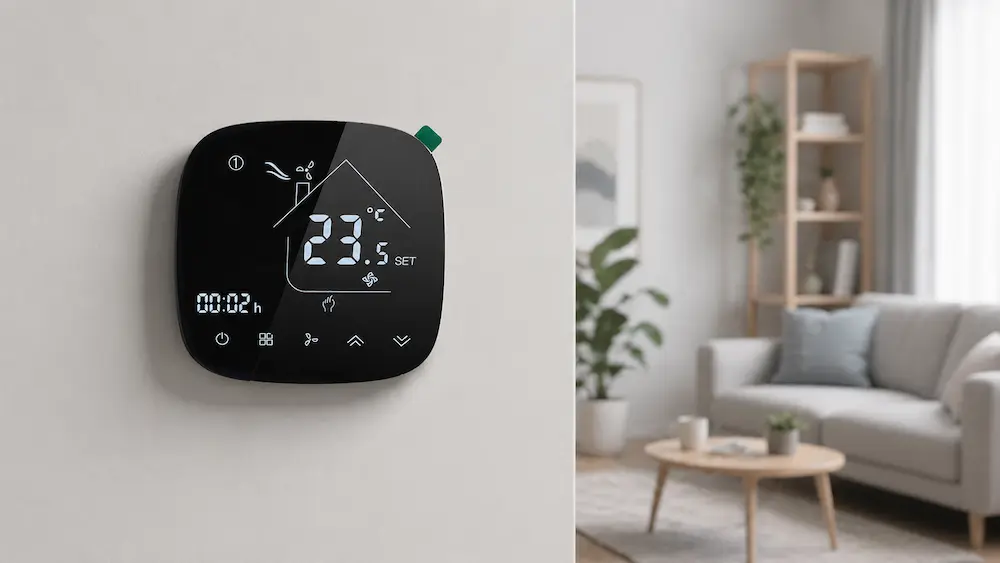
Different buyers need different thermostat details. A distributor, project contractor, OEM brand owner, and online seller may all search for the same keyword. But their real needs are not the same.
A distributor cares about local market acceptance. The product must be easy to explain and easy to stock. A contractor cares about wiring, installation time, and project stability. An OEM buyer cares about logo, packaging, label, manual, and long-term supply. An online seller cares more about appearance, simple operation, and clear product claims.
Before asking for price, buyers should define their role first.
| Buyer Type | Main Concern | Recommended Focus |
|---|---|---|
| Distributor | Market fit and repeat sales | Stable model, clear functions, good packaging |
| Contractor | Installation and project reliability | Wiring diagram, voltage, relay rating |
| OEM buyer | Brand presentation | Logo, label, manual, box design |
| Online seller | Clear selling points | 7 day schedule, easy display, simple use |
This step avoids a common mistake. Many buyers compare thermostats only by screen design and price. That is not enough for export orders. A good programmable thermostat must match the business model and the real application.
Check the Actual HVAC Application
A programmable thermostat controls heating or cooling by schedule. But it cannot fit every HVAC system automatically. The first technical check is the application.
Some thermostats are made for boiler heating. Some are made for electric heating. Some are made for fan coil units. Some control only heating. Some control heating and cooling. Some support fan control, while others do not.
Overseas buyers should confirm the system before ordering samples.
- Is the thermostat used for heating only?
- Is it used for cooling only?
- Does the system require both heating and cooling?
- Does the project need fan speed control?
- Is it for boiler, electric heating, water heating, or fan coil unit?
For a simple home heating system, a basic programmable thermostat may be enough. For a fan coil system, the buyer may need fan speed terminals and valve control. For commercial rooms, the buyer may need stronger relay design and clearer schedule control.
Choosing the wrong application type leads to real problems. The thermostat may power on, but it may not control the system correctly. That creates complaints and returns.
Decide Whether 7 Day Programming Is Really Needed
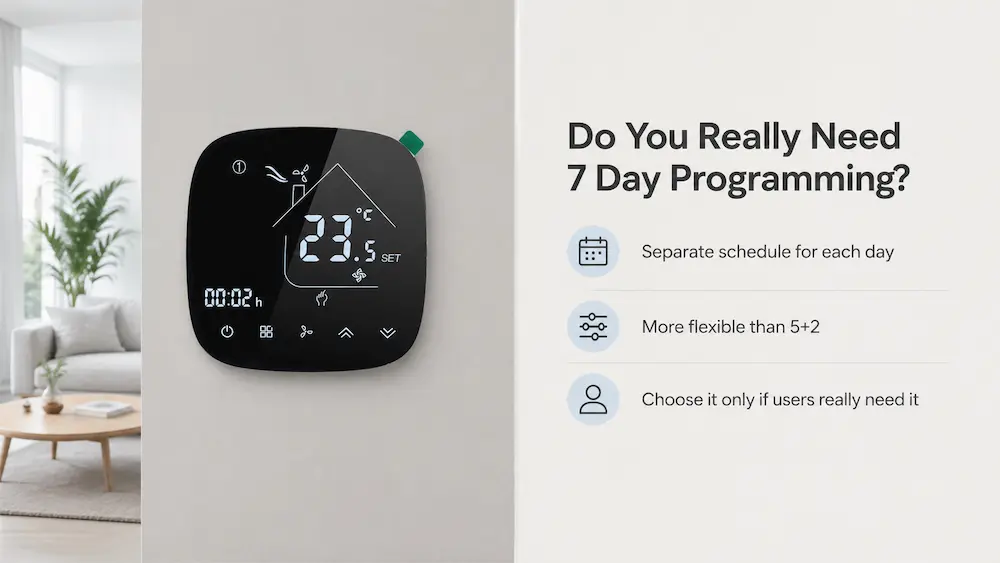
A 7 day programmable thermostat allows different schedules for Monday, Tuesday, Wednesday, and every other day. This gives more flexibility than a simple 5+2 or 5+1+1 model.
But overseas buyers should not choose 7 day programming only because it sounds better. The question is whether the target users really need it.
A 7 day programmable thermostat is usually more suitable for:
- Families with different weekday and weekend routines
- Small offices with changing working hours
- Retail shops with different opening times
- Rental apartments that need flexible user settings
- Markets where buyers prefer higher-value thermostat models
A simpler schedule model may be better when users want very basic operation. Too many settings can confuse some users. This is common in rental rooms, hotels, and senior residential projects.
For overseas buyers, the best option depends on the market. In a mature retail market, 7 day programming can be a strong selling point. In a project market, simple and stable operation may be more important.
Confirm Voltage Before Any Price Decision
Voltage mismatch is one of the fastest ways to turn a good order into a problem order.
Different markets use different power systems. Some projects use 24VAC. Some use 110VAC. Many markets use 220–240VAC. A programmable thermostat must match the local system.
Before ordering, buyers should check:
- Input voltage
- Relay output voltage
- Load voltage
- Whether the thermostat uses dry contact output
- Whether the wiring label matches local installation habits
For example, North American installers may expect R, C, W, Y, and G terminals. European installers may expect L, N, heating output, cooling output, valve output, or fan speed terminals. If the label does not match the market, installation mistakes become more likely.
A serious thermostat supplier should confirm voltage clearly before quotation. A buyer should also write voltage requirements in the purchase order.
Review the Wiring Diagram Like an Installer
A wiring diagram is not only a manual page. It is part of the product experience.
If the diagram is unclear, installers may wire the thermostat incorrectly. This can cause product damage, system failure, or unstable control. In a bulk project, one unclear diagram can create repeated installation problems.
Buyers should ask for these documents before placing an order:
- Complete wiring diagram
- Terminal definition table
- Application wiring example
- Sensor wiring instructions
- Load connection explanation
- Installation manual in simple English
The wiring diagram should answer one simple question: can a real installer connect this thermostat without guessing?
For OEM orders, the wiring diagram should also match the final product label. If the manual says one thing and the back label says another, the product will create after-sales risk.
Check Sensor Accuracy and Control Stability
Many thermostat complaints are caused by poor temperature sensing. The display may show one value, while the room feels different.
For a programmable thermostat, sensor accuracy matters because the schedule depends on correct temperature feedback. If the thermostat reads incorrectly, the schedule will not solve the comfort problem.
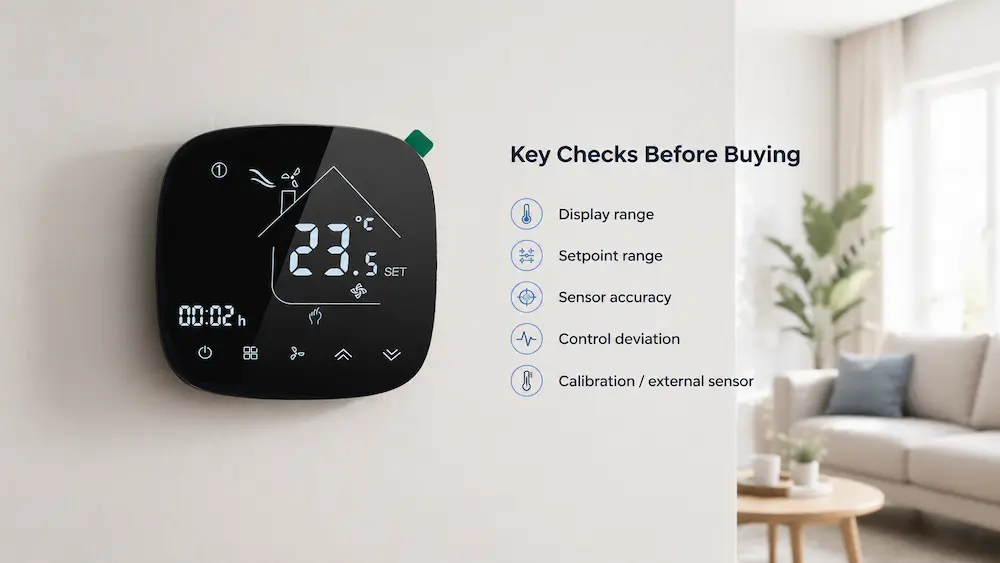
Buyers should check:
- Temperature display range
- Setpoint range
- Sensor accuracy
- Control deviation
- Calibration function
- External sensor option, if needed
For residential buyers, comfort is the main concern. For commercial buyers, consistency across many rooms is more important. If each thermostat reads differently, users will complain that rooms feel uneven.
A high-quality programmable thermostat should offer stable sensing, simple calibration, and predictable control response.
Evaluate Relay Rating and Switching Life
The relay is inside the thermostat, so many buyers ignore it. This is a mistake.
The relay controls the load. It may switch heating, cooling, fan, valve, or other outputs. If relay capacity is too low, the thermostat may fail faster under real use.
Buyers should check:
- Relay current rating
- Supported load type
- Mechanical life
- Electrical life
- Fan or valve compatibility
- Whether the load is resistive or inductive
A relay may look like a small component, but it affects long-term reliability. For distributors and OEM buyers, this is important because failures damage the local brand reputation.
A cheap thermostat with weak relay design may pass a short sample test. But it may fail after repeated switching in real use. That is why relay data should be part of the buying checklist.
Check Display, Buttons, and User Setting Logic
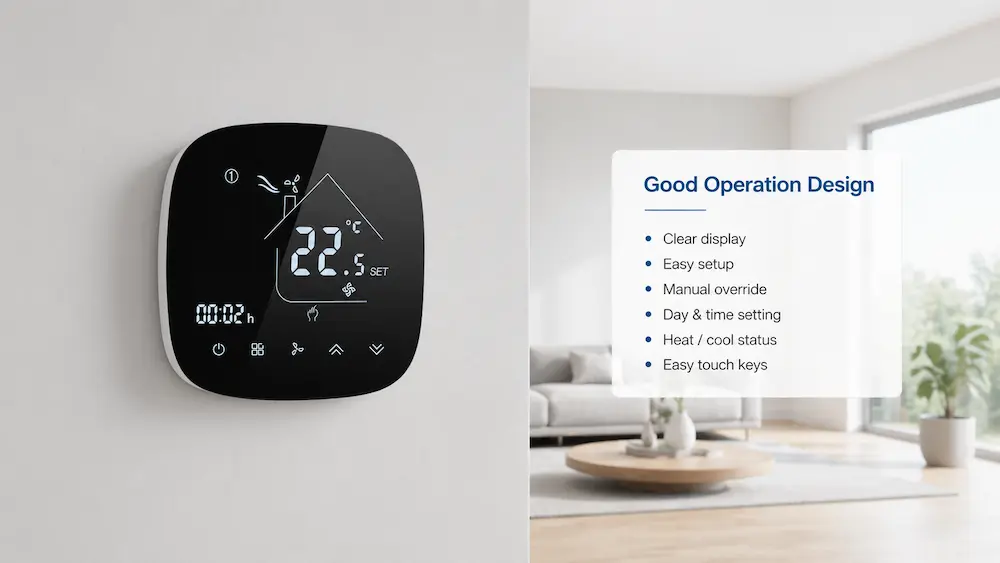
A programmable thermostat must be easy to operate. If users cannot set the schedule, they will not use the programmable function.
Good operation design should include:
- Clear display
- Easy schedule setup
- Simple manual override
- Clear day and time setting
- Readable heating or cooling status
- Buttons or touch keys that are easy to understand
This is very important for overseas markets. The buyer may sell the same thermostat to users with different language levels and different technical skills.
A 7 day programmable thermostat has more settings than a basic model. So the screen and menu must be especially clear. Otherwise, a strong feature becomes a user problem.
Before bulk order, buyers should test the full schedule setting process. If it takes too long to understand, the product may not be suitable for general sales.
Confirm OEM, Packaging, and Market Presentation
For overseas buyers, product presentation matters. A programmable thermostat is not only shipped as a device. It is sold as a complete product.
OEM buyers should confirm:
- Logo position
- Logo printing method
- Model label
- Packaging box
- User manual
- Sticker and barcode
- Neutral or custom branding
Packaging should match the sales channel. A contractor project may accept simple packaging. A retail market needs a more polished box. An online seller may need stronger product images and clearer feature claims.
Manual quality is also important. A poor manual increases after-sales questions. A clear manual reduces support pressure and helps local installers.
Buyers should confirm these details before mass production. Changing packaging after production starts can delay the order and increase cost.
Scientific Data
The data below gives practical reference values for overseas buyers. These values help buyers review programmable thermostat quality before ordering. Actual results depend on the HVAC system, installation location, wiring, and user settings.
| Check Item | Typical Reference Value | Why It Matters |
|---|---|---|
| Temperature control accuracy | ±0.5°C to ±1.0°C | Helps maintain stable comfort. |
| Comfort deviation range | ±1.0°C to ±2.0°C | Larger deviation may cause complaints. |
| Wrong sensor location error | 2°C to 3°C possible | Poor placement can lead to false control. |
| Common setback range | 2°C to 4°C | Useful for energy saving during empty hours. |
| Schedule periods per day | 4 to 6 periods | Enough for morning, day, evening, and night. |
| Quiet room noise reference | 30 dB to 45 dB | Important for bedrooms, hotels, and offices. |
| Relay mechanical life | 100,000 to 1,000,000 cycles | Higher life supports long-term reliability. |
| Typical relay rating | 3A to 16A by model | Must match the real system load. |
These numbers help buyers judge whether a product is suitable for serious use. Temperature accuracy affects comfort directly. A thermostat with poor sensing may create complaints even when the HVAC system is working.
The setback range also needs balance. A 2°C to 4°C setback is often practical. It can save energy while keeping recovery time reasonable. A much larger setback may make users uncomfortable when they return.
Relay life is important in bulk orders. If a thermostat switches many times each day, weak relay quality can become a long-term after-sales problem.
Sample Testing Should Happen Before Bulk Order
Sample testing is not just a formality. It is a risk control step.
Before bulk order, buyers should test the thermostat in the target application. A sample should be checked by both technical staff and normal users if possible.
Sample testing should include:
- Power supply test
- Wiring test
- Schedule setup test
- Temperature control test
- Relay output test
- Display readability test
- Manual and packaging review
- OEM label confirmation
For importers, sample testing helps confirm market fit. For contractors, it helps avoid project failure. For OEM buyers, it helps prevent mistakes before printing logo and packaging.
If the supplier refuses to provide clear documents or avoids technical questions, buyers should be careful. A reliable thermostat manufacturer should support sample testing with enough information.
Related products reference:
Modbus Thermostat for BMS Systems
Common Buying Mistakes to Avoid
Many buying problems are avoidable. They usually happen because buyers move too fast from quotation to order.
- Choosing by lowest price only
- Ignoring local voltage
- Not checking wiring terminals
- Ordering before sample testing
- Not confirming schedule logic
- Ignoring relay rating
- Using one model for all systems
- Confirming logo but forgetting manual and packaging
- Not asking about lead time and replacement support
These mistakes can increase hidden cost. The product may be cheap at first, but after-sales support, replacement, and customer complaints may cost more later.
The better buying method is simple. Confirm application first. Then confirm technical match. Then test samples. Then discuss OEM and bulk order details.
Practical Cases
Case 1: A distributor wanted a low-cost programmable thermostat for apartments. After testing, users found the schedule setting too complex. The buyer changed to a simpler model with clearer operation. The product became easier to sell locally.
Case 2: A contractor ordered samples for an office project. The thermostat function was acceptable, but the voltage did not match the local system. The buyer corrected the voltage before bulk order. This avoided a larger project problem.
Case 3: An OEM buyer approved the thermostat body and logo. But the manual was not suitable for the local market. After revising the manual and box before production, the final product looked more professional and reduced after-sales questions.
These cases show that overseas buying is not only about choosing a product. It is about checking whether the product is ready for the market.
Expert Insights
Programmable thermostats remain important in export markets because they are simple and practical. Not every buyer wants Wi-Fi control. Not every project needs a cloud platform. Many users still prefer a thermostat that works by schedule and does not depend on the internet.
For overseas buyers, the strongest value is product readiness. A good programmable thermostat should come with clear wiring, stable performance, easy operation, and proper packaging.
A good supplier should not only quote a price. The supplier should help confirm application, voltage, wiring, schedule logic, relay rating, and OEM details. This reduces risk for both sides.
For wholesale and OEM orders, long-term cooperation depends on stability. A product that reduces complaints is more valuable than a product that only wins on price.
Final Ordering Checklist
| Check Point | Risk If Ignored | Recommended Action |
|---|---|---|
| Application | Wrong control logic | Confirm heating, cooling, boiler, or FCU. |
| Schedule type | Poor user fit | Choose 7 day model for flexible routines. |
| Voltage | Product damage or failure | Confirm 24V, 110V, or 220–240V. |
| Wiring | Installation errors | Review diagram before ordering. |
| Relay rating | Short service life | Match relay with real load. |
| Manual | More after-sales questions | Check language and clarity. |
| OEM package | Weak market presentation | Confirm logo, label, box, and barcode. |
This checklist helps overseas buyers reduce order risk. It also helps compare suppliers more fairly. The best programmable thermostat is not only the cheapest one. It is the one that fits the market, the system, and the buyer’s business model.
FAQ
1. What should overseas buyers check before ordering a programmable thermostat?
They should check application, voltage, wiring, schedule type, relay rating, sensor accuracy, manual quality, packaging, OEM details, and supplier support.
2. Is a 7 day programmable thermostat better than a basic model?
It is better when users need different schedules for each day, but a simpler model may be better for users who want very easy operation.
3. Can one programmable thermostat fit all HVAC systems?
No. Buyers must confirm whether the system is boiler heating, electric heating, fan coil unit, heat pump, or another HVAC type.
4. Why is sample testing important before bulk order?
Sample testing helps confirm voltage, wiring, schedule setting, display, relay output, packaging, and real market suitability.
5. What makes a programmable thermostat suitable for OEM buyers?
Clear logo options, custom packaging, accurate labels, stable quality, clear manuals, and reliable supply make it more suitable for OEM buyers.
Overseas buyers should treat programmable thermostat sourcing as a system-matching decision, not only a price comparison. The safest buying process is to confirm application, voltage, wiring, schedule logic, relay rating, and OEM details before bulk order. A 7 day programmable thermostat is a strong choice when flexibility matters, but simple operation and clear documentation are still essential.
References / Sources
- U.S. Department of Energy, Energy Saver — Programmable Thermostats
- ENERGY STAR — Smart Thermostats Product Criteria and Energy Saving Guidance
- ASHRAE — ASHRAE Handbook: Fundamentals, Thermal Comfort and Heat Balance
- ASHRAE — Fundamentals of HVAC Control Systems
- Honeywell Home — 7-Day Programmable Thermostat User Guide
- Honeywell Home — Programmable Thermostat Installation Instructions
- Siemens Building Technologies — Room Thermostat and HVAC Control Literature
- Schneider Electric — Room Control and Building Management System Resources
- Danfoss — Room Thermostat and Heating Control Technical Publications
- Carrier — Programmable Thermostat Owner’s Manual and HVAC Control Guidance
- Trane — Programmable Thermostat and Building Comfort Control Resources
- Johnson Controls — Building Automation and Room Control Application Materials
- National Institute of Standards and Technology (NIST) — Building Energy and Control Performance Research