Quick Summary
A smart thermostat can create very different value in hotels, offices and apartments. In hotels, it should help save energy, limit wrong settings and connect with room or building management. In offices, it should support schedules, zones and stable daily operation. In apartments, App control, remote setting and simple user experience usually matter more.
The right choice is not about adding every possible function. We should first understand who controls the room, what problem the project must solve and which features will really be used after installation. A WiFi thermostat can be useful, but only when the HVAC system and control logic are already correct.
Before Choosing Smart Features, Confirm the HVAC System First
While “smart” and “WiFi” features get the most attention, they are just the surface level of a working system. Before choosing smart functions, we need to make sure it matches the right basic HVAC system.
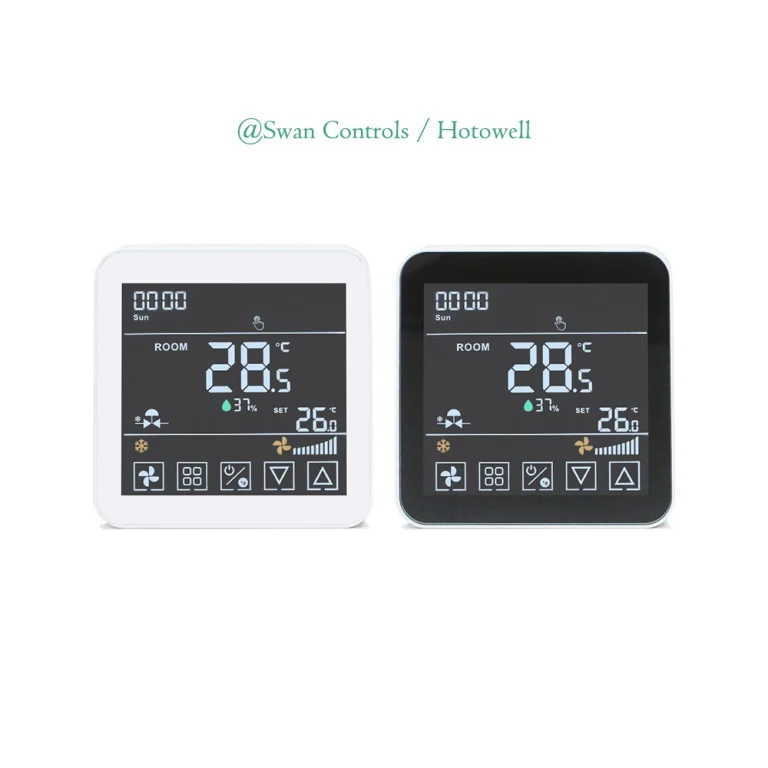
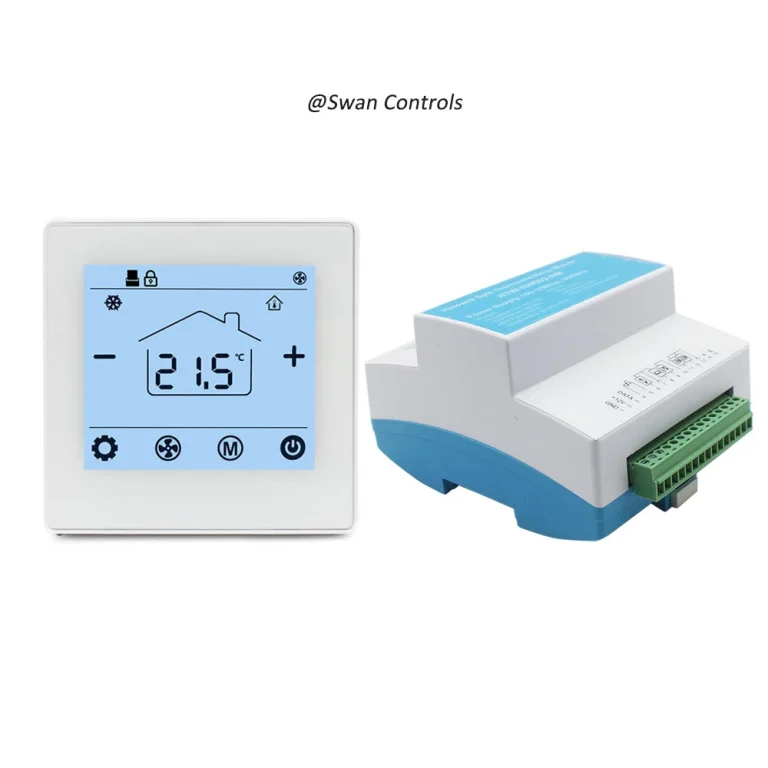
HVAC systems can include fan coil units, underfloor heating, boiler heating, heat pumps, VRF systems, packaged AC units and other equipment. We at Swan Controls, an affiliate of Hotowell, mainly work with fan coil thermostat and heating thermostat solutions, and this article focuses on smart thermostat selection for fan coil unit projects in hotels, offices and apartments. For other HVAC systems, the same decision logic can still help, but wiring, load, output and control details must be checked separately.
Even inside fan coil projects, the system must still be confirmed before we choose smart functions. A 2-pipe FCU is not the same as a 4-pipe FCU. A 3-speed fan is not the same as an EC fan. An on/off valve is not the same as a 0-10V modulating valve. Some projects need keycard input. Some need Modbus or BACnet. Some only need local control with a clear display.
This is why WiFi should not be the first filter. A WiFi thermostat is valuable only after the valve, fan, voltage, pipe system and communication requirements are correct. If the basic control match is wrong, the App may work, but the HVAC system may still fail to operate properly.
Why the Same Smart Thermostat Does Not Work the Same Way in Every Project
Finding a technical match ensures the system works, but understanding the application ensures the project succeeds. Even when the wiring and HVAC hardware—such as a 3-speed fan and on/off valve—are identical, the practical role of the thermostat shifts depending on its environment. This leads to a common question:
“Can we use the same smart thermostat for hotels, offices and apartments?”
The answer is often yes from a hardware perspective. If the basic control logic matches, the same product can indeed be installed across different sectors.
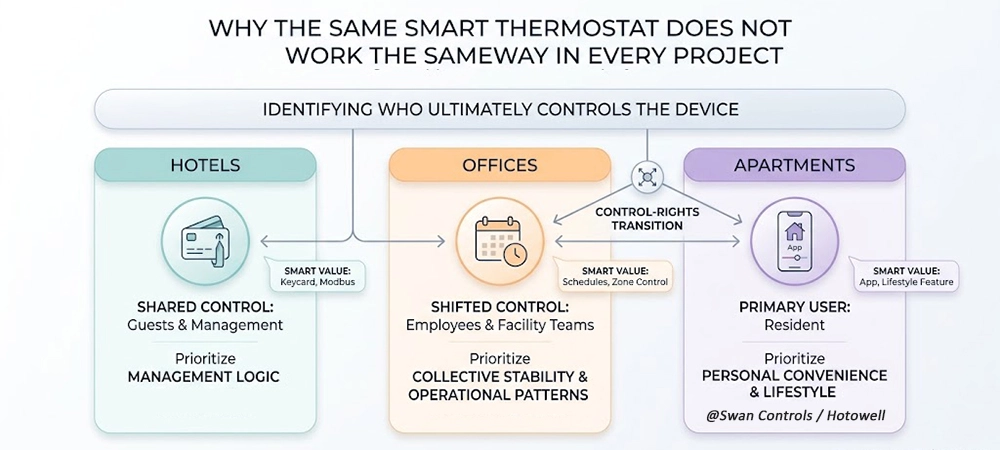
However, the real value of the device changes once we consider who is actually in control. This is the core of the decision: it is a control-rights transition. A thermostat sits between many different users, and we must understand their priorities to choose the right smart features.
-
In hotels, control is shared by guests, front desk staff, and property managers. The guest wants immediate comfort, but we must prioritize management logic—energy saving, setpoint limits, and room status. Here, “smart” value often comes from keycard integration or Modbus communication to protect the owner’s energy costs.
-
In offices, control shifts to employees and facility teams. The priority moves toward collective stability and operational patterns. In this case, “smart” operation usually means automated schedules and zone management to ensure comfort during work hours and efficiency during weekends.
-
In apartments, the resident is the primary user. The “smart” value is most visible through personal convenience—App control, remote settings, and a simple UI. For the resident, the thermostat is not a management tool, but a lifestyle feature.
By identifying who ultimately controls the device, we can decide whether keycard input, locks, App control, schedules, Modbus, or BACnet should be prioritised. A good smart thermostat choice is not just a product selection; it is about matching the control logic to the real needs of the project.
Smart Thermostat for Hotels: Energy Saving and Management Come First
For hotel projects, the main job of a smart thermostat is not to impress the guest with more buttons. It should help the hotel manage energy, comfort and room status more reliably.
A hotel room may be empty for many hours in a day. If the guest leaves the room while the fan coil unit keeps running at a strong setting, energy is wasted. Independent hotel HVAC studies from the U.S. Department of Energy and Pacific Northwest National Laboratory evaluated occupancy-based guest-room controls in real hotels, showing why hotels pay attention to unoccupied-room HVAC operation.
This is why keycard input can be more useful than asking every guest to connect an App. When the guest leaves the room, the thermostat can enter an energy-saving mode or follow a preset control rule. For many hotels, this is more practical than a WiFi thermostat that requires guest pairing, phone settings and extra support.
Hotel thermostats also need permission control. Guests should be able to adjust comfort within a reasonable range, but they should not change engineering parameters. Setpoint limits, lock functions and hidden settings help reduce wrong operation.
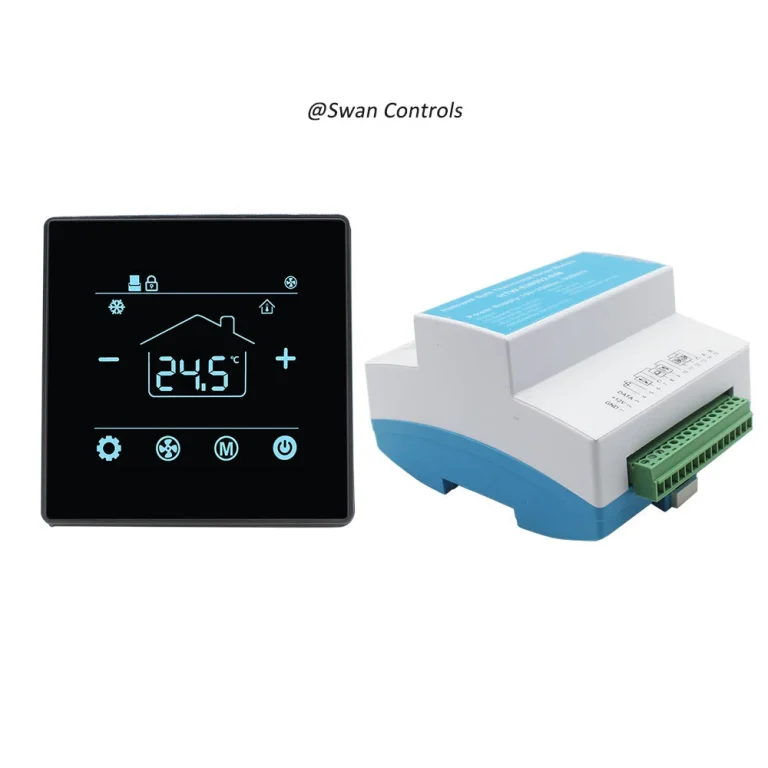
For hotel FCU rooms that do not need WiFi but need practical guest-room energy logic, our HTW-WF01-FC-2K reliable keycard hotel thermostat for 2-pipe FCU systems is a more direct option. If the project also needs a management platform, Modbus or BACnet should be discussed early, not added later as an afterthought.
A hotel thermostat is smart when it protects comfort and energy performance at the same time. It should give guests enough control, but not unlimited control.

Smart Thermostat for Offices: Schedule, Zones and Stable Daily Operation
Office projects have a different problem. The building may have repeated daily patterns: work hours, lunchtime, meeting-room use, overtime, and weekends. The thermostat should support these patterns instead of relying on people to adjust every room manually.
In office spaces, schedule control is often more useful than full individual App control. A small office may benefit from a WiFi thermostat if the owner wants simple remote access. But in a larger office, central control, group control, or BMS communication may be more practical.
Office comfort is also not only about one temperature number. ASHRAE Standard 55 explains thermal comfort as a combination of factors that create satisfactory thermal conditions for most occupants, including temperature, activity and other environmental factors. This supports the idea that office control should focus on stable operation, not constant manual adjustment by many users.
For office FCU projects, we should ask several practical questions. Are there different zones? Are meeting rooms used only part of the day? Does the facility team need to limit settings after working hours? Is the building already using Modbus or BACnet? These questions decide whether a simple WiFi thermostat is enough or whether a central-control model is more suitable.
If a distributor or OEM buyer wants one stronger platform that can be promoted across different FCU project types and reduce inventory pressure, HTW-FC09-FVMN-24WF thermostat for 3 speed fan, EC fan and 0-10V modulating valve control can be positioned as a flexible option. Its value is not that every project must use every function. Its value is that one platform can cover more project variations when the system requirements match.
Smart Thermostat for Apartments: App Control and User Experience Matter More
Apartment projects are closer to the end user. A resident may not care about Modbus address settings, BACnet objects or hidden installer menus. They usually care about simple questions: Can I control the room from my phone? Is the screen clear? Is the schedule easy? Does it look modern on the wall?
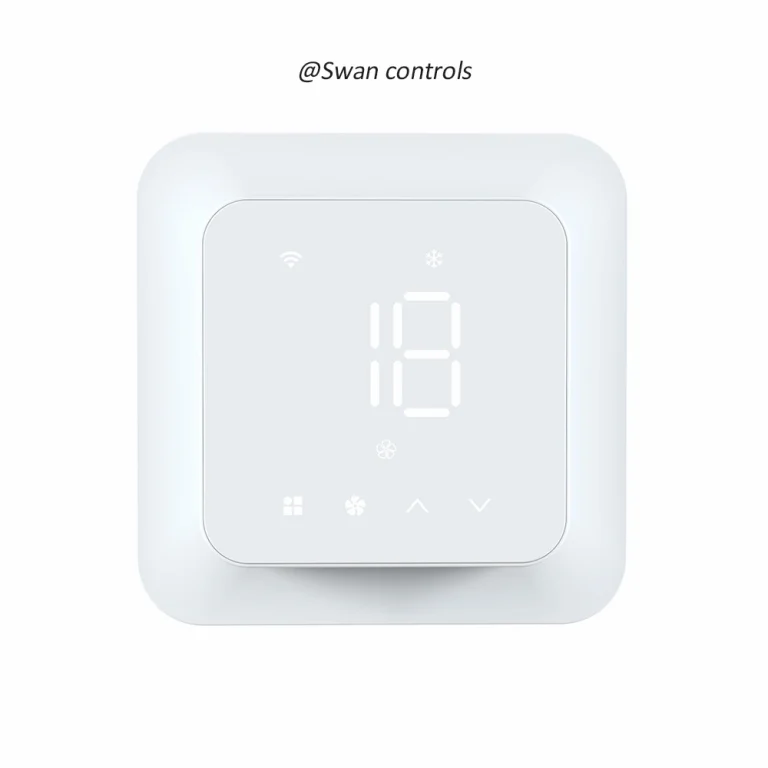
This is where a WiFi thermostat becomes commercially stronger. For apartments, App control is not only a technical feature. It is also a selling point for developers, wholesalers and brand owners. Remote setting, weekly schedule and a simple interface can help the product feel more modern and easier to explain.
For apartment projects, the best solution is usually a balance between easy daily use and correct HVAC matching. The room thermostat should be simple for residents, clear for installers and stable enough to reduce after-sales questions.
Feature Priority Comparison: Hotels vs Offices vs Apartments
| Project Type | Who Controls It? | Main Problem to Solve | Smart Features That Matter Most | Features That May Be Unnecessary |
|---|---|---|---|---|
| Hotels | Guest, front desk, property team, BMS | Energy saving, room status, permission control, fewer guest errors | Keycard input, lock, setpoint limit, Modbus/BACnet, parameter protection | Asking every guest to connect an App |
| Offices | Employees, admin team, facility team, building system | Working-hour control, zone comfort, after-hours saving, management convenience | Schedule, zone logic, group control, central control, Modbus/BACnet | Individual App control for every employee in a large office |
| Apartments | Resident, landlord, property manager, end user | Easy use, remote control, modern selling point, simple after-sales | WiFi App, remote setting, weekly schedule, simple UI | Complex BMS communication in small residential projects |
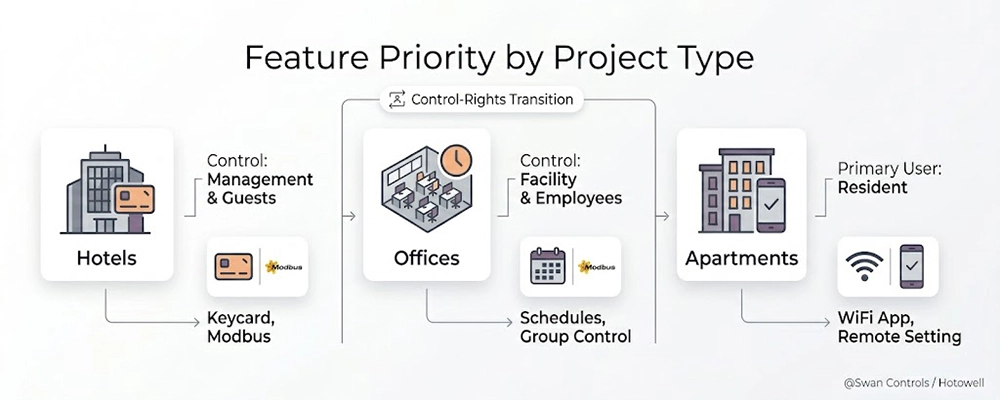
This comparison shows why a smart thermostat should not be selected only by feature quantity. The right choice depends on the control relationship. Hotels need management logic. Offices need daily operation logic. Apartments need user-experience logic.
The International Energy Agency notes that building operations account for about 30% of global final energy consumption, and space cooling demand continues to grow. This does not mean every project needs the most complex thermostat. It means control strategy should match the real building use case.
How Control Priorities Change by Project Situation
| Project Situation | What Usually Happens | Better Thermostat Logic |
|---|---|---|
| Hotel room becomes empty | HVAC may continue running if there is no control rule | Use keycard input, occupancy-related logic or energy-saving parameters |
| Office closes after working hours | Many rooms may stay at comfort setpoints unnecessarily | Use weekly schedule, zone grouping or central control |
| Apartment resident has changing routines | The user may forget to adjust settings before leaving or returning | Use App control, remote setting and weekly schedule |
| Project has different FCU types | One model may not match all fan and valve outputs | Confirm 2-pipe/4-pipe, fan type and valve output first |
| Users can change too many settings | Wrong parameters may create complaints or unstable operation | Use lock, setpoint limits and protected installer settings |
The U.S. Department of Energy says thermostat setback of 7–10°F for eight hours a day can save as much as 10% a year on heating and cooling, depending on climate and system conditions. This supports the practical value of schedule and setback logic, especially in offices and residences where daily routines are predictable.
Practical Purchasing Judgements for Real Projects
Case 1: A hotel buyer asks for WiFi, but the real issue is room control
A hotel buyer may say, “We need a smart thermostat with WiFi for guest rooms.” At first, this sounds like a clear request. But after checking the project, the more important questions are usually different: Does the room use a keycard? Should the setpoint be limited? Does the front desk need room status? Does the hotel want BMS integration?
If the hotel does not want every guest to pair an App, a WiFi thermostat may not be the best first choice. The better purchasing judgement is to prioritise keycard input, lock function, stable FCU control and communication with the hotel management system if required. WiFi can still be considered, but it should not replace the hotel’s energy-saving and permission-control logic.
Case 2: An office supplier wants one model, but the building has different zones
An office supplier may prefer one thermostat model to simplify purchasing and stock. This is reasonable, especially for distributors or project suppliers who want fewer SKUs. But the purchasing judgment should still start from the office layout.
If the project includes open offices, meeting rooms, private rooms and different working schedules, the supplier should confirm whether one model can support the required fan control, valve output, schedule and central management. If the office has more advanced FCU control requirements, a flexible platform may reduce inventory pressure. But it should be promoted with clear application boundaries, not as a universal model for all HVAC systems.
Case 3: An apartment project needs a selling point, but not unnecessary complexity
For apartment projects, the buyer may want a modern thermostat that is easy to promote. App control, remote setting and weekly schedule are useful selling points because residents can understand them quickly.
The better purchasing judgement is to choose a clean, simple and reliable WiFi thermostat when the project needs user-friendly operation, and avoid adding advanced functions that the resident, installer or landlord will not use.
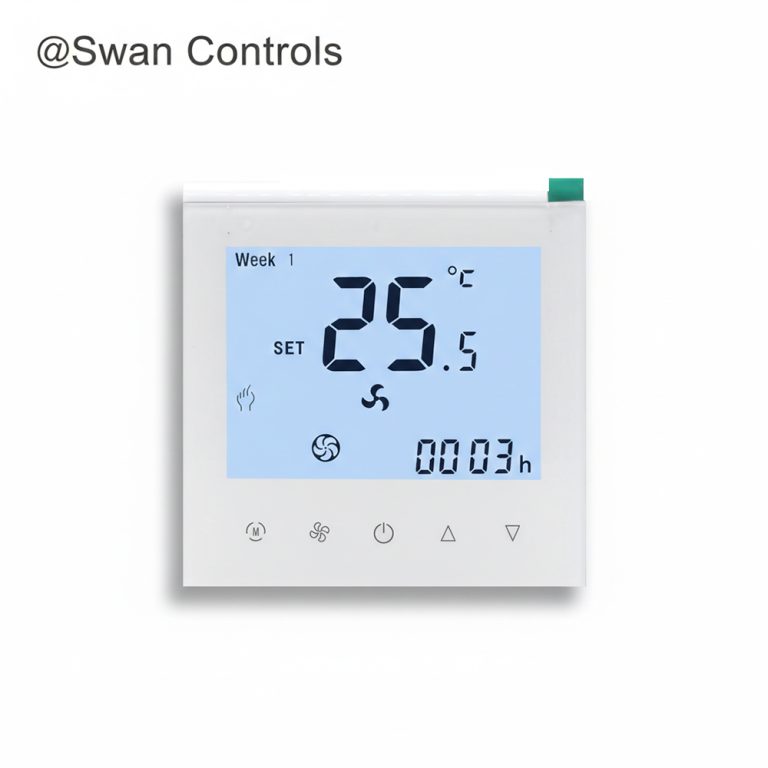
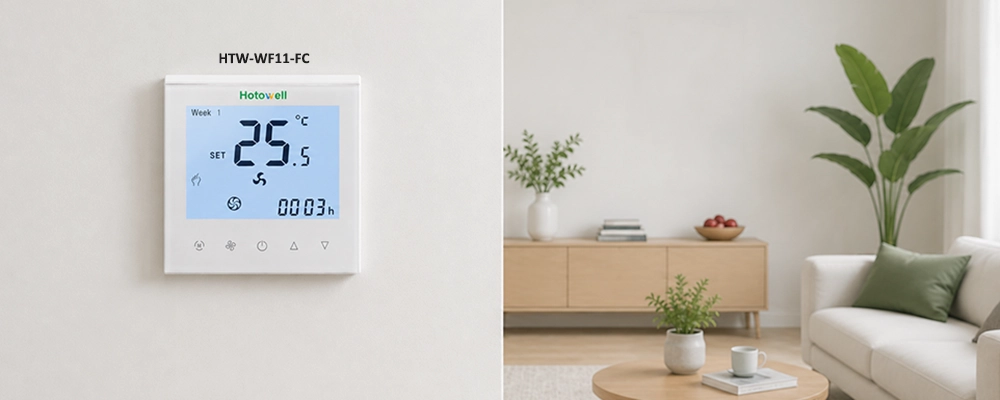
A standard 2-pipe FCU project with App control may use our HTW-WF01-FC-2W smart WiFi thermostat. A 4-pipe FCU project needs a different control match, such as our HTW-WF11-FC-4W Tuya thermostat. The point is not to force one model into every project, but to start from the system and then choose the smart layer.
FAQ
1- What is the best smart thermostat for hotel rooms?
The best smart thermostat for hotel rooms is usually not the one with the most App functions. It should support stable FCU control, keycard input, setpoint limits, lock function and possible BMS communication. For hotels, energy saving and permission control usually come before guest App control.
2- Is WiFi necessary for office HVAC projects?
WiFi can be useful in small offices or rooms that need simple remote access. For larger office projects, schedule control, zone logic, Modbus, BACnet or central control may be more important. The right choice depends on how the facility team manages daily operation and after-hours energy use.
3- Can one room thermostat be used for hotels, offices and apartments?
One room thermostat platform may be promoted across different projects if the output, fan control, valve control and communication options match the system. But one model should not be assumed to fit every HVAC system. Always confirm FCU type, wiring, voltage and control logic before ordering.
4- What smart thermostat features matter most for apartments?
For apartments, App control, remote setting, weekly schedule, simple UI and modern appearance are usually important. These functions help improve user experience and sales value, but the thermostat must still match the actual HVAC system.
5- Should we choose Modbus, BACnet or WiFi for a thermostat project?
Choose Modbus or BACnet when the thermostat must connect to a building management system or central control platform. Choose WiFi when the project needs App control and remote user operation. For hotels and large offices, BMS communication may be more practical. For apartments, WiFi is usually easier to understand and promote.
Final Note
A smart thermostat should not be selected by the word “smart” alone. Hotels, offices and apartments have different control relationships, different energy goals and different users. In hotels, management and energy saving come first. In offices, schedules and zones matter more. In apartments, App experience and simple daily control often create more value.
For fan coil unit projects, the safest decision is to start with the HVAC system, then choose the smart function. If the FCU control, valve output, fan type and communication logic are correct, WiFi, Modbus, BACnet or keycard input can add real value. If the system match is wrong, smart features only add confusion. If we are preparing a hotel, office or apartment thermostat project, please feel free to get in touch with Swan Controls to confirm the suitable model and project configuration.
References
1- U.S. Department of Energy and Pacific Northwest National Laboratory, “Guest Room HVAC Occupancy-Based Control Technology Demonstration.”
2- Western Cooling Efficiency Center, University of California, Davis, “Central Hotel Guest Room Energy Controls Final Report.”
3- ASHRAE, “ANSI/ASHRAE Standard 55: Thermal Environmental Conditions for Human Occupancy.”
4- International Energy Agency, “Buildings.”
5- International Energy Agency, “Staying Cool Without Overheating the Energy System.”
6- U.S. Department of Energy, Energy Saver, “Programmable Thermostats.”
7- California Statewide Codes and Standards Enhancement Program, “Guest Room Occupancy Controls CASE Report.”
8- ASHRAE, “Standard 135: BACnet — A Data Communication Protocol for Building Automation and Control Networks.”
Copyright Note
Copyright © Swan Controls / Hotowell. All rights reserved. This article is written and published by Swan Controls, an affiliate of Hotowell.