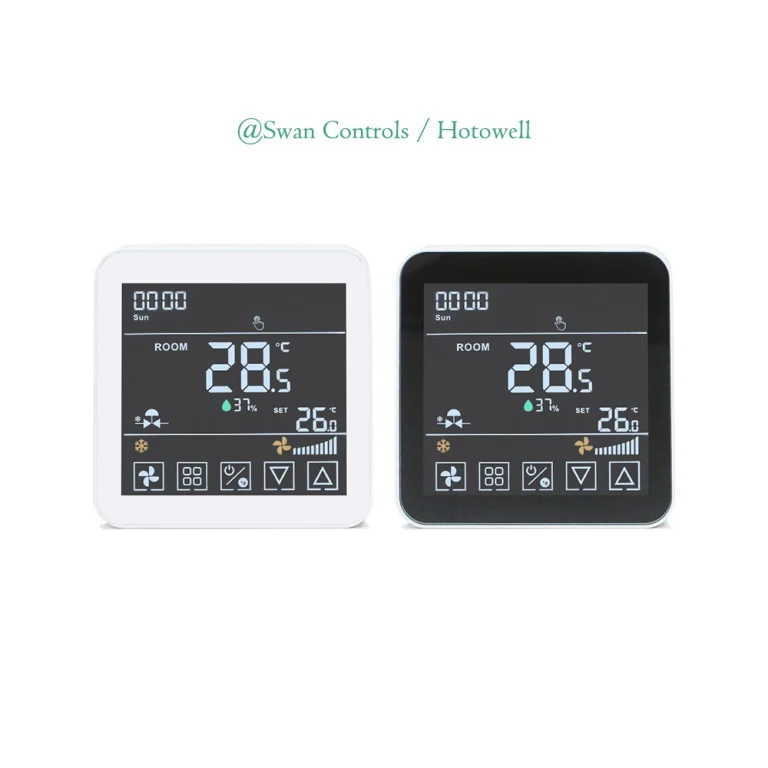
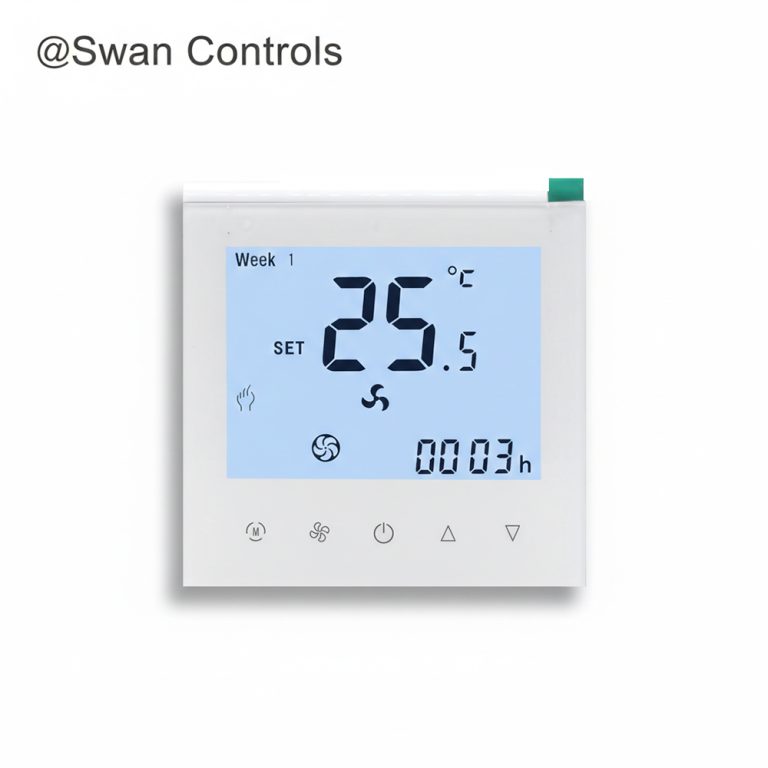
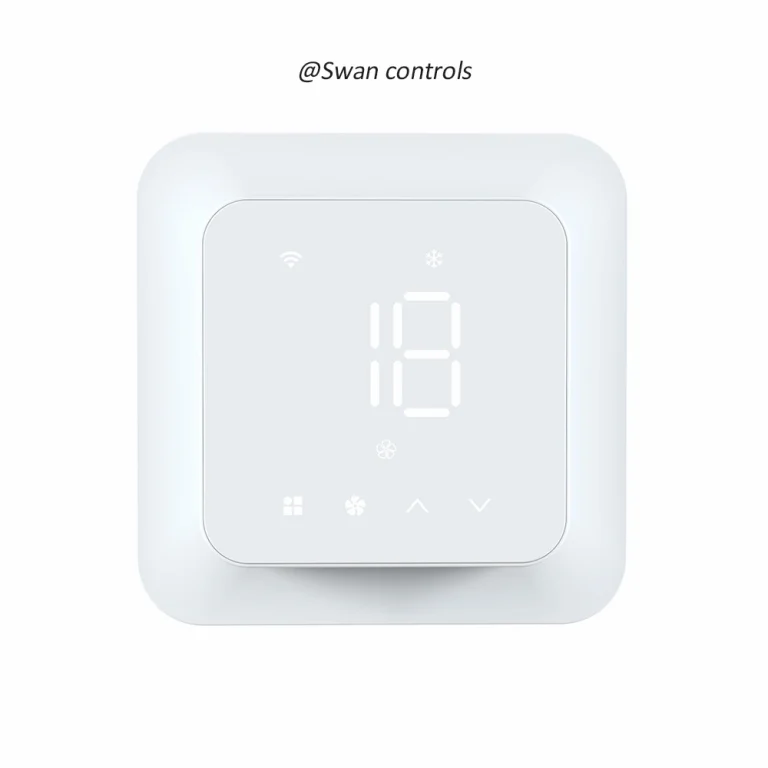
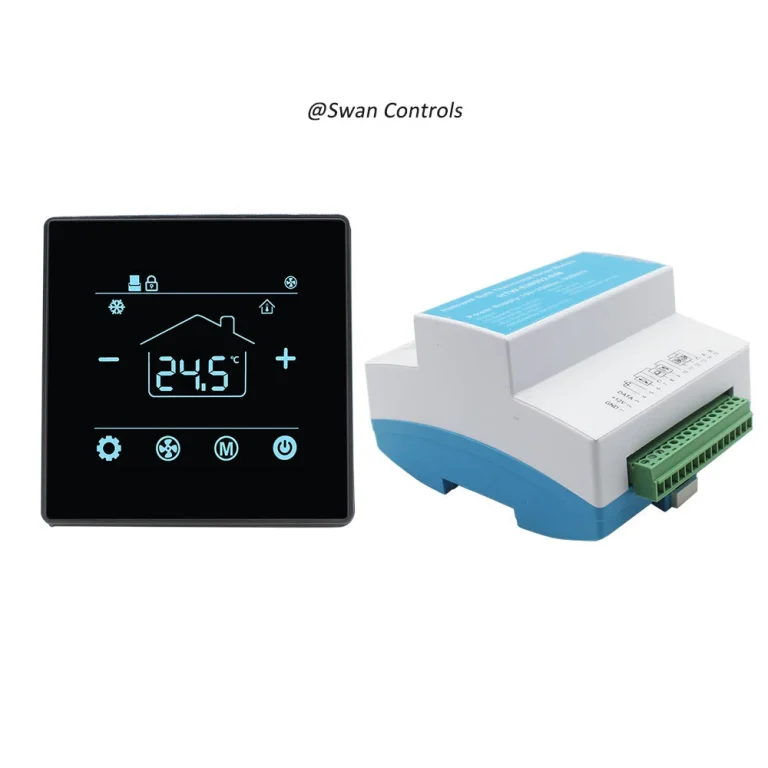
Quick Summary
A digital thermostat is an electronic temperature controller used to sense room temperature and control heating, cooling, fan, or valve output. Compared with a mechanical thermostat, it offers clearer settings, better control flexibility, and easier system matching for modern HVAC projects.
A digital room thermostat is commonly used in hotels, apartments, offices, fan coil units, and heating systems. The best choice depends on the system type, wiring, voltage, control signal, communication needs, and whether the project needs WiFi, Modbus, remote setback, or simple local control.
What Is Digital Thermostat and How Does It Work?
“Do we need a smart model, or is a basic digital model enough?”
This is a common question from HVAC buyers, hotel contractors, and distributors. Many people first think a digital thermostat simply means a thermostat with an electronic screen. That is only partly true. The display is visible, but the real value is inside the control logic.
A digital thermostat reads room temperature through a sensor, compares it with the set temperature, and then sends an output signal to the HVAC or heating equipment. In a fan coil unit system, it may control fan speed, valve opening, heating, cooling, or remote setback. In an electric heating system, it may control the heating load directly.
For overseas buyers, the key question is not only “Is it digital?” The better question is: “Does this control logic match my HVAC system, voltage, wiring, and project application?” This article explains what a digital thermostat is, how it works, where it is used, and how to choose the right type for a real project.
What Is a Digital Thermostat?
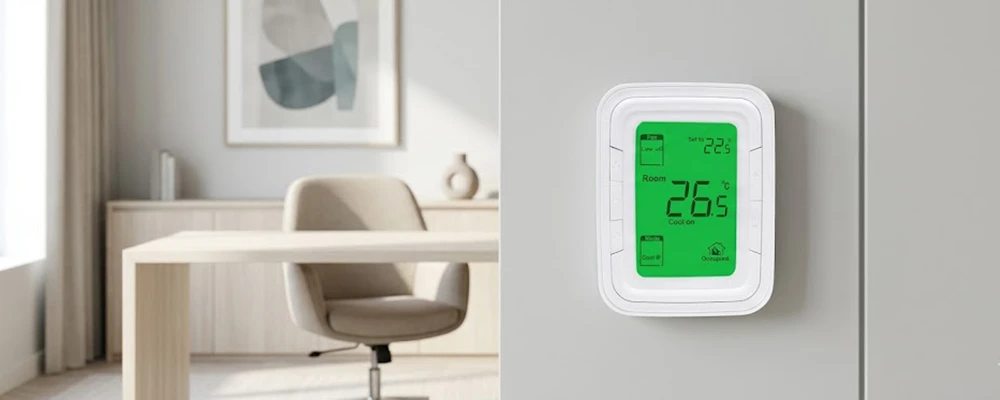
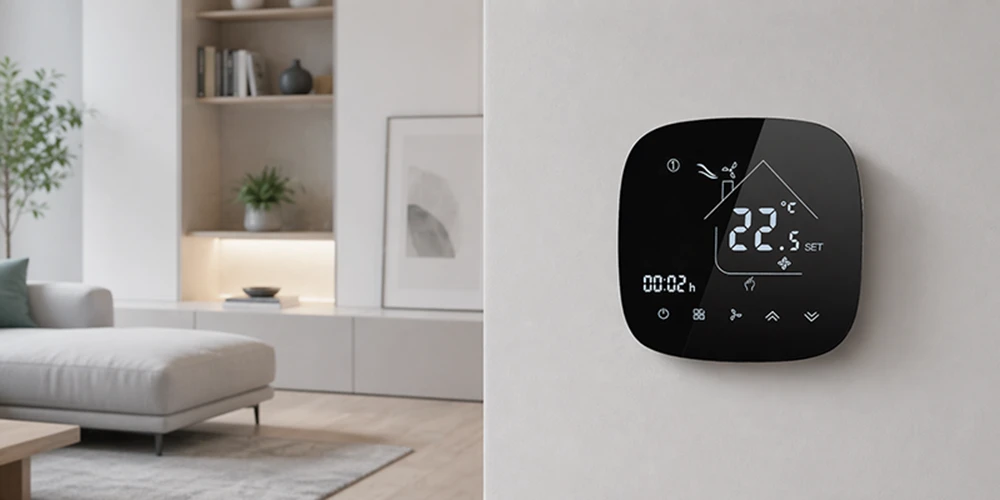
A digital thermostat is a temperature control device that uses electronic sensing and control logic instead of a simple mechanical switch. It usually includes a temperature sensor, microcontroller, display, buttons or touch keys, output terminals, and sometimes communication functions.
In simple terms, it checks the room temperature, compares it with the target setting, and decides whether the system should heat, cool, open a valve, start a fan, or stop operation.
For example, in a fan coil unit, the thermostat may control:
- Fan low / medium / high speed
- Cooling valve output
- Heating valve output
- 2-pipe or 4-pipe changeover
- Keycard or occupancy input
- Modbus communication with BMS
- WiFi app control for smart room management
A digital room thermostat is often used where a project needs stable room comfort, easy operation, and more flexible control than a basic mechanical model.
Digital Thermostat vs Mechanical Thermostat
The difference is not only the screen. The real difference is how the thermostat senses, processes, and controls the system.
| Item | Mechanical Thermostat | Digital Thermostat |
|---|---|---|
| Temperature sensing | Mechanical element | Electronic sensor |
| Display | Usually no screen | LCD, LED, or touch display |
| Setting accuracy | Usually lower | Usually more precise |
| Control logic | Simple on/off | On/off, fan, valve, heating, cooling, communication |
| Project flexibility | Limited | Higher |
| Best use | Simple low-cost control | HVAC, hotel, office, apartment, smart heating |
A mechanical thermostat may still work for simple applications. But for a commercial HVAC project, especially with FCU, BMS, hotel keycard, or 4-pipe operation, a digital thermostat is usually a better choice.
How Does a Digital Thermostat Work?
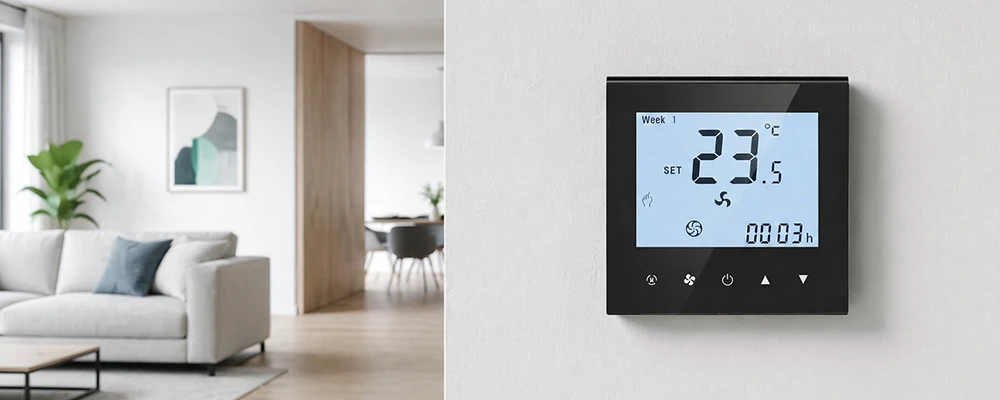
A digital thermostat works through a simple control chain:
- It senses the room temperature.
- It compares the measured temperature with the setpoint.
- It decides whether heating or cooling is needed.
- It sends output to the connected equipment.
- It repeats this process continuously.
The logic sounds simple, but the details matter a lot in real projects.
Step 1: Temperature Sensing
The thermostat first reads the room temperature through an internal or external sensor. For most room control applications, the sensor should be placed away from direct sunlight, air outlets, doors, windows, and heat sources.
Poor sensor placement is one of the most common reasons for wrong temperature control. A good thermostat cannot solve bad installation.
Sensor accuracy and calibration matter because the control decision depends on the measured temperature. Temperature sensors convert environmental changes into electrical or readable signals, which are then used by the controller.
Step 2: Setpoint Comparison
After reading the temperature, the thermostat compares it with the target setting.
For example:
- Room temperature: 28°C
- Cooling setpoint: 24°C
- Result: cooling demand is active
If the room reaches the setpoint, the thermostat may stop cooling output or reduce operation depending on the control design. Some models use simple on/off control. Some use more advanced control logic for better comfort and less frequent switching.
Step 3: Output Control
The thermostat then sends output to the HVAC or heating equipment.
For FCU applications, output may include fan speed and valve control. For heating applications, output may control an electric heating load, boiler signal, or water heating valve. For BMS applications, it may also share status through Modbus.
This is why buyers should not choose only by appearance. Two thermostats may both look digital, but one may support only simple heating, while another can support 2-pipe / 4-pipe FCU, Modbus, remote sensor, and hotel setback.
Main Types of Digital Thermostat
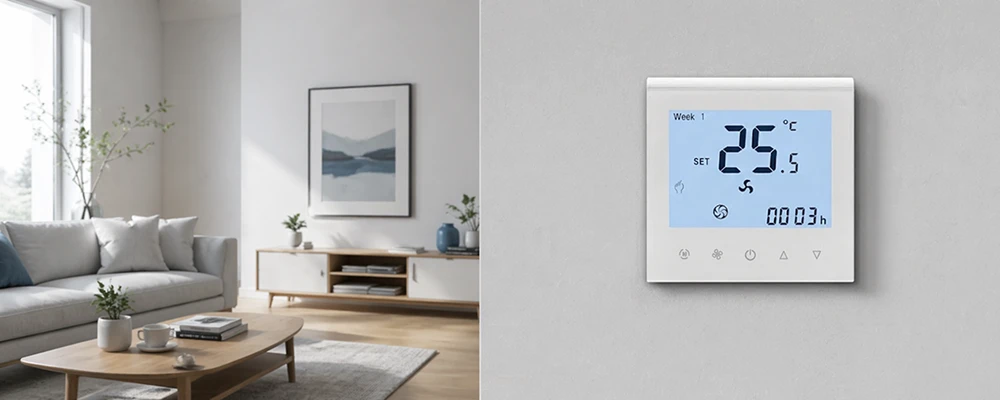
The right type depends on the application. A residential heating project, hotel room, office FCU, and BMS-controlled building may all need different models.
1. FCU Digital Room Thermostat
An FCU digital room thermostat is used with fan coil units. It usually controls the fan and valve according to room temperature.
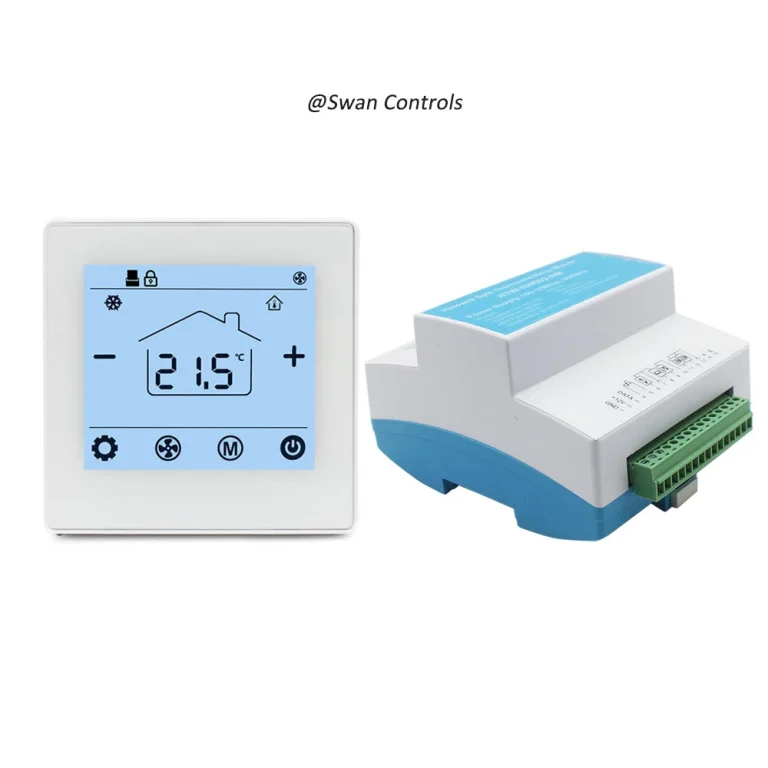
For general FCU projects, a model such as the 2-pipe 4-pipe HVAC thermostat with WiFi, Modbus, and remote sensor is suitable when the project needs flexible system matching. It can fit many office, apartment, and commercial HVAC applications where 2-pipe or 4-pipe control must be confirmed before ordering.
This type is often suitable when buyers need:
- 2-pipe or 4-pipe FCU control
- Fan and valve output
- Remote sensor option
- Modbus or WiFi option
- Better project flexibility
For contractors, this is usually the safer choice when the same project may include different room types or HVAC configurations.
2. Hotel Digital Room Thermostat
Hotels usually need more than normal temperature control. They often need keycard input, remote setback, stable operation, and simple guest use.
For this type of project, the 4-pipe hotel room thermostat with Modbus and remote setback is a more suitable internal link. It matches the real hotel buying logic: comfort, energy control, and room management.
A hotel thermostat should not be too complicated for guests. But it should give the building operator enough control behind the panel.
A good hotel model should support:
- Clear room display
- Stable fan coil control
- Remote setback or keycard logic
- Optional Modbus for BMS
- Simple operation for guests
- Reliable long-term use
For hotels, the right digital thermostat is not only a room accessory. It affects guest comfort, energy use, and maintenance workload.
3. Basic Digital Thermostat
A basic digital thermostat may be enough when the project only needs local control without WiFi, BMS, or advanced integration.
The Halo T6861 digital thermostat for 2-stage cooling can be positioned as a practical option for buyers who need a simple digital control interface and reliable basic operation.
A basic model is usually suitable when:
- The control logic is simple
- No app control is required
- No BMS communication is needed
- Budget is sensitive
- The installation is repetitive and easy to standardise
4. Smart Digital Thermostat with WiFi or Tuya
A smart model adds app control, remote operation, scheduling, or smart platform connection.
The OEM Tuya WiFi thermostat for smart 4-pipe FCU controller is better for apartments, smart home projects, and OEM buyers who want app-based control.
However, buyers should not confuse WiFi with industrial building control. WiFi is useful for app control and user convenience. For large commercial buildings, Modbus or BACnet is often more relevant for BMS integration.
Choose this type when:
- App control is important
- Tuya ecosystem is required
- The project is residential, apartment, or light commercial
- OEM branding is needed
- The buyer wants smart control as a selling point
5. Heating Digital Thermostat
Heating models are used for electric heating, water heating, boiler heating, or floor heating systems. They are not always suitable for FCU.
The Tuya thermostat for 16A electric heating system is suitable as an internal link when explaining heating applications.
A heating digital thermostat should be selected based on:
- Heating load
- Voltage
- Current rating
- Sensor type
- Floor sensor or room sensor requirement
- Wiring safety
- App control requirement
For electric heating, current capacity is very important. A 16A thermostat should not be replaced with a lower-load model unless the system design supports it.
How to Choose the Right Digital Thermostat
Choosing the right product is not difficult if buyers check the system first. The wrong choice usually happens when people start from appearance, price, or display style.
Check the HVAC System Type First
Before choosing, confirm the system type:
- Fan coil unit
- 2-pipe FCU
- 4-pipe FCU
- Electric heating
- Water heating
- Boiler heating
- Heat pump
- DX system
- BMS-controlled HVAC system
For FCU projects, a digital room thermostat must match the pipe system and valve logic. A 2-pipe system and a 4-pipe system do not work in the same way.
Confirm Voltage and Wiring
Voltage mismatch can damage the thermostat or the equipment. Common options include 24VAC, 24VDC, 110VAC, and 220VAC, depending on the model and market.
Before placing an order, buyers should confirm:
- Power supply
- Fan output voltage
- Valve output type
- Relay load
- Wiring terminals
- Whether the thermostat directly powers the load or only sends a signal
This is especially important for OEM buyers and project contractors.
Decide Whether Communication Is Needed
Communication is not always necessary. But when a building needs central monitoring or system integration, it becomes important.
Common communication options include:
- Modbus RTU
- BACnet MS/TP
- WiFi
- Zigbee
- Tuya app control
For BMS, Modbus or BACnet is usually more suitable. For residential app control, WiFi or Tuya is often enough.
Match the Control Output
The thermostat output must match the equipment.
Common output types include:
- On/off relay output
- Fan speed output
- Valve output
- 0-10V output
- Heating output
- Dry contact
- Communication register
If the project uses a modulating valve, an ordinary on/off thermostat may not be suitable. If the project uses a simple electric heating load, a complex FCU controller may be unnecessary.
Common Mistakes Buyers Make
Mistake 1: Thinking Digital Means Smart
A digital thermostat is not always a smart thermostat. A smart thermostat is usually digital, but a digital model may not have WiFi, app control, learning control, or cloud features.
If the buyer needs app control, this must be clearly confirmed before ordering.
Mistake 2: Ignoring 2-Pipe and 4-Pipe Differences
For FCU projects, this is one of the most common mistakes. A 2-pipe system usually uses the same coil for heating and cooling, while a 4-pipe system has separate heating and cooling coils.
A digital room thermostat used for 4-pipe FCU control must support the correct output logic.
Mistake 3: Choosing by Appearance Only
A good display helps users operate the thermostat, but the control logic is more important. The buyer should check system matching, wiring, voltage, output, and installation conditions before checking colour, glass panel, or button style.
Mistake 4: Using WiFi Where BMS Is Required
WiFi is useful for app control. But for building-level control, Modbus or BACnet is usually more practical. A hotel or office project may need stable communication with a BMS rather than only mobile app access.
Mistake 5: Ignoring Sensor Position
Even a high-quality thermostat may perform badly if installed in the wrong place. Avoid installation near doors, windows, direct sunlight, air outlets, hot equipment, or enclosed corners.
Expert Insights: Industry Trends and Project Experience
The thermostat market is moving from simple local control toward connected control, but not every project needs the most complex model. For B2B buyers, the best solution is usually the model that fits the project system with the lowest installation risk.
In hotel projects, energy control and guest comfort are both important. A room thermostat with remote setback can reduce unnecessary operation when the room is unoccupied. It also allows the hotel to keep a basic comfort level before the guest returns.
In office buildings, stable FCU control matters more than app features. Facility managers usually care about fewer complaints, easier maintenance, and system compatibility. For this reason, a Modbus-enabled digital thermostat may be more valuable than a WiFi-only model.
In residential heating projects, simple operation and safety are often the priority. A heating thermostat should be easy to use, match the heating load, and support safe wiring.
Swan Controls supplies thermostat solutions for FCU, hotel room control, smart HVAC, and heating applications. For OEM and project buyers, model selection can be adjusted based on system type, voltage, wiring, communication, appearance, and branding needs. For a first project check, buyers can start from the core FCU digital thermostat page and then choose a more specific model based on the application.
Scientific Data: What Research and Standards Suggest
The energy-saving value of thermostat control depends on user behaviour, climate, building insulation, HVAC type, and control strategy. A thermostat itself does not save energy by magic. It saves energy when it helps the system avoid unnecessary heating or cooling.
The U.S. Department of Energy states that users can save as much as 10% a year on heating and cooling by setting the thermostat back 7°-10°F for 8 hours a day from the normal setting. ENERGY STAR states that certified smart thermostats save approximately 8% of heating and cooling bills on average, though savings vary by climate, equipment, occupancy, and comfort preference.
| Control Factor | Typical Impact | Buyer Meaning |
|---|---|---|
| Setback control | Up to around 10% annual heating/cooling saving under DOE conditions | Useful for hotels, offices, and homes with regular unoccupied periods |
| ENERGY STAR smart thermostat average saving | Around 8% of heating/cooling bills | App or smart control can help, but real savings depend on use |
| Sensor placement | Can strongly affect comfort and switching behaviour | Installation quality matters as much as product quality |
| Communication control | Improves monitoring and central management | More useful for BMS projects than simple homes |
| 2-pipe / 4-pipe matching | Directly affects heating/cooling output | Must be confirmed before ordering FCU thermostats |
ASHRAE also highlights the importance of control limitations, zoning, and system design when managing indoor environments. This supports a practical point: thermostat performance should be judged together with the HVAC system, not as a separate device.
Real Project Cases and User Feedback
Case 1: Hotel Room FCU Control
A hotel buyer needed a thermostat for guest rooms with 4-pipe fan coil units. The first requirement was not WiFi. The key requirement was stable room control, simple guest operation, and energy-saving logic when the room was unoccupied.
In this case, a hotel-focused model with remote setback is more suitable than a normal home thermostat. The 4-pipe hotel room thermostat fits this kind of project because it matches hotel room control needs more directly.
User feedback from this type of project usually focuses on fewer guest complaints, easier operation, and better energy management.
Case 2: Office FCU and BMS Integration
An office project required FCU control and possible BMS monitoring. A WiFi-only thermostat was not the best first choice because the facility team needed stable system-level communication.
For this situation, a Modbus-capable model is usually more suitable. It allows room control and building-side monitoring to work together. The buyer should confirm register requirements, fan speed logic, valve output, and power supply before sample approval.
Case 3: Apartment Heating Control
For an apartment heating project, the buyer wanted a clean interface and app control for home users. The system was not FCU. It was electric heating.
In this case, using an FCU thermostat would be the wrong direction. A heating-focused model, such as the Tuya thermostat for 16A electric heating, is more relevant because it is designed around heating load and home operation.
Buyer Checklist Before Ordering
Before ordering a digital thermostat, confirm these points:
- What system will it control?
- Is it for FCU, heating, boiler, or another HVAC system?
- Is the FCU 2-pipe or 4-pipe?
- What is the power supply?
- What output is required?
- Is WiFi needed?
- Is Modbus or BACnet needed?
- Is a remote sensor required?
- Is hotel keycard or remote setback needed?
- Is OEM branding required?
For a manufacturer, supplier, or project contractor, these questions reduce sampling mistakes and shorten the confirmation process.
FAQ
What is the difference between a digital thermostat and a smart thermostat?
A digital thermostat uses electronic sensing and control logic, usually with a screen and buttons or touch keys. A smart thermostat adds extra features such as WiFi, app control, scheduling, learning logic, or smart home integration.
Can a digital thermostat be used for fan coil units?
Yes, but the model must match the fan coil system. For FCU projects, buyers should confirm 2-pipe or 4-pipe control, fan speed output, valve output, voltage, and whether Modbus, WiFi, or remote setback is required.
Does a digital thermostat save energy?
It can help save energy when used with proper settings, setback control, scheduling, or occupancy logic. However, savings depend on the HVAC system, building insulation, climate, user behaviour, and installation quality.
Do all digital thermostats support WiFi?
No. Many digital thermostats only provide local temperature control. If app control or Tuya integration is required, buyers should choose a WiFi-enabled model and confirm the app platform before ordering.
How should I choose the right digital room thermostat for a project?
Start with the system type, then confirm voltage, wiring, output, pipe type, communication, sensor needs, and installation environment. For hotels, remote setback may be important. For BMS projects, Modbus or BACnet may be more useful than WiFi.
Final Note / Practical Takeaway
A digital thermostat is not just a display upgrade. It is a control device that decides how heating, cooling, fan, and valve outputs work in a real room.
For simple homes, a basic model may be enough. For hotels, offices, apartments, and commercial FCU projects, a digital room thermostat should be selected based on system logic, wiring, communication, and project operation needs.
The clear answer is this: choose the thermostat by system matching first, then choose the display style, smart features, and OEM appearance. This reduces installation risk, improves comfort, and helps buyers avoid costly sampling mistakes.
References / Sources
- U.S. Department of Energy. “Programmable Thermostats.” https://www.energy.gov/energysaver/programmable-thermostats
- ENERGY STAR. “Smart Thermostats FAQs for EEPS.” https://www.energystar.gov/products/heating_cooling/smart_thermostats/smart_thermostat_faq
- ASHRAE. “ASHRAE Handbook.” https://www.ashrae.org/technical-resources/ashrae-handbook
- ASHRAE. “Standard 55 Addenda: Thermal Environmental Conditions for Human Occupancy.” https://www.ashrae.org/file%20library/technical%20resources/standards%20and%20guidelines/standards%20addenda/55-2004_ad55d_e_f_g.pdf
- ENERGY STAR. “A Guide to Energy-Efficient Heating and Cooling.” https://www.energystar.gov/sites/default/files/asset/document/HeatingCoolingGuide%20FINAL_9-4-09_0.pdf
- Matthias Scharfe, Sensirion. “NIST Traceability, ISO17025 Certification and Commodity Temperature Sensing.” https://sensirion.com/products/product-insights/specialist-articles/nist-traceability-iso17025-commodity-temperature-sensing
- NIST. “Representative and Tractable Seasonable Performance Standards for HVAC Equipment.” https://www.nist.gov/programs-projects/representative-and-tractable-seasonable-performance-standards-hvac-equipment
- NIST. “A Super Accurate Temperature Sensor That Works Without Electricity.” https://www.nist.gov/document/super-accurate-temperature-sensor-works-without-electricitymsr
- Honeywell Building Automation. “H77 Series Humidity and Temperature Sensors.” https://buildings.honeywell.com/us/en/products/by-category/sensors/humidity-sensors/h77-series-humidity-and-temperature-sensors
- ASHRAE Journal. “Comfort Conditioning and Thermal Comfort.” https://www.ashrae.org/news/ashraejournal/comfort-conditioning-and-thermal-comfort
- Wikipedia Contributors. “Thermostat.” https://en.wikipedia.org/wiki/Thermostat